

Archive position — measured, not model output
0 likes on Devpost
2,263 of the 7,850 archived projects have more likes, and 5,587 share exactly 0 — so this project's #4,552 place in the like-ranked listing is a tie-break inside that group, not a ranking.
Projects (log scale)
Likes on Devpost. ▲ marks this project's group.
Show the figures
| Likes | Projects | Share of archive |
|---|---|---|
| 0 | 5,587 | 71.2% |
| 1 | 1,758 | 22.4% |
| 2 | 284 | 3.6% |
| 3–4 | 132 | 1.7% |
| 5–9 | 75 | 1.0% |
| 10+ | 14 | 0.2% |
 User Stories BotA demo video on every pull request
Get a demo video on every new feature
GitHub App that watches your pull requests and records a narrated, captioned demo.
Save time on demo prep and make informed decisions faster with a video walkthrough of every new feature.
Executive Summary
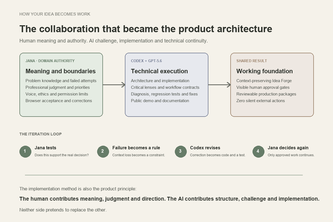
The company appears to be a solo-built, self-reported AI production system for solo experts, designed to help users turn ideas into structured work while maintaining human control over meaning, voice, and consequential decisions. The author states this is a local, browser-based prototype built with Codex Desktop and GPT-5.6, intended as a foundation for a human-led AI workflow rather than a complete platform.
What changed: The project evolved from personal experimentation into a structured system that captures ideas, detects duplicates, challenges them through critical roles, and requires explicit human authorization before AI processing begins. It emphasizes preserving context, requiring review, and avoiding silent assumptions.
The single most important open question: Is there evidence of traction or adoption beyond the author’s own use case? The description offers no data on customers, revenue, usage, or market validation — only a self-reported prototype and personal narrative.
What The Product Actually Is
- The description states that "How Your Idea Becomes Work" is a local, human-led AI production system for solo experts.
- It is described as a browser-based prototype, built using Codex Desktop with GPT-5.6, and implemented in JavaScript/HTML/CSS.
- The system supports:
- Capturing ideas without technical metadata.
- Detecting duplicates or near-duplicates.
- Applying two distinct critical roles to challenge the idea.
- Requiring a human decision before an idea becomes active.
- Creating separate, reviewable content and draft packages.
- Preparing a minimized GPT-5.6 job only after human authorization.
- It is designed to preserve context, make uncertainty visible, and avoid silent assumptions or AI-driven decisions.
Inference: The product is not a full platform but a working prototype intended as a foundation for future development.
Positioning & Claim Evolution
- The author states: “A human-led AI production system — but only if you decide it should.”
- The positioning emphasizes:
- Human control over meaning, voice, and consequential actions.
- AI as assistant, not decision-maker.
- Local execution, no network connection required.
- The claim evolution shows a shift from:
- A personal problem (scattered ideas) → to a structured solution (idea-to-work system).
- From a “nichtbleiben.blog” platform → to a reusable AI workflow for solo experts.
Inference: The positioning is self-defined, not market-tested, and reflects the author’s own experience rather than external validation.
Target Customer & ICP
- The description states: "It turns an initial thought into a structured, reviewable path".
- It targets solo experts — individuals who work independently and need clarity in idea-to-work transitions.
- The system is built for local execution, suggesting it's not designed for enterprise or multi-user environments.
Inference: The ICP is likely self-employed professionals, writers, consultants, or others working alone, but no explicit customer segments are named.
Business Model & Pricing Evidence
- Not evidenced.
- The description does not mention any pricing model, monetization strategy, or business model.
- It is described as a prototype with no commercial implementation.
Technical & Delivery Signals
- Built with:
- Codex Desktop
- GPT-5.6
- JavaScript/HTML/CSS
- The system is:
- Local-only, no framework, account, or API key required.
- Designed to run in a browser.
- Uses workflow contracts and regression tests.
- It includes:
- State management
- Duplicate detection
- Role-based reviews
- Explicit approvals
- Controlled model-job contracts
Inference: The technical approach is custom-built, with an emphasis on local execution and human control, but no evidence of scalability or infrastructure beyond the prototype.
Traction & Maturity Signals
- Not evidenced.
- No data on:
- Customers
- Revenue
- Usage metrics
- Adoption rate
- Product-market fit
- The project is described as a working prototype built in a short timeframe (Build Week).
- It is explicitly stated: “This is therefore a working foundation with an honest boundary — not a mock-up of an all-in-one platform.”
Competitive Context
- Not evidenced.
- No mention of competitors or market positioning.
- The author does not reference existing tools for idea management, AI collaboration, or solo expert workflows.
Open Questions & Risks
- No traction or adoption: The project is described as a prototype with no evidence of real-world usage or customer data.
- Single-person team: Only one member (Jana Pade) is listed — raises questions about scalability and long-term maintenance.
- Self-reported only: All claims are unverified, including the product’s functionality and user experience.
- No commercial model: No evidence of how the system will be monetized or scaled.
- Limited scope: The prototype is intentionally lightweight and not fully functional beyond its core workflow.
Questions the description leaves open
- What specific use cases have you tested with this system?
- How do you plan to scale beyond a single-user, local prototype?
- Have you validated the need for this product with other solo experts or users?
- What are your plans for monetization or commercialization?
- How do you intend to handle data privacy and security in a production environment?
- What is the timeline for moving from prototype to a more complete system?
Overall Assessment
- Not evidenced.
- No financials, revenue, or market validation are provided.
- The project is described as a self-built prototype, not a commercial product.
- It is not clear whether this is intended for investment or partnership, nor what stage of development it represents.
Inference: This is a conceptual prototype with no demonstrated traction or business model. It may be an early-stage idea or experiment, but there is no evidence to support a commercial due-diligence read at this time.
User Stories BotA demo video on every pull request
Get a demo video on every new feature
GitHub App that watches your pull requests and records a narrated, captioned demo.
Save time on demo prep and make informed decisions faster with a video walkthrough of every new feature.
Source
Submitted to the OpenAI 2026 hackathon on Devpost. Project home on Devpost. Back to the full gallery on Devpost.
This competitive analysis was produced by top-founders.com (opens in a new tab)
Generated by a language model from this project's public Devpost page — its tagline, the author's own write-up and any built-with tags listed there — as captured in August 2026. Short quotations are the author's words. It is an opinion on the idea as a business, not on the people behind it, and it reflects the description as published then. If the project has moved on, request a correction below. The analysis is not independent research and contains no verified traction, revenue or customer data.
An independent guide by KFG International LLC — not affiliated with, endorsed by, or connected to Devpost or OpenAI.