

Archive position — measured, not model output
1 like on Devpost
505 of the 7,850 archived projects have more likes, and 1,758 share exactly 1 — so this project's #628 place in the like-ranked listing is a tie-break inside that group, not a ranking.
Projects (log scale)
Likes on Devpost. ▲ marks this project's group.
Show the figures
| Likes | Projects | Share of archive |
|---|---|---|
| 0 | 5,587 | 71.2% |
| 1 | 1,758 | 22.4% |
| 2 | 284 | 3.6% |
| 3–4 | 132 | 1.7% |
| 5–9 | 75 | 1.0% |
| 10+ | 14 | 0.2% |
 User Stories BotA demo video on every pull request
Get a demo video on every new feature
GitHub App that watches your pull requests and records a narrated, captioned demo.
Save time on demo prep and make informed decisions faster with a video walkthrough of every new feature.
Executive Summary
What the company appears to be
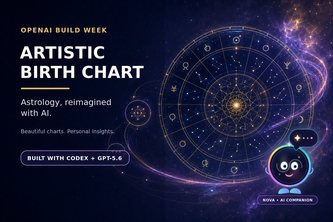
Artistic Birth Chart is a self-reported consumer app that combines astrology with AI, offering users personalized chart interpretations and conversational guidance through an AI companion named Nova. The platform was built using technologies like Next.js, React, TypeScript, and OpenAI’s GPT-5.6 and Codex, and it integrates deterministic astronomical calculations with AI-driven interaction.
What changed
During the OpenAI Build Week hackathon, the team upgraded Nova from a disconnected chatbot into a persistent, site-wide AI companion that understands context, interacts with existing features, and guides users across the platform. This involved integrating Nova’s behavior with the app's UI, navigation, and chart data.
The single most important open question
Is there evidence of actual user adoption or revenue generation beyond the self-reported prototype status?
What The Product Actually Is
- The description states that Artistic Birth Chart is a consumer app offering:
- Western Birth Charts and Vedic Janam Kundli
- Planetary placements, houses, aspects, Nakshatras, Dasha periods
- Couple and synastry charts
- Numerology tools
- Designer chart themes and downloadable PDF reports
- An AI companion named Nova
- Nova is described as a conversational guide that:
- Responds to questions about charts, Kundli, synastry, numerology, pricing, or saved profiles
- Understands the current page context
- Is integrated into the site rather than being a standalone chatbot
- Allows users to control conversation history (including deletion)
- Provides navigation from Nova to chart creation forms and actions
- The app is built with:
- Frontend: React, Next.js, Tailwind CSS, TypeScript
- Backend: Node.js, Vercel
- AI tools: Codex, GPT-5.6, GPT-image2, OpenAI APIs
- Hosting: GitHub, Resend
Inference The product appears to be a hybrid of deterministic astrological calculations and generative-AI-driven interaction, with Nova serving as the primary interface for user engagement.
Positioning & Claim Evolution
- The description states that Artistic Birth Chart aims to combine:
- High-precision astronomical calculations
- Beautiful design
- Approachable AI guidance
- It positions itself as an alternative to platforms that are either:
- Accurate but difficult to understand
- Visually attractive but generic
- During OpenAI Build Week, the team upgraded Nova from a disconnected chatbot into a persistent companion with contextual awareness and integration into core platform features.
Inference The positioning evolved from a basic astrology tool to an AI-enhanced experience that blends data accuracy with conversational accessibility. The upgrade focused on improving user flow and perception of Nova as part of the product rather than an add-on.
Target Customer & ICP
- The description does not specify target customer segments or personas.
- It implies a general consumer audience interested in astrology, including:
- Users seeking personal chart interpretations
- People exploring couple charts or synastry
- Individuals looking for numerology insights
Inference The likely ICP includes astrology enthusiasts and casual users who value both accuracy and ease of access. However, no explicit segmentation or targeting data is provided.
Business Model & Pricing Evidence
- The description does not mention pricing models, monetization strategies, or revenue streams.
- It states that the platform provides "artistic and AI-generated astrology content for informational, reflective and entertainment purposes."
Inference No evidence of a defined business model or pricing structure exists in the provided text.
Technical & Delivery Signals
- The app is built using modern web technologies:
- Frontend: React, Next.js, Tailwind CSS, TypeScript
- Backend: Node.js, Vercel
- AI tools: Codex, GPT-5.6, GPT-image2, OpenAI APIs
- Deployment: GitHub, Resend
- The team used Codex to:
- Navigate and understand the existing codebase
- Plan Nova’s architecture and integration points
- Implement UI components and interaction states
- Debug modal and navigation issues
- Improve responsive behavior and accessibility
- Rapidly iterate on design and UX
Inference The technical stack suggests a modern, scalable web application with AI integration. The use of Codex indicates an engineering approach focused on rapid iteration and debugging.
Traction & Maturity Signals
- The description states that Artistic Birth Chart is a working consumer product.
- It was upgraded during the OpenAI Build Week hackathon, and those improvements were integrated into the live experience.
- The team claims to have moved from idea to production in days using Codex.
Inference There is no evidence of user adoption, retention, or revenue. The project remains a prototype with limited traction data beyond its own self-reporting.
Competitive Context
- The description does not provide information on direct or indirect competitors.
- It positions itself as filling a gap between:
- Accurate but hard-to-understand platforms
- Visually attractive but generic ones
Inference The competitive landscape is unclear. The app may compete with existing astrology apps, but no specific names or market positioning are mentioned.
Open Questions & Risks
- No revenue or traction data: The description does not include any evidence of monetization or user engagement.
- Unverified claims: All statements are self-reported and unverified.
- AI companion risks: Nova’s integration into a complex platform raises questions about:
- Contextual accuracy
- User experience consistency
- Trustworthiness of AI-generated content
- Prototype status: The app is described as a working prototype, not a mature product.
Inference The lack of measurable traction or commercial viability makes this a high-risk opportunity. The project’s success depends on future user adoption and monetization, which are not evidenced here.
Questions the description leaves open
- What is the current user base or engagement level?
- Are there any revenue streams or monetization plans?
- How does the team plan to scale Nova beyond the current integration?
- What are the key challenges in maintaining trust and accuracy with AI-generated content?
- Is there a roadmap for expanding into new markets or languages?
- How is data privacy and user consent handled, especially regarding conversation history?
Overall Assessment
- The description states that Artistic Birth Chart is a working consumer product.
- It was upgraded during the OpenAI Build Week hackathon with Codex assistance.
- No evidence of revenue, customers, or traction is provided.
Assessment This is a self-reported prototype with no demonstrated commercial traction. While the technical execution and AI integration show promise, there is insufficient evidence to assess viability or investment potential. The project lacks key signals for due-diligence evaluation: user data, monetization, or market validation.
Confidence Level Low — based entirely on self-reporting and unverified claims.
User Stories BotA demo video on every pull request
Get a demo video on every new feature
GitHub App that watches your pull requests and records a narrated, captioned demo.
Save time on demo prep and make informed decisions faster with a video walkthrough of every new feature.
Source
Submitted to the OpenAI 2026 hackathon on Devpost. Project home on Devpost. Back to the full gallery on Devpost.
This competitive analysis was produced by top-founders.com (opens in a new tab)
Generated by a language model from this project's public Devpost page — its tagline, the author's own write-up and any built-with tags listed there — as captured in August 2026. Short quotations are the author's words. It is an opinion on the idea as a business, not on the people behind it, and it reflects the description as published then. If the project has moved on, request a correction below. The analysis is not independent research and contains no verified traction, revenue or customer data.
An independent guide by KFG International LLC — not affiliated with, endorsed by, or connected to Devpost or OpenAI.