

Archive position — measured, not model output
1 like on Devpost
505 of the 7,850 archived projects have more likes, and 1,758 share exactly 1 — so this project's #630 place in the like-ranked listing is a tie-break inside that group, not a ranking.
Projects (log scale)
Likes on Devpost. ▲ marks this project's group.
Show the figures
| Likes | Projects | Share of archive |
|---|---|---|
| 0 | 5,587 | 71.2% |
| 1 | 1,758 | 22.4% |
| 2 | 284 | 3.6% |
| 3–4 | 132 | 1.7% |
| 5–9 | 75 | 1.0% |
| 10+ | 14 | 0.2% |
 User Stories BotA demo video on every pull request
Get a demo video on every new feature
GitHub App that watches your pull requests and records a narrated, captioned demo.
Save time on demo prep and make informed decisions faster with a video walkthrough of every new feature.
Executive Summary
What the company appears to be
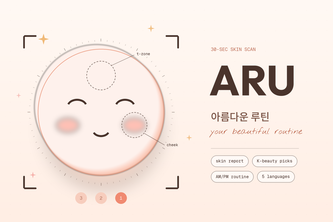
ARU (아름다운 루틴, 'beautiful routine' in Korean) is a mobile-first skin-scanning application designed to help users identify their current skin condition and receive personalized skincare recommendations, morning/evening routines, and product picks. It operates via an on-device 30-second face scan using MediaPipe Face Landmarker, with support for five languages (English, Korean, Japanese, Chinese, Arabic) and RTL layout for Arabic.
What changed
The author states that ARU was built as a hackathon project over a short development period (July 13–19), leveraging AI tools like Codex, GPT-5.6, and others to rapidly iterate on features including camera quality checks, multi-language support, and compliance gates. The product is now live in production with full end-to-end functionality from scan to routine generation.
Single most important open question
Is there any evidence of real user demand or traction beyond the author's own interviews and street testing? The description does not provide data on actual conversion rates, revenue, or customer acquisition — only self-reported intent and anecdotal feedback.
What The Product Actually Is
The description states that ARU is a mobile application that:
- Uses an on-device 30-second skin scan via MediaPipe Face Landmarker.
- Analyzes oil, redness, and texture from facial images.
- Provides a skin report, three product picks, and AM/PM routines in five languages.
- Includes optional email check-ins after two and four weeks.
- Supports full RTL layout for Arabic.
- Operates without requiring an account or API keys.
It also includes:
- A camera quality gate that checks light, distance, steadiness, and glare.
- An auto-capture mechanism triggered only when conditions are good.
- Integration with AI tools like GPT-5.6 for phrasing recommendations.
- Compliance features such as rate limiting, schema validation, and RLS on Supabase tables.
Inference The product appears to be a lightweight, self-contained PWA or native app built primarily using open-source technologies and AI assistants, with an emphasis on privacy (no data leaves the device) and accessibility (multi-language support).
Positioning & Claim Evolution
The author claims ARU addresses a gap in existing K-beauty apps:
- Existing apps either over-promise efficacy ("whitened", "regenerated") or fail to answer the practical question: “What should I buy today?”
- ARU aims to provide honest, actionable skin insights and routines.
- It positions itself as a tool for both foreigners and locals who struggle with Korean ingredient labels.
Inference ARU’s positioning evolved from solving a personal problem (a model-turned-tech worker helping friends navigate K-beauty) into a scalable solution targeting global consumers seeking clarity in skincare choices. The shift toward AI-powered recommendation and localized content suggests an intent to expand beyond its initial use case.
Target Customer & ICP
The description states:
- ARU targets people visiting Korea who want to buy K-beauty products.
- It also serves Korean users who struggle with ingredient labels.
- Users are described as those who "can't read the labels" and need guidance in beauty stores.
Inference The primary customer segment appears to be international travelers or expats interested in K-beauty, with a secondary audience of local Koreans unfamiliar with product ingredients. The inclusion of five languages implies an intent to reach diverse global markets.
Business Model & Pricing Evidence
There is no evidence provided regarding:
- Revenue streams
- Pricing models
- Monetization strategy
- Customer acquisition costs
- Paid features or subscriptions
Not evidenced No mention of how the product will generate income, whether through direct sales, affiliate links, or other mechanisms.
Technical & Delivery Signals
The description indicates:
- Built using React, Next.js, TypeScript, Supabase, PostgreSQL, Playwright, Vitest, and MediaPipe.
- Uses Codex for feature development and GPT-5.6 for AI filtering of recommendations.
- Implements camera quality checks, auto-capture logic, and debugging overlays.
- Includes adversarial testing with Codex before launch.
- Full test coverage: 297 unit tests, 42 E2E mobile tests, and a text-fit matrix covering 180 combinations.
Inference The technical stack suggests a modern, well-tested product built for performance and scalability. The use of AI assistants in development implies rapid iteration capabilities, though the lack of production metrics raises questions about long-term viability.
Traction & Maturity Signals
The description states:
- 9 out of 10 moderated interviewees said they'd buy the exact product ARU picked.
- ~40 street interviews resulted in active engagement and waitlist signups.
- The app is live in production with full functionality (scan → survey → report → routine → check-in).
- The author plans to conduct a manual concierge round to convert stated intent into real transactions.
Not evidenced No data on actual conversions, revenue, or user retention. No mention of paid users, API usage, or marketing traction beyond the author’s own interviews and street testing.
Competitive Context
The description states:
- Existing K-beauty apps either over-promise efficacy or fail to answer practical questions.
- ARU aims to be a more honest and actionable alternative.
- The app is positioned as a companion for people navigating Korean beauty stores.
Inference ARU competes in the skincare recommendation space, particularly where users are looking for clarity rather than marketing hype. However, there is no mention of competitors or market size — only self-perception of differentiation.
Open Questions & Risks
Key risks identified from the description:
- No verified traction or revenue: The product has not yet demonstrated real-world adoption or monetization.
- Unproven conversion rate: While users expressed intent, no data shows actual purchases or engagement beyond interviews.
- Dependence on AI tools: Heavy reliance on Codex and GPT raises concerns about scalability and control if these services change or become unavailable.
- Limited team size: Only one person is involved in the project, which may limit execution speed and depth of product development.
- Self-reported metrics: All evidence is self-reported; no independent verification exists.
Questions the description leaves open
- What specific data do you have on conversion from waitlist signups to actual purchases?
- How are you planning to scale beyond the current manual concierge approach?
- Are there any plans for monetization or revenue models beyond affiliate links or direct sales?
- How do you plan to maintain quality control as you expand into new markets or add more features?
- What is your strategy for user retention and ongoing engagement post-initial scan?
- Have you considered how compliance with international data privacy laws might affect the product?
Overall Assessment
Confidence Level Low
Reasoning
The description provides no verified evidence of revenue, customer traction, or market validation beyond the author’s own interviews and anecdotal feedback. While the technical implementation appears solid and the concept has potential, there is insufficient data to assess commercial viability.
Assessment Summary
ARU is a technically impressive hackathon project with strong execution and clear intent. However, without independent verification of user demand or monetization strategies, it cannot be evaluated as a viable investment or partnership opportunity at this stage. The author's claims about product utility and market need are self-reported and unverified.
User Stories BotA demo video on every pull request
Get a demo video on every new feature
GitHub App that watches your pull requests and records a narrated, captioned demo.
Save time on demo prep and make informed decisions faster with a video walkthrough of every new feature.
Source
Submitted to the OpenAI 2026 hackathon on Devpost. Project home on Devpost. Back to the full gallery on Devpost.
This competitive analysis was produced by top-founders.com (opens in a new tab)
Generated by a language model from this project's public Devpost page — its tagline, the author's own write-up and any built-with tags listed there — as captured in August 2026. Short quotations are the author's words. It is an opinion on the idea as a business, not on the people behind it, and it reflects the description as published then. If the project has moved on, request a correction below. The analysis is not independent research and contains no verified traction, revenue or customer data.
An independent guide by KFG International LLC — not affiliated with, endorsed by, or connected to Devpost or OpenAI.