

Archive position — measured, not model output
0 likes on Devpost
2,263 of the 7,850 archived projects have more likes, and 5,587 share exactly 0 — so this project's #4,556 place in the like-ranked listing is a tie-break inside that group, not a ranking.
Projects (log scale)
Likes on Devpost. ▲ marks this project's group.
Show the figures
| Likes | Projects | Share of archive |
|---|---|---|
| 0 | 5,587 | 71.2% |
| 1 | 1,758 | 22.4% |
| 2 | 284 | 3.6% |
| 3–4 | 132 | 1.7% |
| 5–9 | 75 | 1.0% |
| 10+ | 14 | 0.2% |
 User Stories BotA demo video on every pull request
Get a demo video on every new feature
GitHub App that watches your pull requests and records a narrated, captioned demo.
Save time on demo prep and make informed decisions faster with a video walkthrough of every new feature.
Executive Summary
What the company appears to be
htmldrop is a command-line interface (CLI) tool that allows users to publish HTML documents as links, annotate them with feedback anchored to specific text or elements, and then synthesize those annotations into revised versions of the document using an AI model. It operates without requiring accounts or dashboards, relying instead on client-side encryption and Cloudflare Workers for comment storage.
What changed
The project evolved from a simple tool for publishing HTML files to one that enables collaborative feedback at the sentence or element level, with AI-powered synthesis of comments into document revisions. The author describes this as an evolution from "making it easy to open" to "making it easy to argue with" a document.
Single most important open question
Is there any evidence of real-world usage or adoption beyond the author’s own development and testing? The description is self-reported, unverified, and lacks any data on customers, revenue, or traction.
What The Product Actually Is
The description states that htmldrop is a CLI tool. It wraps one HTML file in three surfaces:
- Edit mode: Local editing environment with live reload over SSE (Server-Sent Events), where comments are anchored to text or elements and can be edited by an agent.
- Published link: A single command (
htmldrop push) publishes the document, encrypting it client-side with AES-256-GCM before uploading. - Annotation widget: Supports two kinds of anchor:
text_range: stores selected text plus a CSS selector.element_rect: captures text under a dragged box over an element (e.g., diagrams), using a CSS selector.
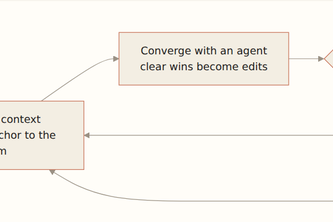
It also includes a converge function (htmldrop converge) that pulls all comments, builds a prompt, and uses GPT-5.6 to return a revised HTML document.
Evidence
- The author describes the CLI functionality in detail.
- It uses Node.js, ESM, no framework.
- Surge hosts static HTML; Cloudflare Worker with KV holds comments.
- Uses raw fetch against vendor APIs (e.g., OpenAI).
- Supports client-side encryption and password-based access control.
Inference The tool is built for developers or technical teams working on documentation or design specs.
Positioning & Claim Evolution
The author states that htmldrop started as a way to make HTML files easy to open, but evolved into a system for making it easy to argue with documents at the exact sentence or picture being discussed.
Claims made
- The tool addresses inefficiencies in AI-generated document workflows where feedback gets lost across multiple threads.
- It aims to solve the problem of "the expensive part is not the writing. Writing got cheap. The expensive part is the decision that never gets made."
- Feedback is anchored to specific parts of a document and folded back into it via AI synthesis.
Evidence
- The write-up details how feedback is anchored, stored, and synthesized.
- It references real-world problems like chat threads and DMs not reconciling against documents.
Inference The positioning is aimed at teams working on technical specs, proposals, or design documents that require iterative feedback and consensus-building.
Target Customer & ICP
The description does not explicitly define a target customer segment or ideal customer profile (ICP). However, the tool’s features suggest it may appeal to:
- Technical writers
- Product managers
- Designers working with HTML-based documentation or specs
- Teams using AI for content generation who need structured feedback loops
Evidence
- The tool is designed for developers and technical users.
- It supports Mermaid diagrams and design contracts, suggesting use in technical environments.
Inference The ICP likely includes small to mid-sized teams working on technical documentation or product specs where iterative review and AI-assisted revision are valuable.
Business Model & Pricing Evidence
There is no evidence of a business model or pricing structure in the description. The tool appears to be open-source or freemium, with no mention of monetization.
Evidence
- No mention of subscriptions, fees, or paid tiers.
- The CLI works without login or dashboard.
- The author mentions using npm for distribution.
Inference It is unclear whether htmldrop intends to generate revenue, though it could be monetized through enterprise features or SaaS offerings in the future.
Technical & Delivery Signals
The project uses:
- Node.js (ESM)
- Cloudflare Workers + KV
- Surge.sh for hosting
- OpenAI API via raw HTTP calls
- AES-256-GCM encryption with PBKDF2 key derivation
- Playwright, TypeScript, Zod, Commander, crypto-js, WebCrypto API
Evidence
- The tool is built without frameworks.
- Uses a custom loopback server for edit mode.
- Supports zero-knowledge encryption and password-based access.
Inference The delivery approach suggests a lightweight, developer-focused tool with strong emphasis on security and client-side processing.
Traction & Maturity Signals
There is no evidence of traction or adoption beyond the author’s own development. The project has:
- 1 team member (Yee Fei Ooi)
- 49 files across 3 releases (v1.10.0, v1.11.0, v1.12.0)
- 5,000 lines of code
- Published to npm in May
Evidence
- The author mentions UAT ran through Codex.
- The tool was submitted to a hackathon (OpenAI 2026).
Inference There is no evidence of real-world usage or customer base. It appears to be an early-stage prototype or proof-of-concept.
Competitive Context
The description does not provide information about competitors or market positioning beyond the general idea of collaborative document editing with AI.
Evidence
- No mention of existing tools like Notion, Google Docs, Confluence, or GitHub Discussions.
- The author focuses on solving a specific problem in AI-assisted writing and feedback workflows.
Inference It may compete indirectly with tools that support collaborative editing or AI-assisted content creation, but no direct comparison is made.
Open Questions & Risks
- No traction or adoption: No evidence of real-world usage.
- Single founder: Only one team member (Yee Fei Ooi).
- Unproven AI integration: While GPT-5.6 is mentioned, there’s no demonstration of consistent performance or reliability.
- Security assumptions: Relies heavily on client-side encryption and password-based access — not scalable for enterprise use.
- Limited scalability: The tool works with one HTML file at a time; unclear how it scales to larger documents or teams.
Evidence
- No mention of customers, revenue, or user feedback.
- The author notes that converge rewriting the whole document is a weak point and that changes are reviewed by reading rather than diffing.
Questions the description leaves open
- Have you tested htmldrop with real users outside of your own development environment?
- How do you plan to scale beyond single-file editing or small teams?
- What is the long-term vision for monetization or commercial viability?
- Are there any known limitations in how comments are interpreted by the AI model?
- How does htmldrop handle conflicts when multiple reviewers comment on the same section?
Overall Assessment
Not evidenced: There is no evidence of revenue, customers, or traction to assess commercial viability.
Confidence level: Low
This is a self-reported, unverified description of a tool in early development. It shows technical capability and a clear problem statement but lacks any indication of real-world adoption or business model traction. The author’s claims about AI integration and feedback anchoring are described in detail, but without external validation or usage data, it remains speculative.
Conclusion
This is an early-stage prototype with potential for further development. It does not yet demonstrate commercial readiness or market demand.
User Stories BotA demo video on every pull request
Get a demo video on every new feature
GitHub App that watches your pull requests and records a narrated, captioned demo.
Save time on demo prep and make informed decisions faster with a video walkthrough of every new feature.
Source
Submitted to the OpenAI 2026 hackathon on Devpost. Project home on Devpost. Back to the full gallery on Devpost.
This competitive analysis was produced by top-founders.com (opens in a new tab)
Generated by a language model from this project's public Devpost page — its tagline, the author's own write-up and any built-with tags listed there — as captured in August 2026. Short quotations are the author's words. It is an opinion on the idea as a business, not on the people behind it, and it reflects the description as published then. If the project has moved on, request a correction below. The analysis is not independent research and contains no verified traction, revenue or customer data.
An independent guide by KFG International LLC — not affiliated with, endorsed by, or connected to Devpost or OpenAI.