

Archive position — measured, not model output
0 likes on Devpost
2,263 of the 7,850 archived projects have more likes, and 5,587 share exactly 0 — so this project's #6,513 place in the like-ranked listing is a tie-break inside that group, not a ranking.
Projects (log scale)
Likes on Devpost. ▲ marks this project's group.
Show the figures
| Likes | Projects | Share of archive |
|---|---|---|
| 0 | 5,587 | 71.2% |
| 1 | 1,758 | 22.4% |
| 2 | 284 | 3.6% |
| 3–4 | 132 | 1.7% |
| 5–9 | 75 | 1.0% |
| 10+ | 14 | 0.2% |
 User Stories BotA demo video on every pull request
Get a demo video on every new feature
GitHub App that watches your pull requests and records a narrated, captioned demo.
Save time on demo prep and make informed decisions faster with a video walkthrough of every new feature.
Executive Summary
What the company appears to be
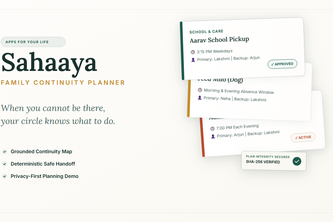
Sahaaya is a family continuity planner built as a hackathon project using AI (GPT-5.6) and deterministic code (Next.js, TypeScript). It allows users to define household responsibilities during temporary absences, with AI extracting facts from a brief, mapping dependencies, proposing assignments, and requiring human approval before finalizing plans.
What changed
The project is a proof-of-concept demo for an OpenAI hackathon. It does not indicate any prior commercial activity or product development beyond this single submission.
Single most important open question
Is there evidence of traction, revenue, or customer adoption beyond the hackathon demo?
What The Product Actually Is
The description states that Sahaaya is a Family Continuity Planner, designed to help households manage responsibilities when one person is temporarily unavailable. It uses AI (GPT-5.6) to extract facts from a household brief and proposes assignments, but requires human approval before finalizing any plan.
- The product is built with:
- Codex driving GPT-5.6
- Next.js, React, TypeScript
- Playwright for testing
- Vercel for deployment
- It includes features such as:
- Extraction of responsibilities from a household brief
- Dependency mapping and gap detection
- Assignment proposals based on availability
- Approval gates for each responsibility
- SHA-256 receipt for reproducibility
Inference The product is a deterministic AI-assisted planning tool, not an automated system.
Positioning & Claim Evolution
The author positions Sahaaya as a solution to the problem of undocumented household knowledge becoming a crisis during temporary absences. It is described as a way to "capture" and "plan" for continuity in family life.
- The tagline: “When you cannot be there, your circle knows what to do.” — suggests a support network-based approach.
- The name “Sahaaya” (meaning help/support) reinforces this positioning.
- The project is framed as a family safety and continuity tool, not a general productivity app.
Inference The product is positioned as a niche, emotionally driven solution for families managing temporary absences — not a mainstream SaaS offering.
Target Customer & ICP
The description states that the product is designed for households where one person’s temporary absence creates a crisis due to undocumented knowledge.
- It targets:
- Families with elderly members
- Parents managing school pickup routines
- Households relying on one person for daily tasks
Inference The ICP appears to be multigenerational or complex households that depend on one person's memory and coordination. No evidence of segmentation beyond this.
Business Model & Pricing Evidence
There is no evidence of a business model, pricing structure, or monetization strategy in the description.
- The product is described as a demo-only project.
- It does not mention:
- Subscription plans
- Freemium tiers
- B2B or B2C sales channels
- Revenue streams
Inference No business model is evidenced. The project is a hackathon demo, not a commercial product.
Technical & Delivery Signals
The description provides technical details about how the product was built:
- Built with:
- GPT-5.6 (Responses API, Structured Outputs)
- Next.js, TypeScript
- Playwright for testing
- Vercel deployment
- Vitest for unit tests
- Features include:
- Deterministic verification via SHA-256 receipts
- Replay mode for demo purposes
- Grounded fact extraction and approval gates
- Accessibility compliance (zero axe violations)
Inference The product uses a hybrid AI + deterministic code approach, with strong emphasis on reproducibility and safety.
Traction & Maturity Signals
There is no evidence of traction or maturity beyond the hackathon submission:
- No customers, users, or adoption data
- No revenue or funding rounds
- No production deployment or live usage
- No mention of post-hackathon development or iteration
Inference The project is at a very early stage — a single demo with no commercial traction.
Competitive Context
There is no evidence of competitors or market analysis in the description.
- No mention of:
- Similar tools or platforms
- Market size or competitive landscape
- Prior art or existing solutions
Inference The competitive context is unknown. The project does not appear to be a follow-up to an existing product or market.
Open Questions & Risks
Several risks and open questions are evident from the description:
- No commercial traction: This is a demo, not a product.
- No business model: No indication of how it would generate revenue.
- Limited scope: The P0 demo is fictional and non-persistent.
- Privacy constraints: The product explicitly avoids storing sensitive data — this may limit its utility or scalability.
- AI dependency: Heavy reliance on GPT-5.6, which may not be scalable or cost-effective for a commercial offering.
Inference The project lacks commercial viability or traction and is not yet a product in any meaningful sense.
Questions the description leaves open
- What is the intended path from this demo to a commercial product?
- How would you monetize this solution, if at all?
- Are there plans for persistence or data storage beyond the demo?
- What is the expected user journey beyond the current P0 demo?
- Have you considered how to scale AI reasoning and approval workflows?
Overall Assessment
Not evidenced.
There is no evidence of:
- Revenue
- Customers
- Product-market fit
- Commercial traction
- Business model
- Funding or investor interest
This project is a single hackathon demo, not a product or company in any commercial sense.
Confidence level: Low.
The description is self-reported and unverified, and contains no evidence of anything beyond a proof-of-concept.
User Stories BotA demo video on every pull request
Get a demo video on every new feature
GitHub App that watches your pull requests and records a narrated, captioned demo.
Save time on demo prep and make informed decisions faster with a video walkthrough of every new feature.
Source
Submitted to the OpenAI 2026 hackathon on Devpost. Project home on Devpost. Back to the full gallery on Devpost.
This competitive analysis was produced by top-founders.com (opens in a new tab)
Generated by a language model from this project's public Devpost page — its tagline, the author's own write-up and any built-with tags listed there — as captured in August 2026. Short quotations are the author's words. It is an opinion on the idea as a business, not on the people behind it, and it reflects the description as published then. If the project has moved on, request a correction below. The analysis is not independent research and contains no verified traction, revenue or customer data.
An independent guide by KFG International LLC — not affiliated with, endorsed by, or connected to Devpost or OpenAI.