

Archive position — measured, not model output
0 likes on Devpost
2,263 of the 7,850 archived projects have more likes, and 5,587 share exactly 0 — so this project's #2,580 place in the like-ranked listing is a tie-break inside that group, not a ranking.
Projects (log scale)
Likes on Devpost. ▲ marks this project's group.
Show the figures
| Likes | Projects | Share of archive |
|---|---|---|
| 0 | 5,587 | 71.2% |
| 1 | 1,758 | 22.4% |
| 2 | 284 | 3.6% |
| 3–4 | 132 | 1.7% |
| 5–9 | 75 | 1.0% |
| 10+ | 14 | 0.2% |
 User Stories BotA demo video on every pull request
Get a demo video on every new feature
GitHub App that watches your pull requests and records a narrated, captioned demo.
Save time on demo prep and make informed decisions faster with a video walkthrough of every new feature.
Executive Summary
What the company appears to be
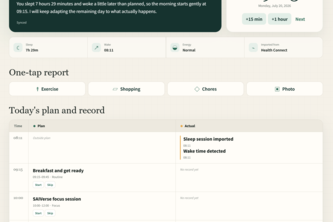
AILifeCoach is a self-reported mobile-first AI life-coaching prototype built as a hackathon submission. The author describes it as an application that juxtaposes a user's planned day with their actual behavior, using AI to suggest adjustments without rewriting history.
What changed
This is a single-person hackathon project submitted to the OpenAI 2026 Build Week. No commercial traction, revenue or customer data are evidenced.
Single most important open question
Is there any evidence of product-market fit or user adoption beyond the author's own use case and prototype?
What The Product Actually Is
The description states that AILifeCoach is a mobile-first life-coaching prototype. It places today’s plan and actual behavior side by side, using AI to suggest adjustments while preserving historical records.
It integrates with Android Health Connect for sleep/wake context and supports one-tap actions, natural-language reports, and photo submissions. The system uses GPT-5.6 via an OpenAI Responses API with Structured Outputs, but the API key is proxied server-side to avoid browser storage.
The prototype includes a simulated clock and seeded data so judges can test the feedback loop without real devices or health data. An optional local API key enables live GPT-5.6 coaching.
Evidence Author's own write-up.
Inference This is a vertical slice of a larger vision, not a production-ready product.
Positioning & Claim Evolution
The author claims AILifeCoach helps users "design the day itself" and notices when reality diverges from the plan. It aims to adapt without judgment or pretending the original plan happened.
It connects to a longer-running project called SAIVerse, which explores how AI personas can observe and affect the physical world through different devices. The author describes this as an exploration of trust and affection toward an AI companion.
Evidence Author's own write-up.
Inference Positioning is aspirational; no evidence of market positioning or competitive differentiation beyond a personal prototype.
Target Customer & ICP
The description does not state specific customer segments or personas. The author describes their own use case — waking up later than planned, exercising less, and wanting an AI that can help design the day without judging them.
Evidence Author's own write-up.
Inference Likely targets individuals interested in personal productivity and AI companionship, but no explicit ICP defined.
Business Model & Pricing Evidence
There is no evidence of a business model or pricing structure. The project is described as a prototype built for a hackathon.
Evidence Not evidenced.
Inference No commercialization strategy or monetization plan described.
Technical & Delivery Signals
The application was built using Codex as the primary implementation partner, with one continuous thread from idea to submission. It uses JavaScript, Python, JSON Schema contracts, and an Android Health Connect adapter boundary.
It includes a narrow server-side proxy for GPT-5.6 access, structured outputs, deterministic validation, and an append-only event store. The system supports both real-time and simulated modes.
Evidence Author's own write-up.
Inference Technical architecture shows some sophistication but is limited to prototype scope.
Traction & Maturity Signals
No evidence of traction, revenue, or customer adoption beyond the author’s personal experience and prototype testing. The project was submitted as a hackathon entry with no indication of ongoing development or user base.
Evidence Not evidenced.
Inference No signs of product-market fit or commercial viability.
Competitive Context
The description does not mention competitors or market positioning. It references the author’s broader vision of SAIVerse but does not compare AILifeCoach to existing tools in the personal productivity, health tracking, or AI coaching space.
Evidence Not evidenced.
Inference No competitive analysis provided; unclear where it fits in the market landscape.
Open Questions & Risks
- Single-person development: Only one team member is mentioned, suggesting limited scalability or depth of execution.
- Prototype-only status: Built for a hackathon, not intended for production use.
- No commercial traction: No evidence of users, revenue, or adoption beyond the author’s own experience.
- Unverified claims: All descriptions are self-reported and unverified.
Evidence Author's own write-up.
Inference High risk due to lack of real-world validation or scalability.
Questions the description leaves open
- What is your plan for transitioning from a prototype to a scalable product?
- Have you validated the need for this tool with potential users outside of yourself?
- How do you intend to monetize AILifeCoach if at all?
- What are the key assumptions underlying your approach, and how might they fail?
- Can you articulate a clear path from prototype to market-ready product?
Overall Assessment
There is no evidence of commercial traction, revenue, or customer adoption. The project is described as a hackathon prototype with no indication of future development or market readiness.
Evidence Not evidenced.
Inference At this stage, there is insufficient basis for investment or partnership consideration. Any potential value lies in the author’s vision and technical execution, but not in demonstrated product-market fit or scalability.
User Stories BotA demo video on every pull request
Get a demo video on every new feature
GitHub App that watches your pull requests and records a narrated, captioned demo.
Save time on demo prep and make informed decisions faster with a video walkthrough of every new feature.
Source
Submitted to the OpenAI 2026 hackathon on Devpost. Project home on Devpost. Back to the full gallery on Devpost.
This competitive analysis was produced by top-founders.com (opens in a new tab)
Generated by a language model from this project's public Devpost page — its tagline, the author's own write-up and any built-with tags listed there — as captured in August 2026. Short quotations are the author's words. It is an opinion on the idea as a business, not on the people behind it, and it reflects the description as published then. If the project has moved on, request a correction below. The analysis is not independent research and contains no verified traction, revenue or customer data.
An independent guide by KFG International LLC — not affiliated with, endorsed by, or connected to Devpost or OpenAI.