

Archive position — measured, not model output
0 likes on Devpost
2,263 of the 7,850 archived projects have more likes, and 5,587 share exactly 0 — so this project's #2,582 place in the like-ranked listing is a tie-break inside that group, not a ranking.
Projects (log scale)
Likes on Devpost. ▲ marks this project's group.
Show the figures
| Likes | Projects | Share of archive |
|---|---|---|
| 0 | 5,587 | 71.2% |
| 1 | 1,758 | 22.4% |
| 2 | 284 | 3.6% |
| 3–4 | 132 | 1.7% |
| 5–9 | 75 | 1.0% |
| 10+ | 14 | 0.2% |
 User Stories BotA demo video on every pull request
Get a demo video on every new feature
GitHub App that watches your pull requests and records a narrated, captioned demo.
Save time on demo prep and make informed decisions faster with a video walkthrough of every new feature.
Executive Summary
What the company appears to be
AIMRoyale is a self-reported educational platform built by a solo developer (16 years old) as part of a hackathon submission. It claims to offer an AI-powered, gamified math learning experience that generates personalized problems based on school grade and difficulty level. The product uses Alibaba Cloud’s Qwen-Max model and is packaged as a Progressive Web App (PWA), with no database or login required.
What changed
The project was submitted to the OpenAI 2026 hackathon, indicating it was developed over a short time frame (a week) during summer vacation. It represents an experimental prototype with minimal commercial traction or user adoption.
Single most important open question
Is there any evidence of actual usage, revenue, or customer engagement beyond the author’s own account? The description contains no data on users, retention, monetization, or product-market fit.
What The Product Actually Is
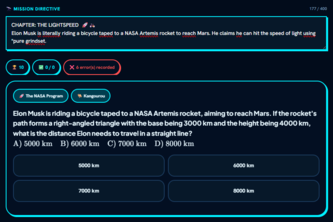
The description states that AIMRoyale is a free, gamified space-math arena. It claims to generate 100% custom math problems, aligned with school curricula and science topics such as Universal Gravitation or Quadratic Functions. The platform uses Alibaba Cloud’s Qwen-Max model for dynamic problem generation.
It integrates:
- A frontend built in HTML, CSS, JavaScript
- A backend proxy using Node.js Express deployed on Render
- An AI core powered by the Qwen-Max LLM API
- A zero-database context engine using localStorage and a custom LocalMemoryAgent loop
The system is described as a PWA, designed for mobile accessibility, and includes features like:
- An intelligent memory agent that tracks academic weaknesses
- A Smart Decay Algorithm to reduce token consumption by flushing old errors from prompt context
Inference: The product appears to be a prototype or proof-of-concept built in a short timeframe, likely for demonstration purposes rather than production use.
Positioning & Claim Evolution
The author positions AIMRoyale as:
- An AI-powered educational tool that democratizes access to high-level math learning
- A gamified alternative to traditional lectures, aiming to make studying engaging and interactive
- A solution to outdated school systems and expensive private tutoring
- A privacy-first platform without login or data collection
The claims evolve from:
- Initial inspiration: Bridging academic rigor with internet culture (e.g., physics problems involving Stephen Curry)
- Functional evolution: Using AI to personalize learning and adapt to user performance
- Technical evolution: Building a secure, scalable architecture using local storage and LLMs without backend databases
Inference: The positioning reflects a strong personal mission and technical ambition but lacks evidence of market validation or commercial traction.
Target Customer & ICP
The description states that AIMRoyale targets:
- Students in school, particularly those preparing for math competitions or exams
- Users who cannot afford private tutors
- Young learners interested in gamified learning experiences
It is positioned as a tool for democratizing education and making it more accessible through AI.
Inference: The ICP seems to be students aged 10–18, especially those in STEM-focused curricula. However, there is no evidence of actual target customer segmentation or feedback from users.
Business Model & Pricing Evidence
The description states that AIMRoyale is:
- Free to use
- Designed as a personal project with no stated monetization strategy
- Intended to be open-source, allowing anyone to deploy it for educational purposes
There is no evidence of pricing, subscriptions, or revenue streams. The author mentions future plans for gamification and community features but does not describe how these would translate into a business model.
Inference: No commercial business model has been implemented or evidenced; the project remains conceptual and non-commercial.
Technical & Delivery Signals
The system is built with:
- Frontend: HTML, CSS, JavaScript
- Backend: Node.js Express proxy on Render
- AI Integration: Alibaba Cloud Qwen-Max API
- State Management: Custom LocalMemoryAgent using localStorage
- Optimization Techniques: Smart Decay Algorithm to manage prompt context
Key technical decisions include:
- Avoiding databases in favor of local storage for privacy and ease of deployment
- Using a proxy to hide API keys from client-side exposure
- Packaging as a PWA for mobile accessibility
Inference: The architecture shows a strong understanding of modern web development and AI integration, but lacks scalability or production-grade infrastructure.
Traction & Maturity Signals
The description states:
- The project was built in one week during summer vacation
- It is a solo developer effort
- It was submitted to the OpenAI 2026 hackathon
- The author describes it as a “full-stack, production-ready architecture”, though this is self-reported and unverified
There is no evidence of user engagement, retention metrics, or real-world usage. No customer data, feedback loops, or adoption indicators are provided.
Inference: This is an early-stage prototype with no demonstrated traction or maturity in terms of user base or product-market fit.
Competitive Context
The description does not mention any competitors directly. However, based on the stated goals:
- Personalized math learning
- Gamified education
- AI-powered problem generation
It would compete with platforms like:
- Khan Academy
- IXL
- Photomath
- Duolingo (for gamification)
- Various AI tutoring tools
The author does not provide any competitive analysis or differentiation strategy beyond their own implementation.
Inference: No clear competitive positioning or market differentiation is evident from the description.
Open Questions & Risks
- No commercial traction or user data: The product is described only as a hackathon submission with no evidence of real-world usage.
- Solo developer model: A single person building and maintaining a full-stack platform raises concerns about long-term sustainability and scalability.
- Technical limitations: Use of localStorage instead of a database may limit functionality and performance at scale.
- Unverified claims: All statements are self-reported, with no independent verification or third-party validation.
- Lack of monetization strategy: No indication of how the platform would generate revenue or sustain itself beyond open-source sharing.
Inference: The project is highly speculative and lacks any commercial viability indicators.
Questions the description leaves open
- How many users have actually used AIMRoyale, if any?
- What specific feedback has been received from students or educators who tried the platform?
- Are there plans to move beyond a PWA and into a scalable backend architecture?
- Has the team considered how to monetize this product in the future?
- How does the current AI integration handle edge cases or complex problem types?
- What are the long-term goals for open-sourcing the platform, and what support will be offered to users?
Overall Assessment
Not evidenced: There is no evidence of revenue, customers, or commercial traction to assess investment potential or partnership viability.
The project appears to be a personal prototype, likely built as part of a hackathon, with no indication of market readiness or business sustainability. It reflects strong technical ambition and personal drive but lacks any commercial foundation.
Confidence Level: Low — based entirely on self-reported information without independent verification or evidence of impact.
User Stories BotA demo video on every pull request
Get a demo video on every new feature
GitHub App that watches your pull requests and records a narrated, captioned demo.
Save time on demo prep and make informed decisions faster with a video walkthrough of every new feature.
Source
Submitted to the OpenAI 2026 hackathon on Devpost. Project home on Devpost. Back to the full gallery on Devpost.
This competitive analysis was produced by top-founders.com (opens in a new tab)
Generated by a language model from this project's public Devpost page — its tagline, the author's own write-up and any built-with tags listed there — as captured in August 2026. Short quotations are the author's words. It is an opinion on the idea as a business, not on the people behind it, and it reflects the description as published then. If the project has moved on, request a correction below. The analysis is not independent research and contains no verified traction, revenue or customer data.
An independent guide by KFG International LLC — not affiliated with, endorsed by, or connected to Devpost or OpenAI.