

Archive position — measured, not model output
0 likes on Devpost
2,263 of the 7,850 archived projects have more likes, and 5,587 share exactly 0 — so this project's #4,543 place in the like-ranked listing is a tie-break inside that group, not a ranking.
Projects (log scale)
Likes on Devpost. ▲ marks this project's group.
Show the figures
| Likes | Projects | Share of archive |
|---|---|---|
| 0 | 5,587 | 71.2% |
| 1 | 1,758 | 22.4% |
| 2 | 284 | 3.6% |
| 3–4 | 132 | 1.7% |
| 5–9 | 75 | 1.0% |
| 10+ | 14 | 0.2% |
 User Stories BotA demo video on every pull request
Get a demo video on every new feature
GitHub App that watches your pull requests and records a narrated, captioned demo.
Save time on demo prep and make informed decisions faster with a video walkthrough of every new feature.
Executive Summary
The description states that Hospitality Infrastructure Planner v2 is an AI-powered platform for planning, sizing, budgeting, and optimizing hotel IT infrastructure. The author claims it helps IT professionals, consultants, and developers define a property and automatically generate an infrastructure model covering multiple domains (network, guest room tech, security, etc.), with CAPEX/OPEX estimates, architecture insights, and actionable recommendations.
The platform was built using Lovable with AI-assisted development and prompt engineering. It is positioned as a tool to reduce planning effort and support faster, more consistent infrastructure decisions in hospitality environments.
Key commercial due-diligence read: The author states the platform aims to transform complex IT infrastructure planning into a structured, repeatable workflow — but there is no evidence of revenue, customers, or adoption. The description is self-reported and unverified; it does not demonstrate traction or validate market demand.
What The Product Actually Is
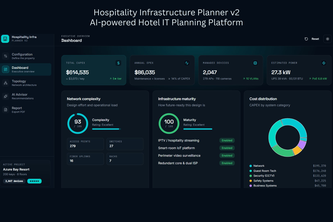
The description states that Hospitality Infrastructure Planner v2 is an AI-powered platform for hospitality IT infrastructure planning. It allows users to define a hotel property and automatically generates:
- Infrastructure models across multiple domains:
- Network (Wi-Fi, switching, fiber uplinks, VLANs, firewall)
- Guest room tech (IPTV, smart rooms, telephony)
- Security systems (CCTV, storage, monitoring)
- Safety and IoT systems
- Business systems and operational devices
- Power requirements and UPS capacity
It provides:
- CAPEX estimation
- Annual OPEX calculation
- Cost distribution by category
- Infrastructure complexity scoring
- Maturity assessment
- Device quantity planning
- Power consumption estimation
- AI-powered recommendations
- Executive dashboard
- PDF project reporting
The platform was built using Lovable, with AI-assisted development and prompt engineering. It is described as a system connecting technical requirements with business-level decisions such as investment planning and lifecycle management.
Inference: The product appears to be an internal tool or prototype for IT planners in hospitality, not yet validated in the market.
Positioning & Claim Evolution
The description states that the platform was created to help IT professionals, consultants, and hotel developers quickly understand what infrastructure a property needs, how much it may cost, and how future-ready the design is. It aims to reduce time spent on combining information from multiple sources, validating requirements, estimating costs, and preparing documentation.
It positions itself as a way to transform expertise into a structured, repeatable workflow. The author notes that the platform was designed around real-world scenarios including pre-opening projects, infrastructure modernization, and long-term operational planning.
Inference: This is a self-reported positioning for a niche B2B SaaS or internal tool targeting technical teams in hospitality. No evidence of market validation or customer feedback.
Target Customer & ICP
The description states that the platform is intended for:
- IT professionals
- Consultants
- Hotel developers
It supports planning scenarios such as:
- Pre-opening projects
- Infrastructure modernization
- Long-term operational planning
It also mentions that it connects technical engineering requirements with business-level decisions like investment planning, budgeting, and lifecycle management.
Inference: The target ICP appears to be internal IT teams or consulting firms working on hospitality infrastructure. No evidence of actual customers or use cases beyond the author's own experience.
Business Model & Pricing Evidence
The description does not state anything about pricing, licensing, or monetization strategy.
There is no mention of:
- Subscription tiers
- Per-user or per-property pricing
- Enterprise contracts
- Freemium or usage-based models
Not evidenced: No business model or pricing information provided.
Technical & Delivery Signals
The description states that the platform was built using:
- Lovable (AI-assisted development)
- Prompt engineering
- React, Tailwind, TypeScript, JavaScript
- OpenAI integration (GPT)
It is described as a web-based application with AI-driven analysis and recommendation capabilities. The author emphasizes that it combines practical hospitality IT knowledge with automation.
Inference: This suggests a low-code or no-code approach using AI tools, likely for rapid prototyping rather than enterprise-grade delivery. No evidence of scalability, performance, or production deployment.
Traction & Maturity Signals
The description states that the project was submitted to the OpenAI 2026 hackathon on Devpost and is a prototype built by one person (Vladimir Stojanovski).
It includes:
- A working prototype
- A complete workflow from property input to reporting
- Integration with AI for analysis and recommendations
However, there is no evidence of:
- Revenue
- Customers
- Adoption
- Product-market fit
- Market traction beyond the hackathon submission
Not evidenced: No signs of traction or maturity beyond a hackathon prototype.
Competitive Context
The description does not mention any competitors or existing solutions in the hospitality IT infrastructure planning space.
It does not state:
- Who else is solving this problem
- What alternatives exist
- Whether similar tools are already available in the market
Not evidenced: No competitive landscape information provided.
Open Questions & Risks
- No revenue or customers: The platform is described as a hackathon submission with no evidence of monetization or adoption.
- Unproven market demand: The author’s own claims about value are not backed by external validation.
- Single-person team: Only one developer is listed, which may limit scalability and product development speed.
- Prototype-only status: No indication of production use, performance testing, or enterprise readiness.
- AI dependency without verification: Reliance on AI for recommendations implies potential inaccuracies unless validated with real-world data.
Inference: The risk of failure is high if the platform does not evolve beyond prototype and gain traction in a niche market.
Questions the description leaves open
- What specific hospitality IT challenges are you solving, and how do you know they exist?
- Have you spoken to any potential customers or partners in the hospitality industry?
- How is the AI-powered recommendation engine trained, and what data sources does it rely on?
- Are there any existing tools in this space that you’re aware of? What differentiates your approach?
- What is your go-to-market strategy for reaching IT professionals, consultants, or hotel developers?
- Do you have any internal testing or feedback loops with users?
- How do you plan to monetize the platform beyond a prototype?
Overall Assessment
The description states that Hospitality Infrastructure Planner v2 is an AI-powered platform for planning and budgeting hospitality IT infrastructure, built as a hackathon submission by one developer.
It is described as a tool to reduce planning effort and support faster, more consistent infrastructure decisions in the hospitality sector.
However, there is no evidence of:
- Revenue
- Customers
- Traction
- Market validation
- Product-market fit
The platform appears to be a prototype with no commercial activity beyond its submission to a hackathon.
Assessment: Not ready for investment or partnership. The project lacks commercial evidence and requires further development, market testing, and traction before it can be considered viable.
User Stories BotA demo video on every pull request
Get a demo video on every new feature
GitHub App that watches your pull requests and records a narrated, captioned demo.
Save time on demo prep and make informed decisions faster with a video walkthrough of every new feature.
Source
Submitted to the OpenAI 2026 hackathon on Devpost. Project home on Devpost. Back to the full gallery on Devpost.
This competitive analysis was produced by top-founders.com (opens in a new tab)
Generated by a language model from this project's public Devpost page — its tagline, the author's own write-up and any built-with tags listed there — as captured in August 2026. Short quotations are the author's words. It is an opinion on the idea as a business, not on the people behind it, and it reflects the description as published then. If the project has moved on, request a correction below. The analysis is not independent research and contains no verified traction, revenue or customer data.
An independent guide by KFG International LLC — not affiliated with, endorsed by, or connected to Devpost or OpenAI.