

Archive position — measured, not model output
0 likes on Devpost
2,263 of the 7,850 archived projects have more likes, and 5,587 share exactly 0 — so this project's #6,506 place in the like-ranked listing is a tie-break inside that group, not a ranking.
Projects (log scale)
Likes on Devpost. ▲ marks this project's group.
Show the figures
| Likes | Projects | Share of archive |
|---|---|---|
| 0 | 5,587 | 71.2% |
| 1 | 1,758 | 22.4% |
| 2 | 284 | 3.6% |
| 3–4 | 132 | 1.7% |
| 5–9 | 75 | 1.0% |
| 10+ | 14 | 0.2% |
 User Stories BotA demo video on every pull request
Get a demo video on every new feature
GitHub App that watches your pull requests and records a narrated, captioned demo.
Save time on demo prep and make informed decisions faster with a video walkthrough of every new feature.
Executive Summary
What the company appears to be
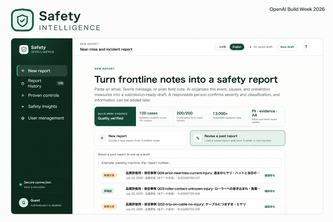
Safety Intelligence is an AI-powered assistant for workplace safety investigations, built as a prototype for the OpenAI 2026 hackathon. It uses OpenAI models (specifically GPT-5.6) to analyze incident data, identify root causes, recommend corrective actions, and generate structured reports in multiple formats (HTML, ODT, PDF). The system includes local PII masking and retrieval-augmented generation (RAG), with a focus on privacy, structured outputs, and human review.
What changed
The project was developed as part of a hackathon submission. It is not evidenced to have moved beyond the prototype stage or entered production use. No commercial deployment, customers, revenue or traction data are available.
Single most important open question
Is there evidence that this system has been tested in real-world safety investigations, or does it remain limited to synthetic data and demonstration use?
Note: This analysis is based entirely on the self-reported description provided by the author. No independent verification, historical data, or third-party sources are available.
What The Product Actually Is
The description states that Safety Intelligence is an AI-powered workplace safety investigation assistant. It supports a workflow from incident input to report generation and includes:
- Local PII masking before OpenAI processing
- Structured analysis of direct causes and contributing factors
- Recommendation of corrective and preventive actions
- Retrieval of historical cases
- Human review and approval steps
- Generation of structured HTML, ODT, and PDF reports
- Multilingual output support
The system is built using FastAPI, Docker, OpenAI GPT-5.6, RAG, function-calling, structured outputs, and SQLite.
Inference: The product appears to be a prototype or proof-of-concept for an AI-assisted safety investigation tool, not a commercial-grade solution yet.
Positioning & Claim Evolution
The author states that the product was created to help safety professionals investigate incidents more consistently, identify root causes, and generate professional reports with AI assistance. It positions itself as an assistant that improves upon inconsistent, time-consuming, experience-dependent investigations.
It also claims to be built with privacy in mind, using local PII masking and structured workflows to ensure compliance and control over outputs.
Claim: The system is designed for safety professionals to improve consistency and reduce reliance on individual investigator expertise.
Inference: This is a self-positioning statement; no evidence of actual adoption or impact is provided.
Target Customer & ICP
The description states that the tool is intended for safety professionals who investigate workplace incidents. It aims to support their workflow by automating parts of the analysis and report generation process.
Inference: The target customer segment is likely safety managers, compliance officers, or incident investigators in industrial, manufacturing, or regulated environments.
Not evidenced: No specific industry, company size, or job role details are provided.
Business Model & Pricing Evidence
No evidence of pricing, monetization strategy, or business model is present in the description.
Not evidenced: There is no mention of licensing, subscription models, SaaS offerings, or any commercial revenue mechanism.
Technical & Delivery Signals
The system uses:
- FastAPI for backend
- Docker for containerization
- OpenAI GPT-5.6
- Structured outputs and function-calling
- RAG (retrieval-augmented generation)
- PII masking
- SQLite for local storage
- JavaScript, Python, privacy, safety, workplace-safety tags
It is designed with modularity in mind, separating components like masking, analysis, and report generation to allow future replacement or integration.
Inference: The architecture suggests a modular, scalable approach that could support commercial deployment.
Not evidenced: No details on scalability, performance, or production readiness are provided.
Traction & Maturity Signals
The project is described as a hackathon submission and was built during Build Week. It uses synthetic data only and does not contain real company or employee incident information.
Key accomplishments mentioned include:
- 100 synthetic incident cases
- 13,931 regression tests with zero failures
- No confidential data in the submission repository
Not evidenced: No real-world usage, customer feedback, or adoption metrics are provided. The system is not demonstrated to be used beyond a demo.
Competitive Context
No evidence of competitors or market positioning is provided in the description.
Not evidenced: There is no mention of existing tools or platforms in the safety investigation space.
Open Questions & Risks
- The system is described as a hackathon prototype, not a production-ready product.
- It uses synthetic data only; no real-world testing or validation is evident.
- No commercial deployment, customers, or revenue are mentioned.
- The use of GPT-5.6 implies reliance on a proprietary model with potential limitations in enterprise settings.
- The system’s architecture suggests it may be difficult to scale without significant rework.
Inference: The project has not yet demonstrated real-world utility or commercial viability.
Questions the description leaves open
- Has the system been tested on real incident data, or is it limited to synthetic examples?
- What specific safety regulations or compliance standards does it aim to support?
- How is the structured output validated in practice? Is there a feedback loop for improving accuracy?
- What are the plans for integrating with existing enterprise safety management systems?
- Are there any plans for multi-tenancy, private cloud deployment, or data sovereignty features?
- What is the expected timeline to move from prototype to commercial product?
Overall Assessment
Not evidenced: There is no evidence of traction, revenue, customers, or a clear path to monetization.
Assessment: This is a hackathon prototype with a promising concept and technical foundation. However, it has not demonstrated real-world use, commercial viability, or product-market fit. It may be a potential seed-stage idea but lacks the signals for early-stage investment or partnership consideration at this time.
Confidence Level: Low — based on self-reported evidence only, with no external validation or traction data.
User Stories BotA demo video on every pull request
Get a demo video on every new feature
GitHub App that watches your pull requests and records a narrated, captioned demo.
Save time on demo prep and make informed decisions faster with a video walkthrough of every new feature.
Source
Submitted to the OpenAI 2026 hackathon on Devpost. Project home on Devpost. Back to the full gallery on Devpost.
This competitive analysis was produced by top-founders.com (opens in a new tab)
Generated by a language model from this project's public Devpost page — its tagline, the author's own write-up and any built-with tags listed there — as captured in August 2026. Short quotations are the author's words. It is an opinion on the idea as a business, not on the people behind it, and it reflects the description as published then. If the project has moved on, request a correction below. The analysis is not independent research and contains no verified traction, revenue or customer data.
An independent guide by KFG International LLC — not affiliated with, endorsed by, or connected to Devpost or OpenAI.