

Archive position — measured, not model output
0 likes on Devpost
2,263 of the 7,850 archived projects have more likes, and 5,587 share exactly 0 — so this project's #6,507 place in the like-ranked listing is a tie-break inside that group, not a ranking.
Projects (log scale)
Likes on Devpost. ▲ marks this project's group.
Show the figures
| Likes | Projects | Share of archive |
|---|---|---|
| 0 | 5,587 | 71.2% |
| 1 | 1,758 | 22.4% |
| 2 | 284 | 3.6% |
| 3–4 | 132 | 1.7% |
| 5–9 | 75 | 1.0% |
| 10+ | 14 | 0.2% |
 User Stories BotA demo video on every pull request
Get a demo video on every new feature
GitHub App that watches your pull requests and records a narrated, captioned demo.
Save time on demo prep and make informed decisions faster with a video walkthrough of every new feature.
Executive Summary
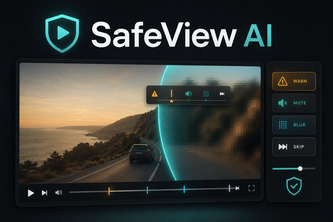
SafeView AI is a self-reported prototype for an AI-powered video player that allows users to configure how sensitive content—such as violence, profanity, or adult themes—is handled during playback. The author states it processes videos between 5 and 10 minutes long using multimodal analysis (visual + audio) via OpenAI services and FFmpeg/FFprobe. It supports six configurable categories of content and five actions per category (skip, blur, mute, warn, watch normally), with automatic execution during playback.
The description indicates this is a hackathon submission, not a commercial product. No revenue, customers, or traction data are provided. The author claims the system handles overlapping detections, merges skip intervals smoothly, and preserves evidence for transparency. It uses React/TypeScript frontend and Python/FastAPI backend with OpenAI Codex as a coding collaborator.
Key open question
Is this prototype ready for real-world use, or is it still in early-stage experimentation?
What The Product Actually Is
The description states that SafeView AI is an AI-powered video player designed to help users control how sensitive content is handled during playback. It analyzes videos for six categories—adult content, violence, profanity, drugs, alcohol, and gambling—and returns timestamps, confidence, evidence, and explanations.
During playback, the viewer selects a default action (skip, blur, mute, warn, or watch normally) for each category. The system then automatically applies these actions in real time. It also supports one-time overrides and groups adjacent detections into understandable occurrences while preserving original evidence.
The author describes it as a multimodal analysis tool that combines visual frames from FFmpeg, audio transcriptions from Whisper, and structured content detection from GPT-5.6. The system is built with React/TypeScript frontend and Python/FastAPI backend.
It is explicitly described as a hackathon prototype, not a commercial product.
Claim: SafeView AI processes user-authorized videos between 5 and 10 minutes long.
Evidence: Author states this scope keeps analysis practical within processing time and API budget.
Claim: The system supports six configurable content categories.
Evidence: Author lists adult content, violence, profanity, drugs, alcohol, and gambling as the categories.
Claim: Playback actions include skip, blur, mute, warn, or watch normally.
Evidence: Author describes these five actions per category.
Claim: The system uses FFmpeg/FFprobe for media processing and GPT-5.6 for content detection.
Evidence: Author mentions FFmpeg for frame extraction, FFprobe for validation, Whisper for transcription, and GPT-5.6 for multimodal analysis.
Positioning & Claim Evolution
The author positions SafeView AI as a personalized video control tool that gives users granular control over sensitive content, unlike traditional parental controls which apply universal rules.
It is described as an assistive content-awareness prototype, not claiming perfect detection or universal judgment. The system emphasizes transparency by showing evidence and allowing overrides.
The project evolved from a hackathon idea focused on improving viewer comfort without blocking entire videos. It was built to demonstrate how multimodal AI can be connected to real-time playback behavior.
Claim: Traditional parental controls make binary decisions (allow/block), while SafeView allows personal control over individual scenes.
Evidence: Author states this inspired the project.
Claim: SafeView is an assistive content-awareness prototype—not a claim of perfect detection.
Evidence: Author explicitly says so in the "What's next" section.
Claim: The system preserves evidence and allows overrides to support viewer autonomy.
Evidence: Author states this is central to design.
Target Customer & ICP
The description does not clearly define a target customer or ideal customer profile (ICP). It implies that the product is for viewers who want fine-grained control over sensitive content but doesn't specify demographics, use cases, or platforms.
It suggests the tool works best with user-authorized videos, meaning those where the viewer has consented to analysis. The author notes it's designed for personal comfort preferences, not institutional or enterprise use.
Claim: SafeView is for viewers who want personal control over sensitive content.
Evidence: Author describes intent behind the product.
Claim: It works with user-authorized videos.
Evidence: Author says “user-authorized videos” are processed.
Claim: The tool supports personal comfort preferences.
Evidence: Author states this is central to design.
Business Model & Pricing Evidence
No business model or pricing information is provided in the description. The author does not mention monetization, licensing, subscriptions, or any commercial offering.
Claim: No business model or pricing data is evident.
Evidence: Not stated anywhere in the description.
Technical & Delivery Signals
The system uses a progressive multimodal analysis pipeline involving FFmpeg/FFprobe for media processing, Whisper for transcription, and GPT-5.6 for structured detection. It supports real-time playback behavior with automatic action execution.
Key technical features include:
- Timestamped detections
- Evidence-backed explanations
- Grouping of adjacent detections
- Merging of skip intervals
- Deterministic handling of overlapping actions
- Protected playback that avoids unknown footage
The frontend is built with React/TypeScript/Vite, and the backend uses Python/FastAPI. The author used OpenAI Codex for implementation assistance.
Claim: Progressive analysis allows playback without waiting for full video processing.
Evidence: Author explains how playable runway is calculated based on resolved skip intervals.
Claim: The system handles overlapping detections and merges skip intervals smoothly.
Evidence: Author describes this as a challenge overcome in development.
Claim: Playback avoids unknown footage by not counting it toward playable runway.
Evidence: Author states this prevents rapid skip-and-buffer loops.
Traction & Maturity Signals
There is no traction or maturity data provided. The project is described as a hackathon prototype, and no revenue, customers, usage metrics, or adoption data are mentioned.
Claim: No traction or maturity data is evident.
Evidence: Not stated anywhere in the description.
Competitive Context
The description does not reference existing competitors or market positioning. It focuses on the novelty of giving viewers personal control over sensitive content rather than comparing to other tools.
Claim: No competitive context is provided.
Evidence: Author does not name or describe competing products.
Open Questions & Risks
- Prototype status: The system is described as a hackathon prototype, not a production-ready product.
- Limited scope: It only processes videos between 5–10 minutes long, which may limit real-world applicability.
- API budget constraints: The author notes they worked under limited API budgets, suggesting potential scalability issues.
- No commercial viability: No business model or pricing is described.
- Unverified accuracy: The system relies on AI models (GPT-5.6) whose performance and reliability are not evaluated in the description.
Claim: Prototype status implies unproven readiness for real-world deployment.
Inference: Based on author's own statement that it’s a hackathon submission.
Claim: Limited video length may hinder broader adoption.
Inference: From the stated 5–10 minute processing window.
Claim: API budget constraints suggest scalability concerns.
Inference: From the author’s mention of deliberate efficiency measures.
Questions the description leaves open
- What is the expected accuracy of GPT-5.6 for content detection in real-world scenarios?
- How does SafeView handle false positives or missed detections?
- Are there plans to expand beyond 5–10 minute video lengths?
- Has the system been tested with actual users, and what feedback was received?
- What are the technical limitations of current implementation that would prevent production use?
- Is there any plan for monetization or commercialization?
- How does SafeView integrate with existing media platforms (e.g., YouTube, Netflix)?
- What is the expected latency between detection and playback action?
Overall Assessment
The description presents SafeView AI as a hackathon prototype, not a commercial product or investment-ready venture. There is no evidence of traction, revenue, customers, or business model.
While it demonstrates technical feasibility in a controlled environment, the lack of real-world testing, scalability planning, and commercial viability makes it unsuitable for immediate investment or partnership consideration.
Claim: Not suitable for investment or partnership at this stage.
Inference: Based on prototype status, no traction, and absence of business model.
User Stories BotA demo video on every pull request
Get a demo video on every new feature
GitHub App that watches your pull requests and records a narrated, captioned demo.
Save time on demo prep and make informed decisions faster with a video walkthrough of every new feature.
Source
Submitted to the OpenAI 2026 hackathon on Devpost. Project home on Devpost. Back to the full gallery on Devpost.
This competitive analysis was produced by top-founders.com (opens in a new tab)
Generated by a language model from this project's public Devpost page — its tagline, the author's own write-up and any built-with tags listed there — as captured in August 2026. Short quotations are the author's words. It is an opinion on the idea as a business, not on the people behind it, and it reflects the description as published then. If the project has moved on, request a correction below. The analysis is not independent research and contains no verified traction, revenue or customer data.
An independent guide by KFG International LLC — not affiliated with, endorsed by, or connected to Devpost or OpenAI.