

Archive position — measured, not model output
0 likes on Devpost
2,263 of the 7,850 archived projects have more likes, and 5,587 share exactly 0 — so this project's #6,509 place in the like-ranked listing is a tie-break inside that group, not a ranking.
Projects (log scale)
Likes on Devpost. ▲ marks this project's group.
Show the figures
| Likes | Projects | Share of archive |
|---|---|---|
| 0 | 5,587 | 71.2% |
| 1 | 1,758 | 22.4% |
| 2 | 284 | 3.6% |
| 3–4 | 132 | 1.7% |
| 5–9 | 75 | 1.0% |
| 10+ | 14 | 0.2% |
 User Stories BotA demo video on every pull request
Get a demo video on every new feature
GitHub App that watches your pull requests and records a narrated, captioned demo.
Save time on demo prep and make informed decisions faster with a video walkthrough of every new feature.
Executive Summary
What the company appears to be
SAGA Core is a developer tool that checks whether an AI-generated claim is supported by evidence before it is allowed to leave the system. It operates as an authorization gate between candidate generation and final release, applying a coded policy to determine if a claim should be ALLOWED, QUALIFIED, or WITHHELD based on its alignment with provided evidence.
What changed
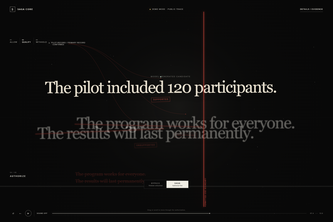
The project was submitted as part of the OpenAI 2026 hackathon. It includes a working public demo, backend implementation (using FastAPI and GPT-5.6), and a cinematic frontend that visualizes how claims are traced, authorized, and reconstructed. The author states it was built solo over a Build Week extension.
Single most important open question
Is there evidence of real-world application or integration beyond the public demo? The description does not indicate any production use, customer feedback, or adoption data — only a self-contained implementation.
What The Product Actually Is
The description states that SAGA Core:
- Checks whether an AI-generated claim is supported by evidence before it leaves the system.
- Applies a coded authorization gate returning ALLOW, QUALIFY, or WITHHOLD.
- Uses GPT-5.6 to extract exact claims and relate them to evidence using strict JSON schema output.
- Reconstructs qualified language into narrower answers when needed.
- Operates between candidate generation and final release.
- Includes a public-safe resolver that demonstrates core principles without exposing proprietary logic.
Inferred: The tool is designed for developers working in systems where AI-generated content could cause harm if not properly constrained by evidence. It is not a general truth-checker or hallucination detector but a mechanism to enforce evidence-based output at the point of release.
Positioning & Claim Evolution
The description states:
- SAGA Core is positioned as an “evidence-grounded authorization for AI-generated claims.”
- It distinguishes itself from traditional AI evaluation tools by acting before output, not after.
- The author emphasizes that “generation and authorization are not the same job.”
- It aims to prevent downstream harm in domains like research assistants, enterprise search, compliance workflows, support tools, reports, and agent pipelines.
Inferred: The positioning focuses on engineering control rather than truth validation. It is framed as a pre-release constraint mechanism, not a post-hoc audit or fact-checker.
Target Customer & ICP
The description states:
- SAGA Core targets developers building systems where fluent claims can cause downstream harm.
- Examples include research assistants, enterprise search, compliance workflows, support tools, reports, and agent pipelines.
Inferred: The primary customer is likely developer teams or engineering organizations within enterprises or product development environments who are concerned with AI-generated content integrity and risk management.
Not evidenced: No specific industry verticals, company sizes, or use cases beyond general domains were mentioned.
Business Model & Pricing Evidence
The description states:
- SAGA Core is a working developer tool.
- The public demo, backend, authorization trace, failure behavior, and tests are available in a judge repository.
- A private resolver exists but is not published.
- No pricing information or commercial model was shared.
Not evidenced: There is no indication of monetization strategy, pricing tiers, or customer acquisition plans. The tool appears to be open-source or demo-only at this stage.
Technical & Delivery Signals
The description states:
- Built with Python (FastAPI), Pydantic, httpx; JavaScript (vanilla JS, Canvas); HTML/CSS.
- Uses GPT-5.6 via OpenAI Responses API for claim extraction and reconstruction.
- Includes deterministic trace logic to prevent unrestricted API spending.
- Has 91 non-live tests, browser regressions, and a public-safe implementation.
- The system supports playback, scrubbing, reverse, reduced motion, mobile layouts.
- Uses Codex during development for rapid prototyping and verification.
Inferred: The technical stack suggests a lightweight, developer-focused tool built with modern web and AI integration patterns. The use of deterministic traces and structured outputs implies attention to safety and traceability.
Traction & Maturity Signals
The description states:
- A public demo exists and is hosted on Vercel.
- Includes setup instructions, sample cases, tests, and a judge repository.
- 91 non-live tests passed; one intentionally skipped live test.
- One live API request returned HTTP 200 with expected structured schema.
- Earlier bounded demonstration classified 28 of 30 cases correctly (93.33% accuracy).
- The system was built solo in a Build Week extension.
Not evidenced: No customer data, revenue, user feedback, or adoption metrics are provided. There is no indication of product-market fit or real-world deployment beyond the demo.
Competitive Context
The description states:
- SAGA Core acts before release, unlike SAGA Audit which examines output.
- It is not a general truth-checker or hallucination detector.
- The author distinguishes it from tools that treat chain-of-thought as proof of validity without evidence verification.
Inferred: The competitive space includes AI content moderation, fact-checking systems, and pre-release AI governance tools. However, no direct competitors are named or described.
Not evidenced: No information on existing solutions in this niche, their features, or market positioning.
Open Questions & Risks
The description states:
- The public cases are synthetic and bounded.
- The public demonstration policy is intentionally smaller than the private resolver.
- System depends on supplied evidence quality.
- Live GPT-5.6 mode is not enabled on the public host.
- Enterprise ingestion, calibration, monitoring, and private deployment remain future work.
Inferred:
- Risk of over-reliance on synthetic data for validation.
- Lack of real-world testing or integration beyond demo.
- Limited scalability or enterprise readiness.
- Proprietary logic remains hidden — raises questions about trust and transparency in production use.
Questions the description leaves open
- What is the exact scope of the private resolver, and how does it differ from the public-safe version?
- Has there been any real-world testing or integration with actual AI systems or workflows?
- How is evidence quality handled — is there a mechanism for validating or enriching source material?
- Are there plans to support enterprise ingestion, monitoring, or private deployment?
- What are the limitations of GPT-5.6 in this context, and how does the system handle model failures or misalignments?
- How would you scale this tool beyond a single developer use case?
Overall Assessment
The description states:
- SAGA Core is a working developer tool built during a hackathon.
- It demonstrates core engineering principles but lacks commercial traction, customers, or revenue data.
- The private resolver exists but is not published.
Not evidenced: No indication of market demand, customer interest, or business viability beyond the demo. The tool appears to be an experimental prototype with potential for future development.
Assessment This is a proof-of-concept with strong engineering execution and a clear problem statement. However, there is no evidence of commercial traction, adoption, or scalability. It may be suitable for early-stage investment if the founders plan to build out enterprise features, integrate with real workflows, or demonstrate real-world usage. As it stands, it is not ready for large-scale deployment or partnership engagement.
User Stories BotA demo video on every pull request
Get a demo video on every new feature
GitHub App that watches your pull requests and records a narrated, captioned demo.
Save time on demo prep and make informed decisions faster with a video walkthrough of every new feature.
Source
Submitted to the OpenAI 2026 hackathon on Devpost. Project home on Devpost. Back to the full gallery on Devpost.
This competitive analysis was produced by top-founders.com (opens in a new tab)
Generated by a language model from this project's public Devpost page — its tagline, the author's own write-up and any built-with tags listed there — as captured in August 2026. Short quotations are the author's words. It is an opinion on the idea as a business, not on the people behind it, and it reflects the description as published then. If the project has moved on, request a correction below. The analysis is not independent research and contains no verified traction, revenue or customer data.
An independent guide by KFG International LLC — not affiliated with, endorsed by, or connected to Devpost or OpenAI.