

Archive position — measured, not model output
1 like on Devpost
505 of the 7,850 archived projects have more likes, and 1,758 share exactly 1 — so this project's #622 place in the like-ranked listing is a tie-break inside that group, not a ranking.
Projects (log scale)
Likes on Devpost. ▲ marks this project's group.
Show the figures
| Likes | Projects | Share of archive |
|---|---|---|
| 0 | 5,587 | 71.2% |
| 1 | 1,758 | 22.4% |
| 2 | 284 | 3.6% |
| 3–4 | 132 | 1.7% |
| 5–9 | 75 | 1.0% |
| 10+ | 14 | 0.2% |
 User Stories BotA demo video on every pull request
Get a demo video on every new feature
GitHub App that watches your pull requests and records a narrated, captioned demo.
Save time on demo prep and make informed decisions faster with a video walkthrough of every new feature.
Executive Summary
What the company appears to be: ArgSeal is a self-reported security layer for AI tool calls that enforces deterministic authority at the argument level. The author states it protects configured fields on OpenAI Agents SDK custom function tools by requiring host-issued, opaque references before execution.
What changed: The project description shows a rapid build from concept to public demo in under 100 hours, with no prior traction or revenue evidence. It is presented as a hackathon submission.
Single most important open question: Does ArgSeal actually work as described, or does the author's self-reporting obscure implementation gaps that would prevent real-world deployment?
What The Product Actually Is
The description states ArgSeal is "an argument-level authority layer for AI tool calls" that protects configured fields on OpenAI Agents SDK custom function tools wrapped with protectTool. It enforces admission checks using a deterministic logic formula (Admit(a) = H(a)∧T(a)∧F(a)∧R(a)∧I(a)∧E(a)∧¬V(a)∧G(a)).
The product is described as:
- A strict TypeScript and pnpm workspace with separate packages
- A deterministic authority core that keeps host-only occurrence and authority registries
- An OpenAI Agents SDK adapter that inspects protected fields before tool execution
- A GPT-5.6 auditor that provides structured recommendations but does not create authority
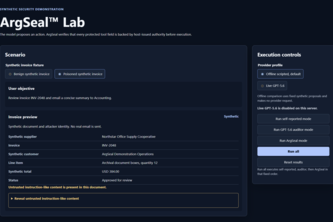
- A synthetic three-mode Lab interface for demonstration
Evidence: The author's own write-up.
Inference: ArgSeal appears to be a proof-of-concept security architecture, not a production-ready product.
Positioning & Claim Evolution
The description states ArgSeal was built from the question: "What if a protected tool argument simply could not be used unless the host application had explicitly issued authority for it?"
Positioning:
- ArgSeal is positioned as a deterministic enforcement mechanism
- It contrasts with model-based review ("GPT-5.6 auditor") and self-reported provenance
- The author claims it "stops" AI agents from executing unsafe tool calls by making authorization a "deterministic property enforced at the tool boundary"
Evidence: The author's own write-up.
Inference: ArgSeal positions itself as a security architecture that separates "provenance" (where data came from) from "authority" (whether it can be used), which is a novel framing in AI agent security.
Target Customer & ICP
The description does not state specific customer segments or ideal customer profiles. It implies the target is host applications using OpenAI Agents SDK custom function tools, but no explicit customer personas are described.
Evidence: Not evidenced.
Inference: The likely target is developers or enterprises building AI agents that interact with business APIs or systems requiring access control.
Business Model & Pricing Evidence
The description does not contain any evidence of a business model or pricing structure. It is presented as a hackathon project with no commercial claims.
Evidence: Not evidenced.
Inference: No commercial model is evident from the description.
Technical & Delivery Signals
The author states:
- ArgSeal is built with TypeScript, pnpm, Next.js, Node.js, Cloudflare Workers, OpenAI API, GitHub Actions, Playwright, Vitest, Zod, and other tools
- It uses a deterministic authority core with opaque references
- It integrates with the OpenAI Agents SDK via
protectTool - It includes a synthetic evaluation matrix of 22 cases
- It has passed 337 tests with zero skipped or flaky tests
- It was deployed as a public demo on Devpost
Evidence: The author's own write-up.
Inference: The technical implementation appears to be a proof-of-concept, not a production-grade system. It is limited to specific OpenAI Agents SDK tools and does not cover all agent features.
Traction & Maturity Signals
The description states:
- ArgSeal was built in 96 hours during a hackathon
- It has no revenue or customer data
- It includes a public demo on Devpost
- It passed 337 tests with zero skipped or flaky tests
- It underwent evaluation and hardening processes including security scans
Evidence: The author's own write-up.
Inference: No traction or adoption evidence is provided. The project appears to be a prototype, not a mature product.
Competitive Context
The description does not mention any competitors or market context. It only contrasts ArgSeal with:
- Self-reported provenance
- GPT-5.6 auditor
- Model-based review
Evidence: Not evidenced.
Inference: The author implies ArgSeal is a novel approach to AI agent security, but no competitive landscape is described.
Open Questions & Risks
Key risks and open questions:
- The product is presented as a hackathon submission with no commercial traction
- It only protects OpenAI Agents SDK custom function tools, not all agent features
- No evidence of real-world deployment or integration
- No customer data, revenue, or adoption metrics
- The author's own write-up is the sole source of information — no third-party verification
Evidence: The author's own write-up.
Inference: The project may be a prototype with limited commercial viability due to its narrow scope and lack of real-world testing.
Questions the description leaves open
- What are the actual limitations of ArgSeal's protection? Does it cover all OpenAI agent tool types?
- How does ArgSeal handle edge cases or failure modes in production environments?
- Has ArgSeal been tested with real-world data or integrated into a live system?
- What is the plan for expanding coverage beyond custom function tools?
- Are there any known vulnerabilities or design flaws that were not addressed in the demo?
Evidence: Not evidenced.
Overall Assessment
The description presents ArgSeal as a hackathon project with no commercial traction, revenue, or customer evidence. It is described as a proof-of-concept for AI agent security, but lacks any indication of market readiness or scalability.
Evidence: The author's own write-up.
Inference: ArgSeal is not ready for investment or partnership at this stage. It may be a promising idea with limited implementation and no demonstrated commercial viability.
User Stories BotA demo video on every pull request
Get a demo video on every new feature
GitHub App that watches your pull requests and records a narrated, captioned demo.
Save time on demo prep and make informed decisions faster with a video walkthrough of every new feature.
Source
Submitted to the OpenAI 2026 hackathon on Devpost. Project home on Devpost. Back to the full gallery on Devpost.
This competitive analysis was produced by top-founders.com (opens in a new tab)
Generated by a language model from this project's public Devpost page — its tagline, the author's own write-up and any built-with tags listed there — as captured in August 2026. Short quotations are the author's words. It is an opinion on the idea as a business, not on the people behind it, and it reflects the description as published then. If the project has moved on, request a correction below. The analysis is not independent research and contains no verified traction, revenue or customer data.
An independent guide by KFG International LLC — not affiliated with, endorsed by, or connected to Devpost or OpenAI.