

Archive position — measured, not model output
0 likes on Devpost
2,263 of the 7,850 archived projects have more likes, and 5,587 share exactly 0 — so this project's #2,341 place in the like-ranked listing is a tie-break inside that group, not a ranking.
Projects (log scale)
Likes on Devpost. ▲ marks this project's group.
Show the figures
| Likes | Projects | Share of archive |
|---|---|---|
| 0 | 5,587 | 71.2% |
| 1 | 1,758 | 22.4% |
| 2 | 284 | 3.6% |
| 3–4 | 132 | 1.7% |
| 5–9 | 75 | 1.0% |
| 10+ | 14 | 0.2% |
 User Stories BotA demo video on every pull request
Get a demo video on every new feature
GitHub App that watches your pull requests and records a narrated, captioned demo.
Save time on demo prep and make informed decisions faster with a video walkthrough of every new feature.
Executive Summary
What the company appears to be
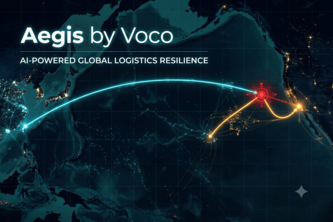
Aegis by Voco is a self-reported project submitted to the OpenAI 2026 hackathon. The description states it is a system that reroutes cargo when ports close or cargo stalls, with users approving moves. It was built using a range of technologies including Python, JavaScript, TypeScript, and PostgreSQL.
What changed
This is a single-team, hackathon submission with no evidence of prior development, traction, or commercial activity beyond its Devpost entry.
The single most important open question
Is this a prototype for a larger product or a proof-of-concept that has not yet been developed into a commercial offering?
Analysis basis
This report is based entirely on the self-reported project description provided by the caller. No external verification, archived data, or third-party sources were used. All claims are stated by the author and have not been independently confirmed.
What The Product Actually Is
The description states that Aegis by Voco "reroutes cargo when ports close or cargo stalls, you just approve the move." It is described as a system for managing logistics disruptions in supply chains.
Evidence
- The tagline describes a system that reroutes cargo under specific conditions.
- The author's own write-up is limited to this tagline and does not elaborate on functionality or features beyond the stated use case.
Inference
- Based on the tagline, it appears to be a logistics or supply chain management tool with some automation capability for handling disruptions.
- It may involve decision-making workflows where users approve rerouting actions.
Not evidenced
- No details about how the system works technically or what data it processes.
- No information on whether this is a web-based application, API, or standalone tool.
- No evidence of any UI, backend architecture, or integration points.
Positioning & Claim Evolution
The author positions Aegis by Voco as a solution for supply chain disruptions — specifically, when ports close or cargo stalls. The tagline implies automation with user approval as the core interaction model.
Evidence
- Tagline: “Ports close. Cargo stalls. Aegis reroutes it, you just approve the move.”
- No additional claims or positioning statements beyond this.
Inference
- The product is positioned to solve a specific problem in global logistics.
- It suggests a hybrid approach combining AI/automation with human oversight.
Not evidenced
- No evidence of prior versions, market research, or competitive analysis.
- No indication of how the system determines when to reroute cargo or what triggers the process.
- No mention of scalability, deployment model, or integration capabilities.
Target Customer & ICP
The description implies that Aegis by Voco targets users involved in logistics and supply chain management — particularly those who must make decisions about rerouting cargo during disruptions.
Evidence
- The tagline refers to “cargo stalls” and “ports,” suggesting a focus on maritime or intermodal transport.
- The system requires human approval, indicating a business user rather than an automated process.
Inference
- Likely targets logistics managers, freight forwarders, or supply chain coordinators.
- May be aimed at large enterprises with complex global supply chains.
Not evidenced
- No explicit customer personas or buyer profiles.
- No evidence of segmentation strategy or target industries beyond general logistics.
- No indication of whether the system is B2B or B2C.
Business Model & Pricing Evidence
There is no evidence in the description regarding a business model, pricing structure, monetization strategy, or revenue streams.
Evidence
- The author does not describe how Aegis by Voco would generate value or income.
- No mention of licensing, subscriptions, usage fees, or other commercial elements.
Inference
- If this becomes a product, it might follow a SaaS model with subscription-based access.
- It could be sold to logistics companies as part of their supply chain tools.
Not evidenced
- No pricing information.
- No evidence of customer acquisition strategy.
- No indication of monetization approach beyond the tagline.
Technical & Delivery Signals
The project was built using a range of technologies including Python, JavaScript, TypeScript, HTML, CSS, PostgreSQL, and others. It was submitted to a hackathon.
Evidence
- Technologies listed: Claude, ClosedLoops, Codex, CSS, ECC, HTML, JavaScript, PL/pgSQL, Python, TypeScript.
- Submitted to the OpenAI 2026 hackathon on Devpost.
Inference
- The use of AI tools like Claude and Codex suggests an AI-enhanced development process.
- The stack includes both frontend (HTML/CSS/JS) and backend (Python, PostgreSQL), indicating a full-stack system.
- It was built in a short timeframe as part of a hackathon.
Not evidenced
- No information on architecture, scalability, or deployment strategy.
- No evidence of testing, CI/CD pipelines, or production readiness.
- No details about data handling, security, or API design.
Traction & Maturity Signals
There is no evidence of traction, adoption, or maturity beyond the hackathon submission.
Evidence
- The project was submitted to a hackathon and has no further development history.
- Team size is listed as one person (Jordan Autrey).
- No mention of users, customers, or usage metrics.
Inference
- This is likely a prototype or proof-of-concept.
- It may be early-stage and not yet ready for commercial use.
Not evidenced
- No evidence of product-market fit.
- No signs of user feedback, iteration history, or market validation.
- No mention of any traction indicators such as signups, downloads, or pilot programs.
Competitive Context
There is no evidence in the description about existing competitors or how Aegis by Voco fits into the broader logistics or supply chain space.
Evidence
- No mention of competitors or similar products.
- No indication of market analysis or differentiation strategy.
Inference
- The logistics and supply chain domain has many players, including large ERP vendors, freight forwarders, and niche AI-driven platforms.
- Aegis may compete with or complement these systems if it develops further.
Not evidenced
- No competitive landscape or positioning against existing solutions.
- No evidence of market size or opportunity assessment.
Open Questions & Risks
Several key risks and open questions emerge from the lack of evidence:
- No commercial traction or product-market fit: The project is only a hackathon submission with no signs of real-world adoption.
- Single-person team: Limited capacity for execution, scalability, or rapid iteration.
- Unproven business model: No indication of how the system will be monetized or used commercially.
- Unclear technical depth: The technology stack is listed but not explained in detail; no evidence of robustness or scalability.
- No validation of core assumptions: There is no evidence that the problem being solved is significant, nor that the proposed solution works.
Inference
- If this project evolves into a product, it will need substantial development and validation before reaching market readiness.
- The lack of prior work raises questions about whether this is a new idea or an existing one repurposed for a hackathon.
Not evidenced
- No evidence of risk mitigation strategies.
- No indication of any intellectual property or competitive moat.
- No mention of regulatory considerations in logistics or supply chain domains.
Questions the description leaves open
- What specific problem are you solving, and how did you identify it?
- How does Aegis by Voco determine when to reroute cargo? Is this rule-based or AI-driven?
- Who are your early adopters or potential customers, and what feedback have you received?
- What is the intended business model for monetizing this system?
- Are there any existing partnerships or integrations with logistics providers or platforms?
- How do you plan to scale beyond a hackathon prototype?
Overall Assessment
Not evidenced
The project description provides no evidence of traction, revenue, customers, or commercial viability. It is a single-person hackathon submission with no indication that it has moved beyond the idea stage.
This is not a product ready for investment or partnership consideration at this time. Any future development would require significant validation and execution to become viable.
If this project were to evolve into a commercial offering, further due diligence would be required to assess its technical feasibility, market demand, and competitive positioning.
User Stories BotA demo video on every pull request
Get a demo video on every new feature
GitHub App that watches your pull requests and records a narrated, captioned demo.
Save time on demo prep and make informed decisions faster with a video walkthrough of every new feature.
Source
Submitted to the OpenAI 2026 hackathon on Devpost. Project home on Devpost. Back to the full gallery on Devpost.
This competitive analysis was produced by top-founders.com (opens in a new tab)
Generated by a language model from this project's public Devpost page — its tagline and any built-with tags listed there, since the author published no write-up — as captured in August 2026. Short quotations are the author's words. It is an opinion on the idea as a business, not on the people behind it, and it reflects the description as published then. If the project has moved on, request a correction below. The analysis is not independent research and contains no verified traction, revenue or customer data.
An independent guide by KFG International LLC — not affiliated with, endorsed by, or connected to Devpost or OpenAI.