

Archive position — measured, not model output
0 likes on Devpost
2,263 of the 7,850 archived projects have more likes, and 5,587 share exactly 0 — so this project's #2,343 place in the like-ranked listing is a tie-break inside that group, not a ranking.
Projects (log scale)
Likes on Devpost. ▲ marks this project's group.
Show the figures
| Likes | Projects | Share of archive |
|---|---|---|
| 0 | 5,587 | 71.2% |
| 1 | 1,758 | 22.4% |
| 2 | 284 | 3.6% |
| 3–4 | 132 | 1.7% |
| 5–9 | 75 | 1.0% |
| 10+ | 14 | 0.2% |
 User Stories BotA demo video on every pull request
Get a demo video on every new feature
GitHub App that watches your pull requests and records a narrated, captioned demo.
Save time on demo prep and make informed decisions faster with a video walkthrough of every new feature.
Executive Summary
What the company appears to be
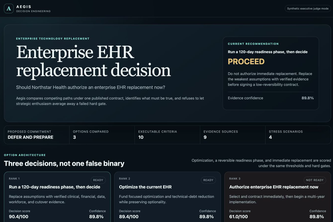
Aegis Decision Engineering is a self-reported decision engineering platform that builds "living Decision Twins" to model, test, and preserve consequential decisions. It applies a five-stage loop (CAPTURE → COMPILE → STRESS → REPAIR → PRESERVE) to evaluate options under hard gates, evidence confidence, and causal dependencies.
What changed
The project evolved from a healthcare-focused hackathon demo into a reusable platform for decision engineering with features like editable Decision Twins, shock engines, repair logic, and decision passports. It was built using GPT-5.6 specialists, FastAPI, Docker, and OpenAI Code Interpreter.
Single most important open question
Is there evidence of traction or adoption beyond the hackathon prototype? The author states intentions and capabilities but does not report any revenue, customers, or usage data.
Note: This analysis is based entirely on the self-reported project description supplied by the caller. No external verification or historical data are available. All claims in this summary are as stated by the author and have not been independently confirmed.
What The Product Actually Is
The description states that Aegis Decision Engineering builds "living, executable Decision Twins" for consequential decisions. These twins contain:
- Competing options
- Claims, assumptions, and evidence
- Weighted criteria and thresholds
- Non-negotiable hard gates
- Causal dependencies
- Fragilities and reversal conditions
- Accountable owners and approval requirements
Aegis applies a five-stage loop: CAPTURE → COMPILE → STRESS → REPAIR → PRESERVE.
The public judge experience is described as a self-contained, credential-free EHR Decision Twin. Judges can edit program budget, expected benefit, enterprise readiness, data-conversion risk, and implementation timeline; Aegis recalculates contract metrics, fragility, scores, disposition, and option ranking live without moving the published thresholds.
It includes:
- A reusable Decision Engineering contract
- A living Decision Twin
- An editable Decision Twin Studio with governed live recalculation
- Multiple-option comparison
- Evidence-confidence scoring
- Hard gates that cannot be averaged away
- Evidence-driven recommendation changes
- A Shock Engine with consequence cascades
- A Repair Engine with owners and thresholds
- An auditable Decision Passport
The system uses:
- Seven bounded GPT-5.6 specialists examining from clinical, privacy, workflow, financial, technology, adoption, and red-team perspectives
- OpenAI Code Interpreter for independent financial verification
- FastAPI application and executive interface
- Codex as primary engineering collaborator
Inference: The product appears to be a hybrid deterministic-generative system designed to model complex decisions with structured logic and AI-assisted reasoning. It is not described as a SaaS platform or marketplace, but rather a decision support tool for governance and risk management.
Positioning & Claim Evolution
The author states that Aegis was built around the question: "What if organizations could stress-test an important decision before reality did?"
Positioning:
- Aims to treat decisions as explicitly modeled, tested, repaired, and preserved.
- Positions itself as a platform for “Decision Engineering” — not just a recommendation engine or chatbot.
- Claims to expose fragile assumptions, stress-test outcomes, and repair weak strategies before organizations commit.
Evolution of claims:
- Started as a healthcare-focused hackathon demo
- Evolved into a reusable Decision Engineering core with multiple-option evaluation, hard gates, evidence-confidence scoring, scenario shocks, repair programs, and an enterprise EHR Decision Twin.
- The author emphasizes that it is not another chat interface wrapped around a recommendation.
Claim: Aegis is positioned as a decision engineering platform for complex, consequential decisions across domains — initially focused on healthcare but with longer-term vision for general use.
Target Customer & ICP
The description states that the initial focus is healthcare because its decisions are expensive, regulated, operationally complex, and sometimes life-affecting. The author also mentions that the longer-term vision is a reusable Decision Engineering platform for any consequential decision that can be expressed through options, evidence, thresholds, risks, and accountable owners.
No specific customer segments or personas are named beyond healthcare organizations making EHR replacement decisions.
Inference: The target customer appears to be large, regulated organizations (especially in healthcare) that make high-stakes, multi-faceted decisions requiring structured governance, risk management, and auditability. The ICP is not clearly defined beyond this initial domain.
Business Model & Pricing Evidence
The description does not provide any information about pricing, revenue models, or monetization strategies.
Not evidenced — no claims or data on business model, pricing tiers, customer acquisition costs, or monetization plans are present.
Technical & Delivery Signals
The system is built using:
- GPT-5.6 specialists
- FastAPI
- Docker
- OpenAI Code Interpreter
- Codex
- Python, JavaScript, HTML5, CSS3
- GitHub, Vercel, Pydantic, pytest, ruff, SDKs
Key technical features include:
- Deterministic layer controlling assessment
- Generative reasoning (GPT-5.6) for investigation and challenge
- Independent verification via Code Interpreter
- Bounded reasoning layers to prevent persuasive output from overriding decision semantics
- Automated tests (46 unit tests, 11 behavioral evaluations)
- Adversarial testing for hard-gate precedence, prompt-like evidence, recommendation integrity, and bypass attempts
Inference: The architecture is described as a hybrid deterministic-ggenerative system with clear separation of logic and reasoning. It includes robust test coverage and adversarial validation.
Traction & Maturity Signals
The description states that the final prototype passed:
- 46 automated tests
- 11 of 11 behavioral evaluations
- Adversarial tests covering hard-gate precedence, prompt-like evidence, recommendation integrity, and attempts to use repair logic to bypass a safety stop.
It also mentions:
- A public demonstration
- A reusable Decision Engineering core
- An enterprise EHR decision pack
- Expansion from a specialized healthcare decision demonstration into a reusable platform
However, there is no mention of:
- Customers or users
- Revenue or monetization
- Product adoption metrics
- Market traction beyond the hackathon submission
Not evidenced — no evidence of real-world usage, customer base, or commercial traction.
Competitive Context
The description does not provide any information about competitors or competitive positioning.
Not evidenced — no mention of existing platforms, tools, or markets for decision engineering or governance systems.
Open Questions & Risks
- No commercial traction or adoption: The project is described as a hackathon prototype with no evidence of real-world use or customers.
- Unverified claims about AI behavior: While the system separates deterministic and generative layers, it relies heavily on GPT-5.6 specialists — whose outputs are not independently verified for consistency or safety in production.
- Limited scope and domain focus: The platform is initially focused only on healthcare; its applicability to other domains remains unproven.
- Self-reported maturity: All claims about testing, validation, and functionality come from the author’s own account — no third-party verification or external audits are mentioned.
- Lack of business model clarity: No indication of how Aegis will generate revenue or scale beyond a prototype.
Inference: The risk is high that this remains a proof-of-concept rather than a viable commercial product, especially without evidence of traction, customers, or monetization strategy.
Questions the description leaves open
- What specific use cases have you identified outside of healthcare?
- How do you plan to scale beyond the current prototype and ensure consistent performance across domains?
- Have you validated the effectiveness of the hard-gate enforcement in real-world scenarios?
- What are your plans for enterprise authentication, data isolation, and compliance?
- How do you intend to monetize this platform? Is there a pricing model or customer acquisition strategy?
- Are there any existing partnerships or pilot programs with organizations using Aegis?
- What is the expected timeline for moving from prototype to production-ready system?
- How do you handle edge cases where assumptions or evidence change over time?
Overall Assessment
Not evidenced — no data on revenue, customers, traction, or financials are available.
Assessment: Based solely on the self-reported description, Aegis Decision Engineering is a conceptually interesting hybrid deterministic-generative system for modeling and stress-testing complex decisions. However, it remains at the prototype stage with no evidence of commercial viability, adoption, or monetization. The author’s claims about functionality, testing, and architecture are not independently verified.
Confidence level: Low — due to lack of external validation, customer data, or financial indicators.
Recommendation: Further diligence required if pursuing investment or partnership. The project needs clear evidence of traction, market demand, and a defined go-to-market strategy before any serious consideration.
User Stories BotA demo video on every pull request
Get a demo video on every new feature
GitHub App that watches your pull requests and records a narrated, captioned demo.
Save time on demo prep and make informed decisions faster with a video walkthrough of every new feature.
Source
Submitted to the OpenAI 2026 hackathon on Devpost. Project home on Devpost. Back to the full gallery on Devpost.
This competitive analysis was produced by top-founders.com (opens in a new tab)
Generated by a language model from this project's public Devpost page — its tagline, the author's own write-up and any built-with tags listed there — as captured in August 2026. Short quotations are the author's words. It is an opinion on the idea as a business, not on the people behind it, and it reflects the description as published then. If the project has moved on, request a correction below. The analysis is not independent research and contains no verified traction, revenue or customer data.
An independent guide by KFG International LLC — not affiliated with, endorsed by, or connected to Devpost or OpenAI.