

Archive position — measured, not model output
0 likes on Devpost
2,263 of the 7,850 archived projects have more likes, and 5,587 share exactly 0 — so this project's #2,342 place in the like-ranked listing is a tie-break inside that group, not a ranking.
Projects (log scale)
Likes on Devpost. ▲ marks this project's group.
Show the figures
| Likes | Projects | Share of archive |
|---|---|---|
| 0 | 5,587 | 71.2% |
| 1 | 1,758 | 22.4% |
| 2 | 284 | 3.6% |
| 3–4 | 132 | 1.7% |
| 5–9 | 75 | 1.0% |
| 10+ | 14 | 0.2% |
 User Stories BotA demo video on every pull request
Get a demo video on every new feature
GitHub App that watches your pull requests and records a narrated, captioned demo.
Save time on demo prep and make informed decisions faster with a video walkthrough of every new feature.
Executive Summary
What the company appears to be
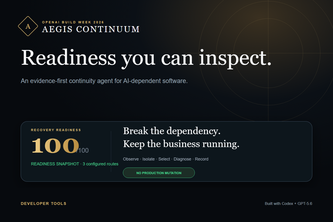
AEGIS CONTINUUM is described as an "evidence-first continuity agent" for platform engineers, SREs, and AI-dependent software teams. It aims to simulate provider outages in a sandboxed environment before production is touched, offering deterministic evidence of recovery paths without risking live systems.
What changed
The project was submitted as part of the OpenAI 2026 hackathon. The author states that it emerged from an operational question: how can a company demonstrate continuity without deliberately breaking production? It represents a self-contained proof-of-concept built during Build Week, with no revenue or customer data.
Single most important open question
Does AEGIS CONTINUUM have any real-world traction or usage beyond its hackathon demo?
What The Product Actually Is
The description states that AEGIS CONTINUUM is:
- An "evidence-first continuity agent" for AI-dependent software.
- Designed to read deployed revision and local provider-circuit configuration.
- To compute a "configuration-readiness score."
- To inject a selected provider outage only inside an isolated sandbox.
- To prove simulated fault isolation without changing production keys or configuration.
- To select a configured fallback route whose local circuit is closed.
- To give deterministic evidence to GPT-5.6 for a bounded four-part diagnosis.
- To record model, provider, duration, residual risk and the production-mutation boundary.
- To record a SHA-256 content-integrity digest over the final recovery record.
Inference The product is described as a sandboxed simulation tool that allows teams to test failover configurations without affecting live systems. It integrates with AI models (GPT-5.6) for diagnosis but does not allow live failovers or changes in production.
Positioning & Claim Evolution
The author states:
- AEGIS CONTINUUM was inspired by the fragility of AI products relying on single providers.
- It addresses a gap between monitoring and actual recovery capability.
- The tool is positioned as an agent for platform engineers, SREs, and teams operating AI-dependent software.
- It claims to offer "deterministic evidence" of recovery paths without touching production.
Inference The positioning suggests AEGIS CONTINUUM is a niche tool aimed at operational resilience in AI-dependent systems. The claim evolution appears to be from a hackathon prototype to a potential vendor-neutral control plane for continuity, though no evidence supports this future direction.
Target Customer & ICP
The description states:
- It targets "platform engineers, SREs and teams operating AI-dependent software."
Inference The target customer is likely technical teams within organizations that rely on AI services (e.g., OpenAI, AWS Bedrock) and need to ensure continuity in case of provider outages.
Business Model & Pricing Evidence
Not evidenced.
Technical & Delivery Signals
The description states:
- Built with Node.js, Express API, Docker, Railway deployment.
- Uses GPT-5.6 for bounded diagnosis.
- Implements a deterministic continuity engine.
- Includes automated tests for continuity, route isolation, token checks, model budgeting, failure handling and evidence sealing.
- Judge interface is isolated from the control center.
- Uses SHA-256 digest for content integrity.
- Judge token cannot reach Control Center or Supabase data.
Inference The technical stack suggests a minimal viable product (MVP) built in a short timeframe. The architecture emphasizes sandboxing and safety boundaries, which may indicate a focus on secure, controlled experimentation.
Traction & Maturity Signals
Not evidenced.
Competitive Context
Not evidenced.
Open Questions & Risks
- The project is described as a hackathon submission with no revenue or customer data.
- It has only one team member (Jean LENO).
- No evidence of real-world usage, adoption or product-market fit.
- The tool is described as a sandboxed simulation, not a live failover system.
- GPT-5.6 is used for diagnosis but not for control or action.
Inference The lack of traction and maturity signals raises questions about whether AEGIS CONTINUUM has moved beyond prototype stage. It may be a proof-of-concept with limited commercial viability.
Questions the description leaves open
- What is the current status of the product beyond the hackathon demo?
- Have any organizations or teams actually used this tool in production or testing environments?
- How does AEGIS CONTINUUM integrate with existing CI/CD or SRE workflows?
- Is there a plan to move beyond sandboxed simulations into live failover capabilities?
- What are the key assumptions about user behavior and adoption that underpin the product vision?
Overall Assessment
Not evidenced.
User Stories BotA demo video on every pull request
Get a demo video on every new feature
GitHub App that watches your pull requests and records a narrated, captioned demo.
Save time on demo prep and make informed decisions faster with a video walkthrough of every new feature.
Source
Submitted to the OpenAI 2026 hackathon on Devpost. Project home on Devpost. Back to the full gallery on Devpost.
This competitive analysis was produced by top-founders.com (opens in a new tab)
Generated by a language model from this project's public Devpost page — its tagline, the author's own write-up and any built-with tags listed there — as captured in August 2026. Short quotations are the author's words. It is an opinion on the idea as a business, not on the people behind it, and it reflects the description as published then. If the project has moved on, request a correction below. The analysis is not independent research and contains no verified traction, revenue or customer data.
An independent guide by KFG International LLC — not affiliated with, endorsed by, or connected to Devpost or OpenAI.