

Archive position — measured, not model output
0 likes on Devpost
2,263 of the 7,850 archived projects have more likes, and 5,587 share exactly 0 — so this project's #4,305 place in the like-ranked listing is a tie-break inside that group, not a ranking.
Projects (log scale)
Likes on Devpost. ▲ marks this project's group.
Show the figures
| Likes | Projects | Share of archive |
|---|---|---|
| 0 | 5,587 | 71.2% |
| 1 | 1,758 | 22.4% |
| 2 | 284 | 3.6% |
| 3–4 | 132 | 1.7% |
| 5–9 | 75 | 1.0% |
| 10+ | 14 | 0.2% |
 User Stories BotA demo video on every pull request
Get a demo video on every new feature
GitHub App that watches your pull requests and records a narrated, captioned demo.
Save time on demo prep and make informed decisions faster with a video walkthrough of every new feature.
Executive Summary
What the company appears to be
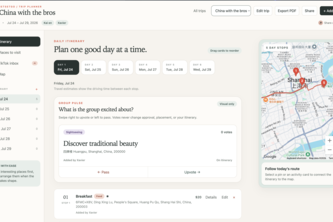
GetSetGO is a self-reported tool that takes TikTok video share links and uses an LLM (Gemini) to extract location information from the video's metadata, then builds a travel itinerary with smart placement based on travel distances.
What changed
The project was submitted as part of the OpenAI 2026 hackathon. It is described as a solo effort by one developer (Vax79 Lee), built over a short timeframe using open-source and free-tier tools.
Single most important open question
Is there any evidence that this tool has traction, revenue or customers beyond the author's personal use case?
What The Product Actually Is
The description states: "Simply, it takes in the share link from the Tiktok video you want to analyse. Information from the video's meta data is then fed into an LLM, which extracts the places listed in the video for the user to review. After which, it is slotted into the itinerary built with smart placement based on travel distances."
- The product takes TikTok share links.
- It uses an LLM (Gemini) to extract location information from video metadata.
- It builds a travel itinerary with smart placement based on travel distances.
Evidence Self-reported by author. No independent verification or demonstration provided.
Positioning & Claim Evolution
The description states: "Have you ever found inspiration of where to travel next on Tiktok. But it takes too much effort to research all the places manually? GREAT NEWS!! GetSetGO is YOUR trusty companion!"
- The product positions itself as a solution for users who find travel inspiration on TikTok but want to avoid manual research.
- It claims to be a "trusty companion" that automates the process of extracting and organizing travel locations from TikTok videos.
Evidence Self-reported. No external validation or market positioning data provided.
Target Customer & ICP
The description states: "I am going on exchange soon and wanted to built a tool that made itinerary planning much easier."
- The author is a student going on exchange, suggesting the target customer is likely students or travelers seeking easy itinerary planning.
- The tool is described as being useful for personal use by the developer.
Evidence Self-reported. No data on actual users or customer segments beyond the author's personal experience.
Business Model & Pricing Evidence
The description states: "With limited finances to fund this project, many of the services I looked to had free tiers, such as google cloud and gemini."
- The tool uses free-tier services like Google Cloud and Gemini.
- No pricing model or monetization strategy is described.
- The author mentions that funding would make the app better, implying no current revenue stream.
Evidence Self-reported. No evidence of pricing, subscriptions, or business model beyond personal use.
Technical & Delivery Signals
The description states:
- "We used React to develop the frontend of the webapp and FastAPI for the backend."
- "Services such as gemini for the LLM and google maps are also part of the system."
- "If given the appropriate amount of resources, this tool would perform significantly better at information extraction."
- Built with React (frontend) and FastAPI (backend).
- Uses Gemini LLM and Google Maps.
- The author notes that performance is limited by current tools and would improve with more resources.
Evidence Self-reported. No evidence of production deployment or scalability beyond a prototype.
Traction & Maturity Signals
The description states:
- "I am proud of the effort I have put in this project working alone for the first time."
- "Thanks to the free openAI credits which supported this apps development, I got to develop a tool that I will definitely use for my travels."
- The author built it solo.
- It was submitted to a hackathon.
- No evidence of users, adoption, or usage beyond the author's personal use.
Evidence Self-reported. No data on traction, customers, or product maturity.
Competitive Context
The description does not provide any information about competitors or market context.
Evidence Not evidenced.
Open Questions & Risks
- The tool is described as a solo project with no external validation.
- It uses free-tier services, suggesting limited scalability or commercial viability.
- No evidence of revenue, customers, or product-market fit beyond the author's personal use case.
- The author explicitly states that funding would make it better — implying lack of current resources or traction.
Evidence Self-reported. No third-party validation or market data provided.
Questions the description leaves open
- What is your actual user base or customer traction beyond personal use?
- How do you plan to monetize this tool if it's currently built on free-tier services?
- Have you validated the demand for this tool with potential users?
- What are the technical limitations of the current implementation, and how do you plan to scale past them?
- Are there any existing competitors or similar tools in the market?
Inference These questions stem from the lack of evidence around traction, monetization, and scalability.
Overall Assessment
The description states that this is a solo project built for personal use during a hackathon. There is no evidence of revenue, customers, or commercial traction beyond the author's own use case.
Evidence Self-reported only. No data on product-market fit, scalability, or business model.
Assessment Not evidenced. This appears to be an early-stage prototype with no demonstrated commercial viability or market traction. The tool is described as personal-use only and built on free-tier services. Any investment or partnership potential would require further evidence of traction, monetization strategy, and product-market fit.
User Stories BotA demo video on every pull request
Get a demo video on every new feature
GitHub App that watches your pull requests and records a narrated, captioned demo.
Save time on demo prep and make informed decisions faster with a video walkthrough of every new feature.
Source
Submitted to the OpenAI 2026 hackathon on Devpost. Project home on Devpost. Back to the full gallery on Devpost.
This competitive analysis was produced by top-founders.com (opens in a new tab)
Generated by a language model from this project's public Devpost page — its tagline, the author's own write-up and any built-with tags listed there — as captured in August 2026. Short quotations are the author's words. It is an opinion on the idea as a business, not on the people behind it, and it reflects the description as published then. If the project has moved on, request a correction below. The analysis is not independent research and contains no verified traction, revenue or customer data.
An independent guide by KFG International LLC — not affiliated with, endorsed by, or connected to Devpost or OpenAI.