

Archive position — measured, not model output
0 likes on Devpost
2,263 of the 7,850 archived projects have more likes, and 5,587 share exactly 0 — so this project's #4,307 place in the like-ranked listing is a tie-break inside that group, not a ranking.
Projects (log scale)
Likes on Devpost. ▲ marks this project's group.
Show the figures
| Likes | Projects | Share of archive |
|---|---|---|
| 0 | 5,587 | 71.2% |
| 1 | 1,758 | 22.4% |
| 2 | 284 | 3.6% |
| 3–4 | 132 | 1.7% |
| 5–9 | 75 | 1.0% |
| 10+ | 14 | 0.2% |
 User Stories BotA demo video on every pull request
Get a demo video on every new feature
GitHub App that watches your pull requests and records a narrated, captioned demo.
Save time on demo prep and make informed decisions faster with a video walkthrough of every new feature.
Executive Summary
What the company appears to be
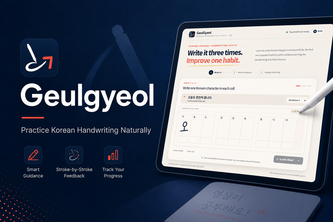
Geulgyeol is a browser-based Korean handwriting practice tool designed for learners of the Korean language. The product allows users to write Hangul characters in individual cells, repeating each sentence three times to enable pattern analysis and targeted feedback. It supports multiple input methods (mouse, touch, digital pen) and emphasizes natural handwriting over perfect font tracing.
What changed
The project was submitted as part of the OpenAI 2026 hackathon. The description reflects a self-reported development effort by one team member, with no evidence of prior traction or commercial activity.
Single most important open question
Is there any indication that this tool has been adopted or used beyond its initial development phase? The lack of user data, revenue, or customer information makes it impossible to assess real-world impact or demand.
What The Product Actually Is
The description states that Geulgyeol is a browser-based Korean handwriting practice tool. It supports mouse, touchscreen, and digital pencil input, and allows users to write Hangul characters within individual practice cells. Users complete the same sentence three times to allow for pattern comparison.
It is built using Next.js, React, TypeScript, HTML5, CSS3, Vite, and Cloudflare, with support for pointer events API and a focus on responsive design.
Inference The tool appears to be a learning aid aimed at improving Korean handwriting through repetition and structured feedback. It does not appear to involve AI-generated coaching or advanced analytics beyond basic stroke tracking.
Positioning & Claim Evolution
The description states that Geulgyeol was created to help Korean learners who can recognize Hangul on screen but feel uncomfortable writing it by hand. It positions itself as an alternative to tools that focus on typing, tracing, or simple correctness checks.
Key claims:
- “Natural handwriting is more personal.”
- “Write it three times. Improve one habit.”
- Focuses on repeated pattern analysis rather than single attempts.
- Aims to preserve the learner’s personal handwriting style while improving readability and balance.
Inference The positioning reflects a shift from traditional language-learning tools toward personalized, behavior-based feedback in handwriting practice.
Target Customer & ICP
The description states that Geulgyeol targets Korean learners, particularly those who can recognize Hangul on screen but struggle with writing it by hand. It is designed for language learners who want to improve their handwriting skills.
There is no evidence of segmentation beyond language level or learner type. No indication of specific demographics, educational institutions, or professional use cases.
Inference The ICP likely includes self-directed learners and students in beginner-to-intermediate stages of Korean language acquisition.
Business Model & Pricing Evidence
The description does not mention any pricing model, monetization strategy, or business model. It is unclear whether the tool will be offered free-of-charge, as a paid service, or through other means.
Inference No evidence exists to determine how the product would generate revenue or if it has a defined monetization path.
Technical & Delivery Signals
The project was built using modern web technologies including:
- Next.js
- React
- TypeScript
- HTML5 / CSS3
- Vite
- Cloudflare
It uses the pointer-events API and captures handwriting data as sequences of coordinates, including stroke order, direction, timing, and character structure.
The interface is described as:
- Simple
- Calm
- Focused on one sentence, one task, and one improvement goal at a time
Inference The tool is technically feasible and built with current web standards. It shows attention to user experience and input normalization across devices.
Traction & Maturity Signals
There is no evidence of traction, such as:
- Users
- Revenue
- Customers
- Adoption metrics
- Product usage data
- Market validation
The project was submitted to a hackathon, indicating it is in an early development or prototype stage. No mention of launch, distribution, or growth.
Inference The product has not yet reached a market-facing maturity level.
Competitive Context
The description does not reference any competitors or existing tools in the Korean handwriting practice space. It implies that current tools do not adequately support natural handwriting feedback or repeated pattern analysis.
Inference There is no evidence of competitive landscape, but the tool may address gaps in existing language-learning platforms focused on typing or font tracing.
Open Questions & Risks
- No traction or user data: The product has no demonstrated adoption or usage.
- Single developer team: Limited capacity for scaling or iteration.
- Unproven business model: No indication of how the tool will be monetized or distributed.
- Limited scope: The tool is described as a prototype, not a full-fledged product.
- No external validation: No third-party reviews, partnerships, or endorsements.
Inference The risk of failure is high without evidence of market demand, user engagement, or sustainable growth potential.
Questions the description leaves open
- Has the tool been tested with actual Korean learners? If so, what were the results?
- Are there any plans to integrate with educational institutions or language learning platforms?
- What is the intended monetization strategy for Geulgyeol?
- How does the tool plan to scale beyond a single developer?
- Is there any interest from teachers or language schools in using this tool?
- What are the long-term goals for the product, and how do they align with current user needs?
Overall Assessment
Not evidenced.
There is no evidence of revenue, customers, traction, or a clear path to monetization. The project appears to be an early-stage prototype submitted to a hackathon, with no indication of commercial viability or market readiness.
Confidence level Low
Risk rating
High
This tool may have potential as a learning aid, but there is no evidence that it has moved beyond the idea or prototype stage. Any investment or partnership decision should be based on further validation and demonstration of real-world use.
User Stories BotA demo video on every pull request
Get a demo video on every new feature
GitHub App that watches your pull requests and records a narrated, captioned demo.
Save time on demo prep and make informed decisions faster with a video walkthrough of every new feature.
Source
Submitted to the OpenAI 2026 hackathon on Devpost. Project home on Devpost. Back to the full gallery on Devpost.
This competitive analysis was produced by top-founders.com (opens in a new tab)
Generated by a language model from this project's public Devpost page — its tagline, the author's own write-up and any built-with tags listed there — as captured in August 2026. Short quotations are the author's words. It is an opinion on the idea as a business, not on the people behind it, and it reflects the description as published then. If the project has moved on, request a correction below. The analysis is not independent research and contains no verified traction, revenue or customer data.
An independent guide by KFG International LLC — not affiliated with, endorsed by, or connected to Devpost or OpenAI.