

Archive position — measured, not model output
0 likes on Devpost
2,263 of the 7,850 archived projects have more likes, and 5,587 share exactly 0 — so this project's #6,270 place in the like-ranked listing is a tie-break inside that group, not a ranking.
Projects (log scale)
Likes on Devpost. ▲ marks this project's group.
Show the figures
| Likes | Projects | Share of archive |
|---|---|---|
| 0 | 5,587 | 71.2% |
| 1 | 1,758 | 22.4% |
| 2 | 284 | 3.6% |
| 3–4 | 132 | 1.7% |
| 5–9 | 75 | 1.0% |
| 10+ | 14 | 0.2% |
 User Stories BotA demo video on every pull request
Get a demo video on every new feature
GitHub App that watches your pull requests and records a narrated, captioned demo.
Save time on demo prep and make informed decisions faster with a video walkthrough of every new feature.
Executive Summary
What the company appears to be
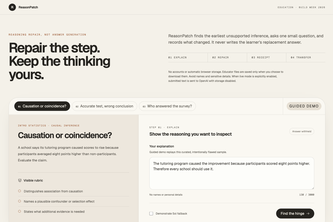
ReasonPatch is a self-reported educational tool designed to help learners identify and repair early unsupported inferences in their reasoning, particularly in statistics education. It uses AI models (GPT-5.6 Sol and Luna) to guide learners through a structured four-step process: Explain → Repair → Receipt → Transfer. The system emphasizes preserving learner authorship, making repairs inspectable, and testing reasoning in new contexts without pretending it is learning.
What changed
The project emerged from an educational hackathon submission, with no evidence of prior traction or commercialization. It is described as a prototype built using AI tools like OpenAI’s GPT models, Next.js, React, and TypeScript. The author states that the product was developed in a single-person team over a short timeframe (likely a hackathon), and it does not yet claim any validated learning outcomes.
Single most important open question
Is there evidence of real-world adoption or educator interest beyond the self-reported prototype? The description makes no claims about revenue, customers, or usage outside of the demo environment.
What The Product Actually Is
The description states that ReasonPatch is a four-step reasoning-repair studio for statistics education. It consists of:
- Explain: Learner submits a short explanation against a visible rubric.
- Repair: GPT-5.6 Sol identifies the earliest unsupported inference; three role-separated GPT-5.6 Luna probes inspect counterexamples, hidden assumptions, and rubric evidence in parallel.
- Receipt: The learner revises in their own words. A printable Repair Receipt binds every claimed improvement to exact submitted text.
- Transfer: The diagnosis, question, rubric, and receipt disappear. Learner applies the same reasoning to an isolated fresh case and receives a separate Transfer Slip based only on that new response.
The system is described as intentionally role-separated, with model storage disabled, and uses structured outputs and schema validation for each AI interaction.
Inference The product is a structured feedback loop designed to improve reasoning by focusing on the earliest unsupported inference in learner explanations.
Positioning & Claim Evolution
The author states that ReasonPatch targets “the hinge” — the earliest unsupported inference — rather than the whole essay. It focuses on repairing reasoning, not just generating answers.
It positions itself as a tool for educators to preserve learner authorship while creating an auditable chain of evidence. The system avoids labeling responses as mastery or learning outcomes, instead presenting only raw evidence and transfer performance.
The product is described as different from traditional AI tutors because it:
- Withholds the answer.
- Makes repairs inspectable.
- Checks reasoning in a new context without pretending it is learning.
Inference ReasonPatch positions itself as a reasoning-focused feedback tool, not a learning assistant or tutor, with an emphasis on transparency and auditability over performance claims.
Target Customer & ICP
The description states that the product is designed for educators and learners in introductory statistics education, particularly those dealing with causal interpretation, base-rate reasoning, and sampling bias.
It mentions that it was tested in a 1,470-student, 33-institution assessment, but does not state whether these are actual users or just test subjects. The product is described as being built for educators who want to audit reasoning, not for learners directly.
Inference The primary user is likely educators or instructional designers in higher education or K-12 settings, using it to assess and improve student reasoning skills.
Business Model & Pricing Evidence
There is no evidence of a business model or pricing structure. The description does not mention any monetization strategy, subscription plans, or customer acquisition methods.
The product is described as a public demo hosted on Vercel (reasonpatch.vercel.app) and includes a public GitHub repository (github.com/FusionCube18712/reasonpatch). It is not presented as a commercial product or service.
Inference No business model or pricing evidence is provided. The system appears to be a prototype, not a commercial offering.
Technical & Delivery Signals
The project is built using:
- Next.js 16, React 19, TypeScript, Tailwind CSS
- OpenAI JavaScript SDK, Responses Structured Outputs
- Vitest, Playwright, axe-core
- Codex for development and testing
- Role-separated orchestration: Sol (planning/synthesis), Luna (parallel probes)
- Schema validation, evidence checks, and fallback behavior
The system is described as:
- Intentionally role-separated.
- Using strict schema validation for all model outputs.
- Disabling model storage.
- Recording role, model, status, latency, and fallback reason for every probe.
Inference The technical architecture shows a high degree of control over AI interactions, with emphasis on transparency, auditability, and structured output. It is built as a secure, traceable feedback system.
Traction & Maturity Signals
The description states that the product was developed in a single-person team (Jiazhen Pan) and submitted to a hackathon. There is no evidence of:
- Revenue
- Customers
- Usage metrics
- Product adoption
- Market traction
It includes:
- A 79-case calibration set
- 125+ automated tests
- Desktop/mobile browser checks
- Accessibility checks
- A public demo that completes the judge path in about 90 seconds
Inference The product is a prototype, not a mature or commercialized offering. It has no demonstrated traction or adoption beyond its own demo.
Competitive Context
The description does not mention any direct competitors. However, it implies a space of:
- AI tutoring tools
- Educational reasoning feedback systems
- Tools for assessing and improving student thinking
It is positioned as distinct from traditional AI tutors by withholding answers and focusing on repair rather than generation.
Inference ReasonPatch operates in a nascent or underserved segment of educational AI, where tools focus on reasoning rather than content delivery. No direct competitors are named or described.
Open Questions & Risks
- No evidence of real-world usage or adoption: The product is described as a prototype with no customer base.
- No validated learning outcomes: The authors explicitly state that the system does not claim improved learning, retention, grades, or workload.
- Single-person team: Limited development and scaling capacity.
- Highly technical and niche use case: Focused on statistics education and reasoning repair, which may limit market appeal.
- Unproven educational impact: The demo is a proof-of-concept, not a validated tool.
Inference The product is high-risk for commercialization or investment without further validation of its utility in real-world settings.
Questions the description leaves open
- What specific feedback have educators provided about the prototype?
- Are there any plans to pilot the system with actual students or teachers?
- How does the system handle edge cases where learners do not engage with the repair process?
- Is there a plan to scale beyond the current demo, and what would that look like?
- What are the long-term goals for the product — is it intended to be a commercial tool or an open-source project?
Overall Assessment
Not evidenced.
The description provides no information about:
- Revenue
- Customers
- Traction
- Valuation
- Funding history
- Market size or competitive positioning beyond self-reporting
This is a self-reported prototype, not a commercial product, and the authors explicitly state that it does not yet claim learning outcomes.
Inference There is no evidence to support an investment or partnership decision at this time. The project is in a pre-commercial phase, with no demonstrated market traction or validated impact.
User Stories BotA demo video on every pull request
Get a demo video on every new feature
GitHub App that watches your pull requests and records a narrated, captioned demo.
Save time on demo prep and make informed decisions faster with a video walkthrough of every new feature.
Source
Submitted to the OpenAI 2026 hackathon on Devpost. Project home on Devpost. Back to the full gallery on Devpost.
This competitive analysis was produced by top-founders.com (opens in a new tab)
Generated by a language model from this project's public Devpost page — its tagline, the author's own write-up and any built-with tags listed there — as captured in August 2026. Short quotations are the author's words. It is an opinion on the idea as a business, not on the people behind it, and it reflects the description as published then. If the project has moved on, request a correction below. The analysis is not independent research and contains no verified traction, revenue or customer data.
An independent guide by KFG International LLC — not affiliated with, endorsed by, or connected to Devpost or OpenAI.