

Archive position — measured, not model output
0 likes on Devpost
2,263 of the 7,850 archived projects have more likes, and 5,587 share exactly 0 — so this project's #6,271 place in the like-ranked listing is a tie-break inside that group, not a ranking.
Projects (log scale)
Likes on Devpost. ▲ marks this project's group.
Show the figures
| Likes | Projects | Share of archive |
|---|---|---|
| 0 | 5,587 | 71.2% |
| 1 | 1,758 | 22.4% |
| 2 | 284 | 3.6% |
| 3–4 | 132 | 1.7% |
| 5–9 | 75 | 1.0% |
| 10+ | 14 | 0.2% |
 User Stories BotA demo video on every pull request
Get a demo video on every new feature
GitHub App that watches your pull requests and records a narrated, captioned demo.
Save time on demo prep and make informed decisions faster with a video walkthrough of every new feature.
Executive Summary
What the company appears to be
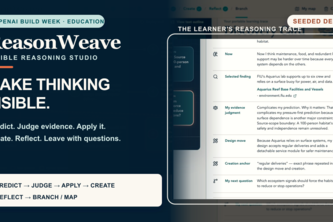
ReasonWeave is a self-reported educational tool for high-school and college learners (age 13+) that uses generative AI to structure reasoning processes around one curiosity. It is not a chatbot, homework writer, or grading system. The product guides users through a finite loop of stages: Spark → Choose → Predict → Investigate → Create → Reflect → Branch.
What changed
The author states this is a prototype built for the OpenAI 2026 hackathon. It includes a seeded-only demo and limited live evaluation with synthetic topics. No production deployment or user base is evidenced.
Single most important open question
Is there evidence that the described reasoning loop improves learning outcomes, or does it merely structure an experience that may not be educational in practice?
Analysis basis: Self-reported project description from author; no independent verification, revenue, customers, or traction data available. All claims are stated by the author and not independently confirmed.
What The Product Actually Is
The description states:
- ReasonWeave is a "finite studio for practicing agency around one real curiosity."
- It follows a defined loop of stages: Spark → Choose → Predict → Investigate → Create → Reflect → Branch.
- In configured live mode, GPT-5.6 and OpenAI web search are used to create an “Evidence Lens” that keeps evidence, inference, and open questions distinct.
- The learner must commit to a prediction before seeing evidence.
- Evidence is sourced from web searches and must be associated with URLs returned by the search.
- The final output is a "Curiosity Map" and a "Discovery Card" in Markdown format.
Inference: The product appears to be an AI-assisted educational interface designed to guide learners through structured inquiry, not to generate content or automate learning.
Positioning & Claim Evolution
The description states:
- ReasonWeave is for “independent high-school and college learners age 13 and older.”
- It is not a chatbot, homework writer, grading tool, or learner-profiling system.
- It aims to preserve learner agency by structuring the process so that prediction precedes explanation, evidence is not conflated with inference, and reflection records before-and-after models.
- The result is a “portable trace” of what the learner chose, thought, evaluated, made, changed, and still wonders.
Claim: The tool is positioned as an educational experience that structures reasoning, not as a content generator or assessment tool.
Inference: It is a learning scaffold, not a learning outcome.
Target Customer & ICP
The description states:
- Target users are “independent high-school and college learners age 13 and older.”
- The product is for “learners who are curious” and want to practice agency in inquiry.
- No explicit mention of educators, institutions, or LMS integration.
Inference: The ICP is self-directed learners with curiosity, not institutional users or teachers.
Business Model & Pricing Evidence
The description states:
- There is no pricing model described.
- The public deployment runs in seeded-only mode; live generation is disabled.
- No mention of accounts, subscriptions, or monetization strategies.
- The authors state that “accounts, grades, LMS features, analytics, and learner profiling remain intentional non-goals.”
Claim: No business model or pricing strategy is evident.
Technical & Delivery Signals
The description states:
- Built with Next.js, React, TypeScript, Zod, OpenAI Responses API, Structured Outputs, OpenAI web search, and OpenAI moderation.
- GPT-5.6 has four defined roles in live mode: propose routes, turn route into quest, synthesize evidence, provide reflection feedback and next questions.
- The application enforces rules via schemas and stage-specific logic; no model owns state transitions or provenance.
- A seeded-only demo is deployed with deterministic fixtures and test coverage (46 test files / 634 unit tests, 145/145 fixture checks).
- The interface is keyboard operable and accessible.
Inference: The product is built with a focus on determinism, safety, and accessibility. It uses structured outputs to enforce design constraints.
Traction & Maturity Signals
The description states:
- This is a prototype for the OpenAI 2026 hackathon.
- A limited local evaluation was run on two synthetic topics with a test-only GPT-5.6 override.
- The result shows that 126/126 checks passed, and sources like NOAA, CDC, PubMed, and NINDS were manually reviewed.
- No live deployment or user feedback is mentioned.
- No production usage, customer data, or adoption metrics are provided.
Claim: No traction or maturity beyond a hackathon prototype.
Competitive Context
The description states:
- ReasonWeave is not positioned as a chatbot, homework writer, or grading tool.
- It does not compete directly with AI tutoring systems or LMS platforms.
- The product is described as a “studio” rather than an AI assistant or content generator.
Inference: The competitive space is undefined in the description; it seems to be a niche educational experience, not a mainstream AI tool.
Open Questions & Risks
The description states:
- Live mode is disabled in public deployment.
- No live model behavior has been generalized or tested broadly.
- The prototype was evaluated only on synthetic topics and with limited test cases.
- No evidence of educational efficacy, user feedback, or adoption.
Open questions:
- Lack of real-world testing or user data.
- Prototype-only deployment with no production use.
- No indication of how the tool would scale or be adopted in real classrooms.
Questions the description leaves open
- What evidence supports the claim that this reasoning loop improves learning outcomes?
- How does the team plan to validate the educational efficacy of the tool beyond synthetic testing?
- Are there any plans for live deployment, and what controls will be in place for moderation and user safety?
- What are the long-term goals for scaling or monetizing this product?
- Has the team considered how to integrate feedback from educators or learners?
Overall Assessment
The description states:
- This is a hackathon prototype with no production deployment, revenue, or customer data.
- The tool is not yet in use by learners or institutions.
- No business model or monetization strategy is evident.
Assessment: Not ready for investment or partnership.
Confidence: Low — the description is self-reported and lacks evidence of traction, adoption, or commercial viability.
Inference: The product shows potential as a learning scaffold but has not demonstrated real-world utility or scalability.
User Stories BotA demo video on every pull request
Get a demo video on every new feature
GitHub App that watches your pull requests and records a narrated, captioned demo.
Save time on demo prep and make informed decisions faster with a video walkthrough of every new feature.
Source
Submitted to the OpenAI 2026 hackathon on Devpost. Project home on Devpost. Back to the full gallery on Devpost.
This competitive analysis was produced by top-founders.com (opens in a new tab)
Generated by a language model from this project's public Devpost page — its tagline, the author's own write-up and any built-with tags listed there — as captured in August 2026. Short quotations are the author's words. It is an opinion on the idea as a business, not on the people behind it, and it reflects the description as published then. If the project has moved on, request a correction below. The analysis is not independent research and contains no verified traction, revenue or customer data.
An independent guide by KFG International LLC — not affiliated with, endorsed by, or connected to Devpost or OpenAI.