

Archive position — measured, not model output
2 likes on Devpost
221 of the 7,850 archived projects have more likes, and 284 share exactly 2 — so this project's #384 place in the like-ranked listing is a tie-break inside that group, not a ranking.
Projects (log scale)
Likes on Devpost. ▲ marks this project's group.
Show the figures
| Likes | Projects | Share of archive |
|---|---|---|
| 0 | 5,587 | 71.2% |
| 1 | 1,758 | 22.4% |
| 2 | 284 | 3.6% |
| 3–4 | 132 | 1.7% |
| 5–9 | 75 | 1.0% |
| 10+ | 14 | 0.2% |
 User Stories BotA demo video on every pull request
Get a demo video on every new feature
GitHub App that watches your pull requests and records a narrated, captioned demo.
Save time on demo prep and make informed decisions faster with a video walkthrough of every new feature.
Executive Summary
MatrixAI – Local-First AI Engineering Workspace is a self-reported developer tool built by one person (Bohdi Flint) for use in local AI-assisted software development. The project claims to offer a workspace that understands repositories, organizes engineering context, and supports local AI while keeping developers in control of their data. It integrates with Ollama and optionally OpenAI or other cloud providers. The product is described as having reached a functional state with repository intelligence, guided first contact, and UI workflows, but no evidence of revenue, customers, or traction is provided.
The single most important open question is: What level of actual developer adoption or usage exists for this tool, and how does it compare to existing AI development tools in the market?
What The Product Actually Is
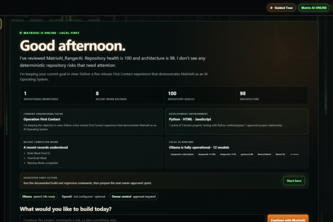
The description states that MatrixAI is a "local-first AI engineering workspace". It analyzes repositories, builds engineering context, summarizes project health, organizes development information, and integrates local AI through Ollama. It also supports optional cloud AI integration but does not require it.
It was built using OpenAI Codex with GPT-5.6, and technologies include FastAPI, Python, JavaScript, HTML, CSS, Git, and PyWebview.
The product is described as being developed iteratively over a Build Week, and includes features like repository-aware conversations, engineering summaries, and validated UI workflows.
Positioning & Claim Evolution
The author positions MatrixAI as an AI workspace that starts with engineering context rather than a blank prompt. It emphasizes local-first principles, keeping developers in control of their repositories and data. The tool is described as being designed to feel useful before the first prompt is entered, and to make local AI the primary experience while keeping cloud providers optional.
The claim evolution shows a focus on developer autonomy and local AI integration over cloud-based solutions, with an emphasis on understanding repository context and organizing engineering information.
Target Customer & ICP
Not evidenced. The description does not specify target customer segments or ideal customer profiles (ICP). It only states that the tool is for developers working in software development environments.
Business Model & Pricing Evidence
Not evidenced. There is no mention of pricing, monetization strategy, or business model in the provided description.
Technical & Delivery Signals
The project was built using OpenAI Codex with GPT-5.6 and includes technologies such as FastAPI, Python, JavaScript, HTML, CSS, Git, and PyWebview. It integrates with Ollama for local AI capabilities and optionally with cloud providers like OpenAI.
It is described as having reached a functional state with repository intelligence, guided first contact, UI workflows, and repository-aware conversations.
Traction & Maturity Signals
Not evidenced. No evidence of revenue, customers, user base, or adoption metrics is provided in the description. The project is described as being developed by one person over a Build Week, but no data on usage or traction is included.
Competitive Context
Not evidenced. There is no mention of competitors or how MatrixAI compares to existing tools in the market for AI-assisted development or local-first AI workspaces.
Open Questions & Risks
- Single-person team: The entire project is attributed to one individual, which raises questions about scalability and long-term maintenance.
- No traction evidence: No data on users, customers, or revenue is provided, making it difficult to assess commercial viability.
- Unverified claims: All statements are self-reported and unverified; there is no independent validation of the product’s functionality or performance.
- Limited scope: The project appears to be in early development stages, with no indication of broader market readiness or integration capabilities.
Questions the description leaves open
- What specific use cases have you identified for MatrixAI, and how do they align with current developer workflows?
- How does MatrixAI differ from existing tools like GitHub Copilot or local AI solutions such as Ollama in terms of functionality and value proposition?
- Have you conducted any user testing or gathered feedback from developers who have tried the tool?
- What is your roadmap for expanding beyond the current features, particularly around voice interaction and persistent engineering memory?
- How do you plan to monetize this product if it continues to develop?
Overall Assessment
Not evidenced. There is no information available regarding investment interest, partnership opportunities, or commercial viability beyond the self-reported project description. The lack of traction data, revenue, or customer evidence makes it difficult to assess whether this represents a viable opportunity for investment or strategic partnership.
User Stories BotA demo video on every pull request
Get a demo video on every new feature
GitHub App that watches your pull requests and records a narrated, captioned demo.
Save time on demo prep and make informed decisions faster with a video walkthrough of every new feature.
Source
Submitted to the OpenAI 2026 hackathon on Devpost. Project home on Devpost. Back to the full gallery on Devpost.
This competitive analysis was produced by top-founders.com (opens in a new tab)
Generated by a language model from this project's public Devpost page — its tagline, the author's own write-up and any built-with tags listed there — as captured in August 2026. Short quotations are the author's words. It is an opinion on the idea as a business, not on the people behind it, and it reflects the description as published then. If the project has moved on, request a correction below. The analysis is not independent research and contains no verified traction, revenue or customer data.
An independent guide by KFG International LLC — not affiliated with, endorsed by, or connected to Devpost or OpenAI.