

Archive position — measured, not model output
2 likes on Devpost
221 of the 7,850 archived projects have more likes, and 284 share exactly 2 — so this project's #386 place in the like-ranked listing is a tie-break inside that group, not a ranking.
Projects (log scale)
Likes on Devpost. ▲ marks this project's group.
Show the figures
| Likes | Projects | Share of archive |
|---|---|---|
| 0 | 5,587 | 71.2% |
| 1 | 1,758 | 22.4% |
| 2 | 284 | 3.6% |
| 3–4 | 132 | 1.7% |
| 5–9 | 75 | 1.0% |
| 10+ | 14 | 0.2% |
 User Stories BotA demo video on every pull request
Get a demo video on every new feature
GitHub App that watches your pull requests and records a narrated, captioned demo.
Save time on demo prep and make informed decisions faster with a video walkthrough of every new feature.
Executive Summary
What the company appears to be
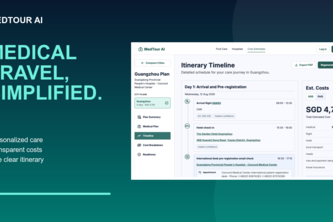
MedTour AI, as described by its authors, is a web-based platform designed to help international patients plan an end-to-end medical journey to China. It combines healthcare decision-making with travel logistics, using both deterministic and AI-powered planning engines.
What changed
The project was submitted as part of the OpenAI 2026 hackathon. The description indicates it is a prototype built in a short timeframe, with no evidence of commercial traction or revenue generation.
Single most important open question
Is there any evidence that MedTour AI has begun to attract users or partners who could validate its utility beyond the prototype stage?
Note: This analysis is based solely on the self-reported project description provided by the authors. No external verification, historical data, or third-party sources are available.
What The Product Actually Is
The description states that MedTour AI is a web application that helps international patients plan a medical journey to China. It allows users to input their medical needs, budget, travel preferences, and other details, then generates a structured plan including:
- Hospital recommendations
- Cost estimates
- Travel logistics (flights, accommodation)
- Insurance considerations
- Timeline and checklist guidance
It uses two planning engines:
- A deterministic local planner for reliability
- An AI-powered multi-agent workflow using tools like Google ADK, LiteLLM, and OpenAI models
The system outputs structured reports in formats such as PDFs, with features like plan snapshots and schema validation.
Claim: MedTour AI is a web-based platform that integrates medical planning with travel logistics.
Evidence: The project write-up explicitly describes how the product works and what it offers.
Positioning & Claim Evolution
The authors position MedTour AI as more than a hospital directory or basic chatbot. They claim it transforms complex, high-stakes decisions into actionable plans that connect healthcare choices with practical travel details.
They emphasize:
- The complexity of medical tourism (not just cost comparison)
- The integration of multiple domains: medicine, insurance, travel, and logistics
- A shift from information aggregation to personalized planning
Claim: MedTour AI is positioned as a comprehensive planning tool for international patients seeking treatment in China.
Evidence: The write-up highlights the platform’s attempt to go beyond simple listings or chatbots.
Target Customer & ICP
The description states that MedTour AI targets international patients who are considering medical treatment in China. These users have:
- Medical needs requiring specialized care
- Budget constraints
- Travel preferences and requirements
- Need for coordination across hospitals, insurance, flights, and accommodation
It does not specify a narrow customer segment beyond "international patients" or indicate whether the platform is targeting specific nationalities or types of treatments.
Claim: The target customer is international patients seeking medical care in China.
Evidence: The inspiration section and product description both refer to this user group.
Business Model & Pricing Evidence
There is no mention of pricing, monetization strategy, or business model in the provided description. The authors do not describe how they intend to generate revenue from the platform.
Claim: No evidence of a defined business model or pricing structure.
Evidence: The project write-up does not include any details about monetization or pricing.
Technical & Delivery Signals
The platform is built as a web application with:
- Lightweight frontend
- FastAPI backend
- Multi-agent AI workflow using Google ADK, LiteLLM, and OpenAI models
- Pydantic schemas for validation
- Browser-side plan snapshots for stateless deployment
It supports both deterministic and AI-powered planning engines, with fallback mechanisms when AI fails.
Claim: MedTour AI uses a hybrid architecture combining AI and deterministic planning.
Evidence: The write-up describes the dual planning engines and technical stack used.
Traction & Maturity Signals
There is no evidence of traction or maturity beyond the prototype stage. The project was submitted to a hackathon, and there are no references to:
- Users
- Customers
- Revenue
- Product usage metrics
- Market adoption
Claim: No evidence of traction or product maturity.
Evidence: The description focuses on development and prototype features only.
Competitive Context
The description does not mention competitors or provide context about the broader market for medical tourism platforms or AI-driven planning tools. It does not reference existing solutions in this space.
Claim: No competitive landscape information provided.
Evidence: The project write-up lacks any discussion of competition or market positioning.
Open Questions & Risks
Several risks and open questions are evident from the description:
- The platform is a prototype, with no commercial traction
- Reliance on AI for planning introduces uncertainty in reliability and consistency
- No mention of regulatory compliance or data privacy safeguards
- No evidence of integration with real-world data sources (hospitals, insurers, etc.)
- Lack of clear monetization strategy
Claim: Risks include lack of traction, AI unreliability, and unclear commercial viability.
Evidence: The description highlights prototype status, AI challenges, and absence of business model.
Questions the description leaves open
- What is the current stage of development beyond the hackathon prototype?
- Have you begun testing with actual users or potential partners in the medical tourism space?
- How do you plan to integrate real-time data from hospitals, insurers, and travel providers?
- What are your thoughts on regulatory compliance and data privacy in international healthcare contexts?
- Are there any early partnerships or pilot programs underway?
- How do you intend to monetize this platform, and what is your go-to-market strategy?
Inference: These questions aim to uncover whether the project has moved beyond prototype status and into a viable business model.
Overall Assessment
There is no evidence of commercial traction, revenue, or customer adoption. The project is described as a hackathon submission with no indication of market validation or scalability.
Claim: MedTour AI appears to be an early-stage prototype with no demonstrated commercial viability.
Evidence: The description is limited to the development process and lacks any signs of product-market fit or monetization strategy.
User Stories BotA demo video on every pull request
Get a demo video on every new feature
GitHub App that watches your pull requests and records a narrated, captioned demo.
Save time on demo prep and make informed decisions faster with a video walkthrough of every new feature.
Source
Submitted to the OpenAI 2026 hackathon on Devpost. Project home on Devpost. Back to the full gallery on Devpost.
This competitive analysis was produced by top-founders.com (opens in a new tab)
Generated by a language model from this project's public Devpost page — its tagline, the author's own write-up and any built-with tags listed there — as captured in August 2026. Short quotations are the author's words. It is an opinion on the idea as a business, not on the people behind it, and it reflects the description as published then. If the project has moved on, request a correction below. The analysis is not independent research and contains no verified traction, revenue or customer data.
An independent guide by KFG International LLC — not affiliated with, endorsed by, or connected to Devpost or OpenAI.