

Archive position — measured, not model output
2 likes on Devpost
221 of the 7,850 archived projects have more likes, and 284 share exactly 2 — so this project's #388 place in the like-ranked listing is a tie-break inside that group, not a ranking.
Projects (log scale)
Likes on Devpost. ▲ marks this project's group.
Show the figures
| Likes | Projects | Share of archive |
|---|---|---|
| 0 | 5,587 | 71.2% |
| 1 | 1,758 | 22.4% |
| 2 | 284 | 3.6% |
| 3–4 | 132 | 1.7% |
| 5–9 | 75 | 1.0% |
| 10+ | 14 | 0.2% |
 User Stories BotA demo video on every pull request
Get a demo video on every new feature
GitHub App that watches your pull requests and records a narrated, captioned demo.
Save time on demo prep and make informed decisions faster with a video walkthrough of every new feature.
Executive Summary
What the company appears to be
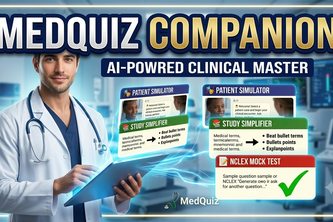
MedQuiz Companion is a self-reported AI-powered educational platform for medical and nursing students. The project describes itself as an interactive learning workspace with three core modules: a clinical patient simulator, a text simplification tool, and an NCLEX mock test generator.
What changed
This is a hackathon submission (submitted to the OpenAI 2026 hackathon), indicating that it is in early development. It was built using Flask, Python, JavaScript, Bootstrap, and OpenAI APIs, with no evidence of revenue, customers, or production use beyond the author’s own claims.
Single most important open question
Is there any evidence of actual user adoption, traction, or commercial viability beyond the self-reported project description?
What The Product Actually Is
The description states that MedQuiz Companion is a production-ready educational workspace with three modules:
- Patient Simulator: A clinical roleplay engine for practicing history-taking with virtual patients.
- Study Simplifier: A tool to convert complex medical texts into bullet points and mnemonics.
- NCLEX Mock Test: A test generator that provides scenario-based questions with detailed rationales.
It is built using:
- Backend: Python 3.11, Flask Blueprints
- AI Orchestration: OpenAI API with custom system prompts
- Frontend: Bootstrap 5 and JavaScript Fetch API
- Deployment: Replit Secrets management
Inference: The product is described as modular and full-stack, but no evidence of live deployment or usage exists.
Positioning & Claim Evolution
The author positions MedQuiz Companion as a safe, interactive, AI-driven workspace for medical students to practice clinical skills and prepare for board exams like the NCLEX.
Key claims:
- It bridges the gap between dense medical literature and student learning.
- Provides a risk-free environment for practicing history-taking.
- Offers high-yield, scenario-based test preparation with detailed explanations.
Inference: The positioning is focused on student education, especially for preparation for global board exams, but no evidence of market validation or competitive differentiation exists.
Target Customer & ICP
The description states that the target customer is:
- Medical and nursing students
- Specifically those preparing for global board exams like the NCLEX
No further segmentation or customer persona details are provided.
Inference: The ICP appears to be healthcare students in exam preparation, but no evidence of actual users, cohorts, or market size is presented.
Business Model & Pricing Evidence
The description does not provide any information about:
- Revenue model
- Pricing strategy
- Monetization approach
- Subscription plans or freemium structure
Not evidenced: No commercial or financial details are included in the self-reported description.
Technical & Delivery Signals
The project is built with:
- Backend: Flask, Python 3.11
- Frontend: Bootstrap 5, JavaScript Fetch API
- AI Integration: OpenAI GPT models via API
- Deployment: Replit Secrets, native Flask engine on port 8080
- Security: Environment variables, no hardcoded keys
Challenges mentioned:
- Prompt engineering for multi-turn dialogues
- Deployment proxy conflicts resolved through debugging and configuration
Inference: The technical stack is standard for a small-scale educational tool. No evidence of scalability or production-grade infrastructure.
Traction & Maturity Signals
The description states that this is a hackathon submission, built in a short timeframe, with no mention of:
- Users
- Customers
- Revenue
- Product usage metrics
- Market traction
- Product maturity beyond prototype stage
Not evidenced: No evidence of traction or product-market fit.
Competitive Context
The description does not include any information about:
- Competitors
- Market landscape
- Differentiation from existing tools in medical education or simulation platforms
Not evidenced: No competitive analysis or positioning relative to other tools is provided.
Open Questions & Risks
- No commercial evidence: The project is a hackathon submission with no revenue, customers, or adoption.
- Unverified claims: All features and capabilities are self-reported without independent validation.
- Limited team size: Only two team members (both MDs) may limit execution capacity.
- AI dependency risks: Heavy reliance on OpenAI APIs introduces potential cost and availability risks.
- No scalability or infrastructure evidence: Deployment is described as basic, with no mention of cloud or production-grade systems.
Inference: The project lacks commercial viability indicators and is likely in early prototype phase.
Questions the description leaves open
- What specific clinical workflows or learning outcomes are you targeting?
- How do you plan to validate the accuracy and educational value of AI-generated content?
- Are there any existing partnerships with medical schools or institutions?
- What is your go-to-market strategy for reaching students?
- Have you tested the platform with actual users (e.g., students or educators)?
- What are the key assumptions underlying the product’s design and functionality?
Overall Assessment
Not evidenced: No data on commercial traction, revenue, or user adoption is provided.
Confidence level: Low — this is a self-reported hackathon project with no evidence of real-world use or business model.
Assessment: The project appears to be an early-stage prototype with strong technical execution but no demonstrated product-market fit or commercial viability. It is not ready for investment or partnership without further validation and traction.
User Stories BotA demo video on every pull request
Get a demo video on every new feature
GitHub App that watches your pull requests and records a narrated, captioned demo.
Save time on demo prep and make informed decisions faster with a video walkthrough of every new feature.
Source
Submitted to the OpenAI 2026 hackathon on Devpost. Project home on Devpost. Back to the full gallery on Devpost.
This competitive analysis was produced by top-founders.com (opens in a new tab)
Generated by a language model from this project's public Devpost page — its tagline, the author's own write-up and any built-with tags listed there — as captured in August 2026. Short quotations are the author's words. It is an opinion on the idea as a business, not on the people behind it, and it reflects the description as published then. If the project has moved on, request a correction below. The analysis is not independent research and contains no verified traction, revenue or customer data.
An independent guide by KFG International LLC — not affiliated with, endorsed by, or connected to Devpost or OpenAI.