

Archive position — measured, not model output
2 likes on Devpost
221 of the 7,850 archived projects have more likes, and 284 share exactly 2 — so this project's #385 place in the like-ranked listing is a tie-break inside that group, not a ranking.
Projects (log scale)
Likes on Devpost. ▲ marks this project's group.
Show the figures
| Likes | Projects | Share of archive |
|---|---|---|
| 0 | 5,587 | 71.2% |
| 1 | 1,758 | 22.4% |
| 2 | 284 | 3.6% |
| 3–4 | 132 | 1.7% |
| 5–9 | 75 | 1.0% |
| 10+ | 14 | 0.2% |
 User Stories BotA demo video on every pull request
Get a demo video on every new feature
GitHub App that watches your pull requests and records a narrated, captioned demo.
Save time on demo prep and make informed decisions faster with a video walkthrough of every new feature.
Executive Summary
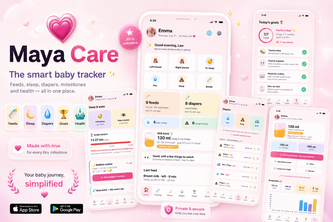
Maya Care is a self-reported personal project by two founders (Paúl Eduardo Hernández Ríos and Rubi Marin) that describes itself as an AI-assisted baby care tracking tool for exhausted parents. It is presented as a privacy-first Progressive Web App (PWA), built without a traditional backend, using GitHub Pages and local browser storage for data synchronization. The product claims to support multiple caregivers through encrypted private repository sync, with features covering feeding, diapers, sleep, pumping, health tracking, and wellbeing.
The description states that the project was originally built for personal use within the author’s own family and later adapted into a public demonstration. It includes synthetic data generation for demo purposes, and no real customer base or revenue is evidenced.
Key commercial due-diligence read: The self-reported evidence does not support any claims of traction, revenue, or adoption. There is no evidence of customers, pricing, or business model beyond the author’s own description. The project appears to be a personal tool developed for family use, with limited public-facing functionality and no indication of commercialization.
Single most important open question: Is there any evidence of real-world usage or user feedback from caregivers outside the founding team?
What The Product Actually Is
The description states that Maya Care is:
- A privacy-first Progressive Web App (PWA) designed for parents and caregivers.
- Built as a mobile-first application using HTML, CSS, JavaScript, and service workers.
- Runs entirely on GitHub Pages, without a traditional backend or public user database.
- Uses local browser storage and the GitHub Contents API for data synchronization between caregivers.
- Includes features such as:
- Feeding (breastfeeding timers, formula records)
- Diaper tracking with photo analysis
- Sleep session logging
- Breast milk inventory management
- Pumping guidance and history
- Health and development tracking
- Medical condition and appointment tracking
- Maternal wellbeing screening using the EPDS
- Bilingual support (English/Spanish)
- Offline-first functionality
- Support for up to five children
The application is described as a static PWA, with no build step required, and uses libraries like Chart.js and jsPDF stored locally.
Inference: The product is built using web technologies and is intended to be lightweight and accessible offline. It does not appear to rely on cloud infrastructure or third-party services for core functionality.
Positioning & Claim Evolution
The description states that Maya Care was originally a personal project after the birth of the author’s daughter, aimed at solving a real problem within their own family.
It evolved into a public demonstration for the OpenAI Build Week hackathon, with synthetic data used to avoid exposing private family information.
The positioning is:
- Target audience: Exhausted parents and caregivers.
- Value proposition: A shared, privacy-first place to record and review daily baby care routines.
- Differentiation: Built without a backend or third-party platforms; uses GitHub for synchronization.
- AI integration: Used OpenAI Codex (GPT-5.6) for code auditing, security testing, and prototype development, but the deployed system does not send private data to AI models for diagnosis.
Inference: The product is positioned as a personal tool with hackathon-level public demonstration, not a commercial offering or scalable SaaS product.
Target Customer & ICP
The description states that Maya Care is designed for:
- Parents and caregivers
- Exhausted users who need to track baby routines
- Families with multiple caregivers (e.g., partners, grandparents)
- Users seeking privacy-first solutions
It supports:
- Up to five children
- Bilingual support (English/Spanish)
- Offline functionality
- Mobile-first design
The description does not state whether the product targets a specific market segment beyond “parents” or if it has been tested with real users outside the founding team.
Inference: The ICP is likely new parents and caregivers, but there is no evidence of customer validation or segmentation beyond self-reporting.
Business Model & Pricing Evidence
The description does not provide any information about:
- Revenue streams
- Pricing model
- Monetization strategy
- Customer acquisition costs
- Subscription plans or in-app purchases
It states that the application runs on GitHub Pages and uses local storage, with no mention of paid features or services.
Inference: No business model is evidenced. The product appears to be a personal tool, not a commercial offering.
Technical & Delivery Signals
The description states:
- Built as a lightweight PWA using HTML, CSS, JavaScript
- Uses GitHub Pages and the GitHub Contents API
- Implements local browser storage, service workers, and offline caching
- Synchronization between caregivers is handled via private GitHub repositories
- Uses AES-GCM encryption with PBKDF2-SHA256 key derivation for credential handling
- Includes synthetic public demo mode using localStorage
- No build step required; uses vanilla JavaScript
- Features include timers, charts, PDF reports, and local insights engine
Inference: The technical architecture is lightweight and self-contained, with no reliance on cloud infrastructure or third-party services. It is designed for offline use and privacy-first data handling.
Traction & Maturity Signals
The description states:
- The project was originally built for personal family use
- A public demo was created using synthetic data
- No real-world usage or adoption beyond the founding team is evidenced
- No mention of user feedback, retention metrics, or customer base
Inference: There is no evidence of traction or maturity. The product appears to be a personal tool with limited public-facing functionality, not a product in active use by others.
Competitive Context
The description does not provide any information about:
- Competitors
- Market size
- Product differentiation from existing baby care apps
- Industry trends or adoption patterns
Inference: No competitive context is evidenced. The project appears to be self-contained, with no external market data or comparison to other tools.
Open Questions & Risks
The description states:
- The product is not a commercial offering
- It was built for personal use only
- No real-world testing or feedback from users beyond the founders
- The public demo uses synthetic data, not real user information
- No evidence of revenue, customers, or business model
Open questions:
- No evidence of customer base or adoption.
- No indication of monetization or scalability.
- The product is described as a personal tool, not a commercial product.
- AI integration is limited to development assistance; no real-time AI services are used in the deployed app.
Questions the description leaves open
- What is the actual usage of this tool beyond your family? Have you tested it with other caregivers?
- How do you plan to monetize or scale this product if at all?
- Are there any real-world users or feedback from parents outside the founding team?
- Do you have plans for a backend or cloud infrastructure, or will you continue relying on GitHub Pages?
- What is your long-term vision for Maya Care beyond the current features and demo?
Overall Assessment
The description states that Maya Care is a personal project built by two individuals for their own family use, later adapted into a public demonstration for a hackathon.
There is no evidence of:
- Revenue
- Customers
- Adoption
- Business model
- Scalability or commercialization plans
It is described as a privacy-first PWA, with no indication that it is intended to be a product for sale or partnership.
Assessment: Not evidenced as a viable investment or partnership opportunity. The project appears to be a personal tool with limited public-facing functionality, not a scalable or commercialized product.
User Stories BotA demo video on every pull request
Get a demo video on every new feature
GitHub App that watches your pull requests and records a narrated, captioned demo.
Save time on demo prep and make informed decisions faster with a video walkthrough of every new feature.
Source
Submitted to the OpenAI 2026 hackathon on Devpost. Project home on Devpost. Back to the full gallery on Devpost.
This competitive analysis was produced by top-founders.com (opens in a new tab)
Generated by a language model from this project's public Devpost page — its tagline, the author's own write-up and any built-with tags listed there — as captured in August 2026. Short quotations are the author's words. It is an opinion on the idea as a business, not on the people behind it, and it reflects the description as published then. If the project has moved on, request a correction below. The analysis is not independent research and contains no verified traction, revenue or customer data.
An independent guide by KFG International LLC — not affiliated with, endorsed by, or connected to Devpost or OpenAI.