

Archive position — measured, not model output
0 likes on Devpost
2,263 of the 7,850 archived projects have more likes, and 5,587 share exactly 0 — so this project's #2,348 place in the like-ranked listing is a tie-break inside that group, not a ranking.
Projects (log scale)
Likes on Devpost. ▲ marks this project's group.
Show the figures
| Likes | Projects | Share of archive |
|---|---|---|
| 0 | 5,587 | 71.2% |
| 1 | 1,758 | 22.4% |
| 2 | 284 | 3.6% |
| 3–4 | 132 | 1.7% |
| 5–9 | 75 | 1.0% |
| 10+ | 14 | 0.2% |
 User Stories BotA demo video on every pull request
Get a demo video on every new feature
GitHub App that watches your pull requests and records a narrated, captioned demo.
Save time on demo prep and make informed decisions faster with a video walkthrough of every new feature.
Executive Summary
What the company appears to be
AegisMCP — Agentic Traffic Firewall is a self-reported security tool designed to inspect and control AI coding agent traffic at the protocol level. It positions itself as a real-time firewall that sits inline between MCP clients (like Codex CLI, Copilot, Claude Code) and their tool servers, enforcing policies on tool calls and results.
What changed
The author describes building this tool in response to perceived gaps in AI security — specifically, that agentic traffic lacks the inspection and control mechanisms that other network traffic has had for decades. It was built over 12+ years of cloud/DevOps experience, using an agent-driven development process with a focus on specs, gated milestones, and tests-as-contracts.
The single most important open question
Is there evidence of real-world usage or traction beyond the author's own development? The description is self-reported and unverified; no revenue, customers, or adoption data are provided. The tool appears to be a prototype or proof-of-concept, not yet deployed in production environments.
What The Product Actually Is
The description states that AegisMCP is a firewall for agentic AI traffic. It operates inline between MCP clients and their tool servers, with integration requiring only one config line. Traffic passes through:
- A YAML policy engine
- Tier-0 detectors (credentials, PII, prompt injection)
- A assessment system: allow, redact, block, or freeze for human approval
- A response-path inspection mechanism that correlates request IDs across tool output to detect hidden payloads before they enter the agent’s context
It also includes:
- An audit log, tagged with OWASP LLM Top 10 and MITRE ATLAS technique IDs
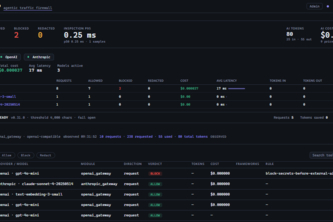
- A zero-dependency single-file dashboard with ~[X] ms p95 inspection overhead
- A structured JSON-RPC error response for blocked traffic, not raw payloads
The tool is built using:
- Python asyncio
- SQLite (WAL)
- Pure regex detection
- Vanilla JS MVC dashboard with strict CSP header enforcement
This is a self-reported technical architecture and functionality. No independent verification or evidence of deployment exists.
Positioning & Claim Evolution
The author claims that AegisMCP addresses a gap in AI security — specifically, that while other network traffic has had firewalls for decades, agentic traffic lacks such controls. It is positioned as a security gateway for AI coding agents, with the differentiation being its response-path inspection, which blocks malicious payloads hidden in tool outputs.
The evolution of claims appears to be:
- A problem exists: agentic traffic lacks inspection.
- A solution exists: inline firewall with policy enforcement and response-path inspection.
- The solution is built using classical engineering practices (specs, tests-as-contracts).
- The tool is designed for legibility in security UX — an assessment a human can read in one second.
These are claims made by the author, not verified facts. No external validation or market positioning beyond the hackathon submission exists.
Target Customer & ICP
The description states that AegisMCP targets:
- AI coding agents (Codex CLI, Copilot, Claude Code)
- Organizations using MCP tool servers
- Teams running agents in production ("teams already running agents in anger")
It is implied that the primary users are developers or DevOps teams managing AI agent workflows and seeking to secure them.
However, there is no evidence of:
- Specific customer segments
- Use cases beyond the author’s own development
- Adoption or feedback from target users
The ICP (Ideal Customer Profile) is inferred from the product's architecture and stated use case but not evidenced.
Business Model & Pricing Evidence
There is no pricing information provided in the description. The author mentions:
- A free gateway
- An open-core paid tier for centralized policy, SSO, GitHub Enterprise sync, SIEM export
This suggests a potential freemium or open-core model, but no details are given about:
- Pricing tiers
- Revenue streams
- Monetization strategy
- Customer acquisition costs
The business model is described only in speculative terms.
Technical & Delivery Signals
Key technical signals from the description:
- Built with Python asyncio, SQLite, regex, and vanilla JS
- Delivered using an agent-driven process (Codex + GPT 5.6)
- Uses spec-first development, gated milestones, and tests-as-contracts
- Brownfield reuse of earlier prototype code
- Zero-dependency dashboard with strict CSP enforcement
- Response-path inspection via request ID correlation in async bidirectional stdio relay
The delivery process is described as:
- Transparent stdio proxy → policy engine + detectors → audit + dashboard → demo kit → hardening
- Each milestone closed only when pytest suite went green
- No retroactive gate waivers
These are self-reported engineering practices, not independently verified.
Traction & Maturity Signals
There is no evidence of traction or maturity beyond the author’s own development:
- No customers, users, or deployments are mentioned
- No revenue or monetization data exists
- No production usage or feedback from teams running agents in anger
- The tool is described as a proof-of-concept, not yet deployed
The project was submitted to a hackathon (OpenAI 2026), suggesting it is early-stage.
Competitive Context
The description does not mention any competitors. It implies that:
- Agentic traffic lacks the inspection mechanisms of other network traffic
- The tool fills a gap in AI security, particularly around prompt injection, secret exfiltration, and tool call auditing
No comparison to existing tools or platforms is made.
Open Questions & Risks
Key risks and open questions:
- No real-world usage — the tool is described only as a prototype
- Unverified claims — all features, performance, and architecture are self-reported
- No traction or monetization strategy — no evidence of revenue, customers, or adoption
- Limited team size — only one member (Jeyakanth Thangam)
- Self-reported development process — while described as rigorous, it is not independently verified
The tool appears to be in a very early stage and lacks any commercial or operational evidence.
Questions the description leaves open
- What specific use cases have you identified for AegisMCP beyond your own development?
- Have you tested the tool with real agents in production environments?
- How do you plan to scale the detection capabilities (e.g., entropy scanning, LLM-as-judge triage)?
- What is the current status of the open-core paid tier? Is there a roadmap for monetization?
- Are there any early adopters or design partners currently using the tool?
- How does AegisMCP handle edge cases in async bidirectional communication without corrupting framing?
- What are your plans for integrating with existing security tools (e.g., SIEM, IAM platforms)?
- Can you provide evidence of performance testing under load?
Overall Assessment
The description is self-reported and unverified. There is no evidence of:
- Revenue
- Customers
- Traction
- Adoption
- Product-market fit
- Commercial viability
AegisMCP appears to be a proof-of-concept or prototype, built by one person in response to a perceived gap in AI security. It is not yet a product with real-world usage or commercial relevance.
Confidence level: Low
This project is at an extremely early stage, and any investment or partnership decision should be based on further evidence of traction, market validation, and product maturity — none of which are present in the provided description.
User Stories BotA demo video on every pull request
Get a demo video on every new feature
GitHub App that watches your pull requests and records a narrated, captioned demo.
Save time on demo prep and make informed decisions faster with a video walkthrough of every new feature.
Source
Submitted to the OpenAI 2026 hackathon on Devpost. Project home on Devpost. Back to the full gallery on Devpost.
This competitive analysis was produced by top-founders.com (opens in a new tab)
Generated by a language model from this project's public Devpost page — its tagline, the author's own write-up and any built-with tags listed there — as captured in August 2026. Short quotations are the author's words. It is an opinion on the idea as a business, not on the people behind it, and it reflects the description as published then. If the project has moved on, request a correction below. The analysis is not independent research and contains no verified traction, revenue or customer data.
An independent guide by KFG International LLC — not affiliated with, endorsed by, or connected to Devpost or OpenAI.