

Archive position — measured, not model output
0 likes on Devpost
2,263 of the 7,850 archived projects have more likes, and 5,587 share exactly 0 — so this project's #6,273 place in the like-ranked listing is a tie-break inside that group, not a ranking.
Projects (log scale)
Likes on Devpost. ▲ marks this project's group.
Show the figures
| Likes | Projects | Share of archive |
|---|---|---|
| 0 | 5,587 | 71.2% |
| 1 | 1,758 | 22.4% |
| 2 | 284 | 3.6% |
| 3–4 | 132 | 1.7% |
| 5–9 | 75 | 1.0% |
| 10+ | 14 | 0.2% |
 User Stories BotA demo video on every pull request
Get a demo video on every new feature
GitHub App that watches your pull requests and records a narrated, captioned demo.
Save time on demo prep and make informed decisions faster with a video walkthrough of every new feature.
Executive Summary
Company: Rebuilders
Self-reported basis: The description is entirely self-reported by the author, unverified, and submitted as part of a hackathon project. No independent evidence of traction, revenue, customers, or operational history exists.
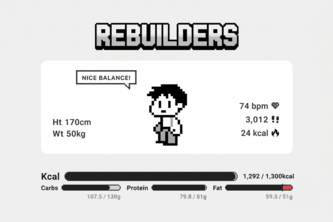
What it appears to be: A prototype food-tracking tool that uses AI to draft meal entries from user input, which can then be reviewed and edited in a web interface. It is built around an AI agent integrated into a messaging app for simplicity.
What changed: The author reports having moved from idea to prototype during a hackathon, using AI tools like Codex and GPT-5.6 to build the core functionality.
Key open question: Is there sufficient evidence of product-market fit or commercial viability to warrant further due-diligence attention?
What The Product Actually Is
The description states that Rebuilders is a tool that allows users to send meal descriptions through a mobile messaging app to an AI agent. The agent searches for food information, calculates nutrition based on the amount consumed, and drafts the entry for the user. Users can then review and correct this draft in a web interface.
- Core functionality: AI-powered meal logging via messaging app.
- User interaction: Send message → AI drafts → Review/edit in web UI.
- Data handling: Nutrition calculation, food database lookup.
- Delivery method: Messaging app integration (not standalone mobile app).
- Technology stack: Includes Codex, GPT-5.6, HTML5, CSS3, JavaScript, Python, Telegram.
Not evidenced: No details on how the AI agent connects to food databases, whether it uses proprietary or public APIs, or if there is any data storage or privacy architecture beyond “IndexedDB” and “local/public environments.”
Positioning & Claim Evolution
The author claims that Rebuilders aims to remove enough repetitive work from food logging so that users no longer find it easier to avoid recording meals. It positions itself as a solution for people who want to track their nutrition but are hindered by complexity or friction.
- Positioning claim: Simplifies meal logging through AI.
- Evolution of claim: Started with personal frustration (missing data, manual effort), evolved into a prototype that proves the concept works.
- Traction signal: Not evidenced. The author says they built it for themselves and tested it in their own routine.
Inference: If the tool is effective at reducing friction, it could appeal to users who struggle with traditional food logging apps or platforms like MyFitnessPal or Cronometer.
Target Customer & ICP
The description does not name specific customer segments. However, the author’s personal motivation suggests an initial target:
- Initial user: Someone trying to build strength through exercise and improve health via diet tracking.
- User pain point: Difficulty in logging meals due to missing data or manual effort.
- ICP inference: Health-conscious individuals or those beginning a fitness journey who want structured nutrition logging but lack time or technical skills.
Not evidenced: No segmentation, personas, or market research. No mention of other potential users (e.g., athletes, dietitians, weight loss programs).
Business Model & Pricing Evidence
The description does not contain any information about pricing models, monetization strategies, or business model assumptions.
- Business model claim: Not stated.
- Pricing evidence: Not evidenced.
- Revenue streams: Not mentioned.
Inference: If the tool becomes a public product, it might consider freemium, subscription, or ad-supported models. But no such inference is supported by the description.
Technical & Delivery Signals
The author reports building the prototype using AI tools like Codex and GPT-5.6, and mentions that the system uses technologies such as HTML5, CSS3, JavaScript, Python, and IndexedDB.
- AI integration: Central to product planning and development.
- Development approach: Use of AI for code generation, testing, and debugging.
- Technical stack: Includes Codex, GPT-5.6, Telegram, GitHub, Figma, Adobe tools.
- Deployment status: Prototype only; not yet a public product.
Not evidenced: No details on scalability, API usage costs, authentication systems, or deployment architecture beyond “local and public environments.”
Traction & Maturity Signals
There is no evidence of traction, adoption, or user engagement beyond the author’s personal use.
- User base: Not evidenced.
- Adoption metrics: Not mentioned.
- Maturity level: Prototype stage; not yet a product for general use.
- Feedback loop: Not described.
Inference: The author has tested it personally and found it useful, but no external validation or usage data exists.
Competitive Context
The description does not reference competitors or market positioning relative to existing tools.
- Competitive landscape: Not discussed.
- Differentiation claim: AI-driven drafting of meals.
- Market overlap: Likely overlaps with apps like MyFitnessPal, Cronometer, or similar food logging platforms.
Not evidenced: No mention of how Rebuilders differs from current offerings in terms of UX, AI use, or feature set.
Open Questions & Risks
Several risks and open questions emerge from the self-reported description:
- Prototype-only status: No evidence of a functioning product for others.
- AI dependency: Heavy reliance on Codex and GPT-5.6; unclear how this scales or remains stable.
- Security concerns: Mentioned as a challenge, but no details on how privacy or data handling is addressed.
- Onboarding complexity: The author notes that turning it into a public product would require simpler onboarding and stronger privacy safeguards.
- Founder background: One-person team with limited coding experience beyond newsletters and websites.
Inference: If the tool does not scale beyond personal use, it may not be viable as a commercial product without significant development or team expansion.
Questions the description leaves open
- What specific food databases are used for lookups? Are they proprietary or public?
- How is user data stored and protected? Is IndexedDB sufficient for production-level privacy?
- What is the long-term plan for AI integration—will it be self-hosted, API-based, or reliant on third-party services?
- Has there been any external testing or feedback from users beyond yourself?
- What are the key assumptions about user behavior and adoption that underpin this product?
- How do you plan to handle API costs and scalability if the tool becomes widely used?
- Are there any legal or regulatory considerations around food logging, especially for health-related data?
Overall Assessment
Confidence level: Low
Assessment: Rebuilders is a prototype built during a hackathon with no evidence of traction, revenue, or customer validation. It shows potential in solving a personal problem but lacks commercial viability indicators.
- Investment rationale: Not evident.
- Partnership opportunity: Possibly relevant if the author plans to scale it into a product with broader appeal and clear monetization strategy.
- Next steps: If the author intends to develop this further, due diligence should focus on technical feasibility, scalability, data privacy, and market validation.
Note: This is an early-stage idea with no verified commercial execution. The description does not support any conclusion about readiness for investment or partnership.
User Stories BotA demo video on every pull request
Get a demo video on every new feature
GitHub App that watches your pull requests and records a narrated, captioned demo.
Save time on demo prep and make informed decisions faster with a video walkthrough of every new feature.
Source
Submitted to the OpenAI 2026 hackathon on Devpost. Project home on Devpost. Back to the full gallery on Devpost.
This competitive analysis was produced by top-founders.com (opens in a new tab)
Generated by a language model from this project's public Devpost page — its tagline, the author's own write-up and any built-with tags listed there — as captured in August 2026. Short quotations are the author's words. It is an opinion on the idea as a business, not on the people behind it, and it reflects the description as published then. If the project has moved on, request a correction below. The analysis is not independent research and contains no verified traction, revenue or customer data.
An independent guide by KFG International LLC — not affiliated with, endorsed by, or connected to Devpost or OpenAI.