

Archive position — measured, not model output
0 likes on Devpost
2,263 of the 7,850 archived projects have more likes, and 5,587 share exactly 0 — so this project's #6,267 place in the like-ranked listing is a tie-break inside that group, not a ranking.
Projects (log scale)
Likes on Devpost. ▲ marks this project's group.
Show the figures
| Likes | Projects | Share of archive |
|---|---|---|
| 0 | 5,587 | 71.2% |
| 1 | 1,758 | 22.4% |
| 2 | 284 | 3.6% |
| 3–4 | 132 | 1.7% |
| 5–9 | 75 | 1.0% |
| 10+ | 14 | 0.2% |
 User Stories BotA demo video on every pull request
Get a demo video on every new feature
GitHub App that watches your pull requests and records a narrated, captioned demo.
Save time on demo prep and make informed decisions faster with a video walkthrough of every new feature.
Executive Summary
What the company appears to be
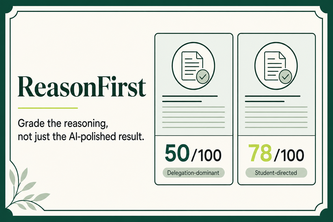
ReasonFirst is a self-reported educational tool designed to make student reasoning visible when using generative AI in academic settings. The author describes it as a workflow that structures AI use into analytical stages, with semi-structured prompts that separate fixed instructor instructions from variable student contributions. It aims to assess both technical output and the intellectual process behind it.
What changed
The project evolved from a university teaching method into a prototype web application during OpenAI Build Week. The author states that the pedagogical approach existed before the hackathon but was transformed into a working product using AI tools like GPT-5.6, Codex, and the OpenAI API.
Single most important open question
Is there evidence of traction or adoption beyond the author's own teaching context, and how does the system actually function in practice with real students?
What The Product Actually Is
The description states that ReasonFirst is an educational workflow for using AI without making students passive recipients. It involves:
- Decomposing exercises into ordered analytical stages
- Using semi-structured prompts where:
- Fixed instructor components constrain AI assistance
- Variable student components reveal reasoning
- Three interaction regimes:
- Regime A: Analysis and model reasoning (student proposes route; AI verifies/organizes)
- Regime B: Computational translation (AI translates validated stages into code)
- Regime C: Critical verification (student challenges results; AI accepts/rejects)
- Produces two linked artifacts:
- Clean executable Jupyter Notebook
- Interaction trace containing prompts, student contributions, model responses, decisions, and corrections
The system is described as a lightweight Python web application that manages immutable Case Sheets, fixed/variable prompt components, response provenance, structured JSON outputs, deterministic assessment, trusted execution, and notebook/export functionality.
Evidence Self-reported by author. No independent verification or demonstration of actual use beyond prototype development.
Positioning & Claim Evolution
The author states that ReasonFirst emerged from a discussion about how AI in education risks losing educational value if instructors cannot observe how much reasoning has been delegated to models. The key shift was moving focus from final results to the intellectual contribution made through prompts.
Positioning claims:
- Not an AI detector
- Makes student responsibility visible while work is taking place
- Designed to assess both technical product and intellectual process
- Aims to make AI-supported learning rigorous, attributable, and genuinely educational
The evolution described shows a progression from informal teaching method → structured workflow → prototype application during OpenAI Build Week.
Evidence Self-reported. No external validation or market positioning data provided.
Target Customer & ICP
The description states that ReasonFirst is intended for use in academic settings, particularly quantitative finance courses where students work on computational exercises. The target audience includes:
- Instructors teaching quantitative methods
- Students working on structured analytical problems
- Educational institutions seeking to maintain intellectual rigor while allowing AI use
The author mentions piloting the method in a laboratory setting and plans to test with actual students starting October 2026.
Evidence Self-reported. No data on specific customer segments, institutional adoption, or usage patterns beyond personal teaching context.
Business Model & Pricing Evidence
Not evidenced. The description does not contain any information about pricing models, revenue streams, monetization strategies, or business model assumptions.
Evidence Absence of evidence.
Technical & Delivery Signals
The project is described as a lightweight Python web application built with:
- CSS3, HTML5, JavaScript
- Jupyter Notebook, JSON Schema
- Microsoft tools, OpenAI API (GPT-5.6, Codex, Responses API)
- Playwright, Python
- GitHub for version control
Key technical features include:
- Immutable Case Sheet constraints
- Fixed and variable prompt components
- Response provenance tracking
- Structured JSON outputs
- Deterministic assessment capabilities
- Notebook and interaction-trace exports
- Credential-free deterministic mode for demonstrations
The application uses GPT-5.6 in live mode but does not execute model-generated Python automatically; instead, it returns candidate cells for review.
Evidence Self-reported. No information about scalability, infrastructure, or technical performance metrics.
Traction & Maturity Signals
Not evidenced. The description contains no data on:
- Number of users or institutions using the system
- Revenue or funding status
- Customer adoption rates
- Product usage statistics
- Market traction indicators
The author mentions piloting in a laboratory setting and testing with students in October 2026, but these are not quantified or validated.
Evidence Absence of evidence.
Competitive Context
Not evidenced. The description does not mention:
- Competitors in the educational AI space
- Existing solutions for tracking student AI use
- Market positioning relative to other tools
- Differentiation from similar products
The author focuses on the pedagogical approach rather than competitive analysis.
Evidence Absence of evidence.
Open Questions & Risks
Inferences based on self-reported information:
- Unproven market demand: The system is described as emerging from one person's teaching experience, with no evidence of broader institutional adoption or commercial interest.
- Unclear scalability: As a single-developer project built for a specific academic context, there is no indication of how it would scale to multiple institutions or large student populations.
- Limited validation: The only testing mentioned is laboratory-based and planned for future student use in October 2026 — no real-world data on effectiveness or user feedback.
- Dependency on AI APIs: Heavy reliance on OpenAI APIs (GPT-5.6, Codex) introduces risk of API changes, cost increases, or availability issues.
- Unclear assessment criteria: While the system claims to support rubric-based assessment, no details are given about how these rubrics are implemented or validated.
- Potential for misuse: If not properly implemented, the system could be bypassed or misused by students or instructors.
Evidence Self-reported. No independent validation or performance data.
Questions the description leaves open
- What specific feedback have you received from colleagues or institutions regarding the pedagogical approach?
- How do you plan to ensure consistent implementation of the three interaction regimes across different instructors and courses?
- Have you conducted any pilot studies with actual students, and what were the results?
- What are your plans for integrating with existing learning management systems (LMS)?
- How will you handle cases where students attempt to circumvent the structured workflow?
- What is the expected timeline for full deployment and institutional adoption?
- Are there any partnerships or institutional commitments already in place?
- How do you intend to measure success beyond student performance scores?
Overall Assessment
Not evidenced. The description provides no information about:
- Financial status or funding rounds
- Revenue projections or business model viability
- Strategic partnerships or institutional support
- Market opportunity size or competitive positioning
The author describes a prototype built during a hackathon, with plans for future piloting and development — but no indication of commercial readiness or investment potential.
Evidence Absence of evidence.
User Stories BotA demo video on every pull request
Get a demo video on every new feature
GitHub App that watches your pull requests and records a narrated, captioned demo.
Save time on demo prep and make informed decisions faster with a video walkthrough of every new feature.
Source
Submitted to the OpenAI 2026 hackathon on Devpost. Project home on Devpost. Back to the full gallery on Devpost.
This competitive analysis was produced by top-founders.com (opens in a new tab)
Generated by a language model from this project's public Devpost page — its tagline, the author's own write-up and any built-with tags listed there — as captured in August 2026. Short quotations are the author's words. It is an opinion on the idea as a business, not on the people behind it, and it reflects the description as published then. If the project has moved on, request a correction below. The analysis is not independent research and contains no verified traction, revenue or customer data.
An independent guide by KFG International LLC — not affiliated with, endorsed by, or connected to Devpost or OpenAI.