

Archive position — measured, not model output
0 likes on Devpost
2,263 of the 7,850 archived projects have more likes, and 5,587 share exactly 0 — so this project's #2,312 place in the like-ranked listing is a tie-break inside that group, not a ranking.
Projects (log scale)
Likes on Devpost. ▲ marks this project's group.
Show the figures
| Likes | Projects | Share of archive |
|---|---|---|
| 0 | 5,587 | 71.2% |
| 1 | 1,758 | 22.4% |
| 2 | 284 | 3.6% |
| 3–4 | 132 | 1.7% |
| 5–9 | 75 | 1.0% |
| 10+ | 14 | 0.2% |
 User Stories BotA demo video on every pull request
Get a demo video on every new feature
GitHub App that watches your pull requests and records a narrated, captioned demo.
Save time on demo prep and make informed decisions faster with a video walkthrough of every new feature.
Executive Summary
What the company appears to be
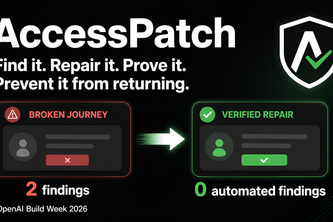
AccessPatch is a self-reported proof-of-concept tool for accessibility repair in React/TypeScript applications. It is described as a "Journey Repair and Proof Agent" that uses GPT-5.6 to generate bounded repair plans, applies deterministic templates in isolated copies, replays journeys, and generates reviewable "Proof Bundles". The author states it is not a complete solution but a first step toward more accessible digital experiences.
What changed
The project description shows an evolution from a general claim about improving accessibility for smaller teams to a specific technical demonstration of one controlled journey with two barriers. It moves from a broad positioning ("many more digital projects should have practical paths") to a narrow, reproducible workflow.
The single most important open question
Is there evidence that the described workflow can be scaled beyond its current controlled demonstration without losing its core principles of bounded repair, deterministic application, and human review?
What The Product Actually Is
The description states that AccessPatch is a "Journey Repair and Proof Agent for React and TypeScript applications". It runs keyboard-based journeys using Playwright, records accessibility evidence with axe-playwright, sends structured findings to GPT-5.6 (via OpenAI Responses API) for repair planning, validates those plans against an allowlist, applies deterministic templates in disposable copies, replays the journey, verifies results, and generates a "Proof Bundle".
The author claims it does not directly write or apply source code but uses bounded GPT-5.6 responses validated through schema and allowlist before deterministic repair logic acts.
It includes a "controlled Mutation Guard" demonstration that injects regressions and detects them without modifying the original fixture.
Evidence The description states this is a controlled demonstration using one checkout journey, two intentional barriers, and deterministic repair templates in isolated copies. It does not claim to support arbitrary repositories or general-purpose accessibility testing.
Inference This appears to be a developer tool for accessibility repair workflows rather than an end-user product or platform.
Positioning & Claim Evolution
The author states that AccessPatch is "not a complete solution, but a deliberately limited first step toward making more digital experiences usable by more people."
It positions itself as a way to move beyond isolated checklist findings to "broken journeys" — focusing on user experience rather than abstract scores.
The project evolved from a broad claim about accessibility support for smaller teams to a specific technical demonstration with bounded scope and reproducible workflow.
Evidence The description states that the author chose to deliberately narrow the scope to avoid overstating what automated tooling can prove, emphasizing boundaries and verification over broad automation.
Inference This suggests a conscious decision to build something testable and verifiable rather than a full-featured platform.
Target Customer & ICP
The description states that AccessPatch is intended for "smaller development teams" who need support to identify, repair, and verify accessibility barriers without pretending automation can replace expert human review.
It also mentions that it explores a more accountable workflow for accessibility — suggesting developers or teams working on digital products where accessibility matters but may lack resources for full compliance.
Evidence The project is built for React/TypeScript applications and targets developers who want to integrate accessibility into their development workflows.
Inference The target ICP seems to be technical teams building web applications with limited accessibility expertise, looking for a structured way to improve accessibility in their codebase.
Business Model & Pricing Evidence
Not evidenced. The description does not mention any pricing model, revenue streams, or commercialization plans beyond the hackathon submission.
Evidence No information is provided about how AccessPatch would be monetized or whether it has any business model at this stage.
Technical & Delivery Signals
AccessPatch was built using:
- React and Vite for the controlled checkout application
- Node.js and TypeScript for orchestration
- Playwright for keyboard journeys and browser evidence
- axe-playwright for automated accessibility checks
- OpenAI Responses API with GPT-5.6 for bounded repair planning
- Deterministic templates for controlled source repairs
- pnpm for dependency management
- Git/GitHub for traceable development
It uses a "Judge Workflow" that includes 178 API-free tests, an eight-stage Judge Workflow, and a seventeen-stage clean-clone verification.
Evidence The project was submitted to the OpenAI 2026 hackathon on Devpost. It includes a controlled demonstration with one checkout journey, two barriers, and deterministic repair logic in isolated copies.
Inference This indicates a strong focus on reproducibility, traceability, and developer experience, but not necessarily scalability or production readiness.
Traction & Maturity Signals
Not evidenced. There is no mention of users, customers, revenue, adoption, or any traction beyond the author's own submission to a hackathon.
Evidence The project is described as a controlled demonstration, not a general-purpose platform. It does not claim to be in production or used by others.
Competitive Context
Not evidenced. No information is provided about competitors or market positioning beyond the self-description of the tool itself.
Evidence The description does not reference existing accessibility tools, platforms, or workflows in the market.
Open Questions & Risks
- Over-reliance on GPT-5.6 for repair planning without direct code application: The model's output is validated and then applied via deterministic templates — but this raises questions about whether such a system can scale beyond its current narrow scope.
- Limited scope and reproducibility concerns: It currently supports only one checkout journey, two barriers, and Chromium. Scaling to broader use cases may break the controlled workflow.
- No commercial viability or monetization strategy: The tool is described as a demonstration with no indication of how it would be sold or used commercially.
- Developer-centric but not production-ready: The focus on developer workflows and isolated execution suggests it’s not yet ready for enterprise or production use.
Evidence The author explicitly states that the project avoids broad scanning or claiming automatic compliance, and that expansion must remain honest about automation's limits.
Questions the description leaves open
- What are the specific boundaries of the allowlist used to validate GPT-5.6 repair strategies? Can this be expanded?
- How does AccessPatch handle edge cases or new types of accessibility barriers beyond the two currently supported?
- Is there any plan for integrating with CI/CD pipelines or pull request workflows?
- What are the technical challenges in scaling from one checkout journey to multiple journeys or platforms?
- Are there any plans to support other frameworks beyond React/TypeScript?
- How does AccessPatch distinguish between automated detection and human review responsibilities?
Overall Assessment
Not evidenced. No information is provided about funding, valuation, or investment interest in AccessPatch.
Evidence The project was submitted as a hackathon entry and lacks any indication of commercial traction or investor interest.
Inference At this stage, it appears to be a proof-of-concept tool with potential for further development, but no clear path to commercialization or partnership opportunities based on the provided description.
User Stories BotA demo video on every pull request
Get a demo video on every new feature
GitHub App that watches your pull requests and records a narrated, captioned demo.
Save time on demo prep and make informed decisions faster with a video walkthrough of every new feature.
Source
Submitted to the OpenAI 2026 hackathon on Devpost. Project home on Devpost. Back to the full gallery on Devpost.
This competitive analysis was produced by top-founders.com (opens in a new tab)
Generated by a language model from this project's public Devpost page — its tagline, the author's own write-up and any built-with tags listed there — as captured in August 2026. Short quotations are the author's words. It is an opinion on the idea as a business, not on the people behind it, and it reflects the description as published then. If the project has moved on, request a correction below. The analysis is not independent research and contains no verified traction, revenue or customer data.
An independent guide by KFG International LLC — not affiliated with, endorsed by, or connected to Devpost or OpenAI.