

Archive position — measured, not model output
0 likes on Devpost
2,263 of the 7,850 archived projects have more likes, and 5,587 share exactly 0 — so this project's #4,275 place in the like-ranked listing is a tie-break inside that group, not a ranking.
Projects (log scale)
Likes on Devpost. ▲ marks this project's group.
Show the figures
| Likes | Projects | Share of archive |
|---|---|---|
| 0 | 5,587 | 71.2% |
| 1 | 1,758 | 22.4% |
| 2 | 284 | 3.6% |
| 3–4 | 132 | 1.7% |
| 5–9 | 75 | 1.0% |
| 10+ | 14 | 0.2% |
 User Stories BotA demo video on every pull request
Get a demo video on every new feature
GitHub App that watches your pull requests and records a narrated, captioned demo.
Save time on demo prep and make informed decisions faster with a video walkthrough of every new feature.
Executive Summary
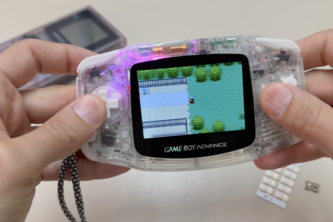
What the company appears to be: GBoost is a self-reported project by one developer (Franz Mueller) that builds a Game Boy overclocking module with firmware development tools. It includes both hardware and software components, including a browser-based workbench for firmware testing.
What changed: The author reports building a firmware workbench using AI assistance (Codex powered by GPT-5.6), which allows developers to test embedded C++ firmware logic in a browser environment without needing physical hardware for every iteration.
The single most important open question: Is there any evidence of traction, revenue or customer adoption beyond the author's own development efforts?
What The Product Actually Is
The description states that GBoost is:
- A "tiny programmable replacement for the original oscillator in classic Game Boy consoles"
- A module installed inside a Game Boy to control overclocking, underclocking, calibration, and power-aware operation
- Composed of multiple repositories including hardware (KiCad), firmware (C++), programmer/tester (Raspberry Pi + Python), documentation (MkDocs), product site (Hugo), and management (Markdown)
The author also reports building a "Firmware Workbench" that runs production firmware logic in WebAssembly and browser environments, using AI tools like Codex to accelerate development.
Evidence strength: Self-reported. No independent verification of functionality or commercial viability.
Positioning & Claim Evolution
The author claims:
- GBoost is designed for retro gamers who want faster gameplay on original hardware
- It supports individual console calibration rather than fixed speeds
- The firmware workbench enables efficient development and testing without physical hardware
- AI-assisted development was used to build the workbench, with Codex completing 13 milestones
The positioning appears to be:
- A niche tool for retro gaming enthusiasts
- A developer tool for embedded firmware engineering
- Possibly a prototype or proof-of-concept project
Evidence strength: Self-reported. No evidence of market positioning beyond author's own description.
Target Customer & ICP
The description states:
- The target is "retro gamers" who want to play on original hardware but faster
- It supports individual console calibration, implying a need for customization
- The firmware workbench targets developers working with embedded systems
No explicit customer segments or personas are defined.
Evidence strength: Self-reported. No evidence of actual customers or buyer personas.
Business Model & Pricing Evidence
The description states:
- There is a "public MkDocs Material wiki" covering installation, operation, calibration, compatibility, recovery, and troubleshooting
- A "self-contained Hugo shop and waitlist experience for GBoost RGB"
- The project includes a "waitlist experience", suggesting pre-orders or interest collection
There is no mention of pricing, revenue streams, or monetization strategy.
Evidence strength: Self-reported. No evidence of business model or financials.
Technical & Delivery Signals
The author reports:
- Use of C++, embedded systems, WebAssembly, JavaScript, Python, KiCad, FastAPI, Hugo, MkDocs
- AI-assisted development using Codex (GPT-5.6 Sol)
- Firmware workbench runs real shared production firmware logic in browser and macOS
- The system uses deterministic scenarios for testing boot, mode switching, timing boundaries, etc.
- Shared C++ remains the single source of truth; JavaScript only forwards inputs and displays results
Evidence strength: Self-reported. No evidence of technical performance or scalability.
Traction & Maturity Signals
The description states:
- The project was submitted to an OpenAI hackathon (Devpost)
- It includes multiple specialized repositories
- A waitlist experience exists for GBoost RGB
- The author built a functional workbench using AI tools
There is no evidence of:
- Revenue
- Customers
- Adoption
- Market traction
- Product-market fit
Evidence strength: Self-reported. No evidence of traction or maturity beyond the author's own efforts.
Competitive Context
The description does not mention any competitors or competitive landscape.
Evidence strength: Not evidenced.
Open Questions & Risks
Key risks and open questions based on self-report:
- The project is described as a single-person effort (team size: 1)
- No evidence of revenue, customers, or market traction
- The firmware workbench does not emulate physical hardware behavior (e.g., CPU timing, signal integrity, power consumption)
- AI-assisted development may introduce risks around reliability and auditability
- The project is presented as a hackathon submission — no indication of long-term commercial viability
Evidence strength: Inferred from self-report. No external validation.
Questions the description leaves open
- What is the actual demand for this product in the market?
- Are there any customers or users beyond the author’s own use case?
- How does the firmware workbench compare to traditional embedded development workflows?
- What are the risks of relying on AI tools like Codex for development?
- Is there a plan for scaling beyond a single developer?
- Have you validated that the workbench accurately reflects real hardware behavior?
- What is the timeline and roadmap for moving from prototype to production?
Evidence strength: Inferred from self-report. No evidence of answers.
Overall Assessment
The description states:
- This is a single-developer project submitted to a hackathon
- It includes a waitlist experience, suggesting early interest
- The author claims AI-assisted development was effective
- No revenue, customers or traction are evidenced
Assessment: Not evidenced. There is no evidence of commercial viability, traction, or market demand beyond the author’s own efforts.
This project appears to be a prototype or proof-of-concept with limited commercial potential at this stage. It lacks any demonstrated business model, customer base, or financial metrics.
Evidence strength: Self-reported only. No independent verification.
User Stories BotA demo video on every pull request
Get a demo video on every new feature
GitHub App that watches your pull requests and records a narrated, captioned demo.
Save time on demo prep and make informed decisions faster with a video walkthrough of every new feature.
Source
Submitted to the OpenAI 2026 hackathon on Devpost. Project home on Devpost. Back to the full gallery on Devpost.
This competitive analysis was produced by top-founders.com (opens in a new tab)
Generated by a language model from this project's public Devpost page — its tagline, the author's own write-up and any built-with tags listed there — as captured in August 2026. Short quotations are the author's words. It is an opinion on the idea as a business, not on the people behind it, and it reflects the description as published then. If the project has moved on, request a correction below. The analysis is not independent research and contains no verified traction, revenue or customer data.
An independent guide by KFG International LLC — not affiliated with, endorsed by, or connected to Devpost or OpenAI.