

Archive position — measured, not model output
0 likes on Devpost
2,263 of the 7,850 archived projects have more likes, and 5,587 share exactly 0 — so this project's #6,238 place in the like-ranked listing is a tie-break inside that group, not a ranking.
Projects (log scale)
Likes on Devpost. ▲ marks this project's group.
Show the figures
| Likes | Projects | Share of archive |
|---|---|---|
| 0 | 5,587 | 71.2% |
| 1 | 1,758 | 22.4% |
| 2 | 284 | 3.6% |
| 3–4 | 132 | 1.7% |
| 5–9 | 75 | 1.0% |
| 10+ | 14 | 0.2% |
 User Stories BotA demo video on every pull request
Get a demo video on every new feature
GitHub App that watches your pull requests and records a narrated, captioned demo.
Save time on demo prep and make informed decisions faster with a video walkthrough of every new feature.
Executive Summary
What the company appears to be
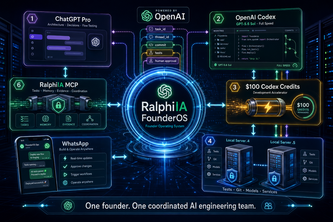
RalphiIA FounderOS is described as an agentic operations SaaS platform built by a solo founder (Rafael Lopez) for small businesses, startups, and non-technical founders. It integrates AI tools like ChatGPT and Codex with governed business workflows, persistent memory, and sovereign infrastructure through the Model Context Protocol (MCP). The system is designed to help one person remember, operate, and build from anywhere.
What changed
The project evolved from a specific workflow tool called QuoteOps into a broader platform called FounderOS. During OpenAI Build Week, it was restructured to become an extensible operating system that supports both AI engineering loops (where tasks are created and executed via Codex) and founder operating loops (where remote inputs from WhatsApp or interfaces trigger actions on local servers).
The single most important open question
Is there evidence of real-world usage or traction beyond the author's own development environment? The description is self-reported, unverified, and lacks any data on revenue, customers, or adoption.
What The Product Actually Is
The description states that RalphiIA FounderOS is an agentic operations SaaS platform. It is not simply a CRM or unrestricted remote shell.
It includes:
- An intelligent copilot (RalphiIA) connecting interfaces like ChatGPT and WhatsApp to governed business tools, memory, Codex development tasks, and sovereign infrastructure.
- Two main loops:
- AI Engineering Loop: A conversation with ChatGPT leads to structured task creation, which Codex implements in an isolated Git worktree, runs tests, and commits changes. Evidence is recorded throughout.
- Founder Operating Loop: Inputs from WhatsApp or the interface can trigger actions on two sovereign Linux servers, including local processing of media (voice, images), authentication, and human-in-the-loop controls for sensitive operations.
The system uses:
- Model Context Protocol (MCP) as a shared contract
- OpenAI Codex with GPT-5.6 Sol for architecture, implementation, debugging, testing
- ChatGPT for planning and supervisory interface
- Python and MongoDB for task state, memory, audit events
- Git worktrees, AppArmor, Bubblewrap, Ollama, Whisper, Tesseract OCR, local models
- Two sovereign Linux nodes with monitoring and recovery capabilities
Inference: The product is described as a self-contained system that allows solo founders to coordinate AI-driven tasks across multiple tools and environments while maintaining governance and traceability.
Positioning & Claim Evolution
The author claims that FounderOS helps small businesses, startups, foundations, and non-technical founders leverage AI without needing large engineering teams or becoming AI engineers themselves.
It positions itself as:
- An extensible operating system for founders
- A way to turn intent into coordinated, verifiable work
- Not a chatbot but a dependable tool for turning ideas into action
The evolution from QuoteOps (a real workflow for understanding customer requests and preparing quotations) to FounderOS shows a shift toward a platform layer underneath specific modules, allowing future expansion into other business domains like marketing, internal knowledge, or infrastructure.
Inference: The positioning is that of a low-code, high-governance platform aimed at solo founders or small teams who want AI assistance but lack dedicated technical resources. It emphasizes control and evidence over automation.
Target Customer & ICP
The description states the target audience includes:
- Small businesses
- Startups
- Foundations
- Non-technical founders
These users are characterized as having:
- Limited time
- Finite budgets
- No large engineering teams
- Need for AI leverage without becoming engineers
Inference: The ideal customer profile is a solo founder or small team that wants to use AI for operational tasks but lacks the infrastructure, tools, or expertise to do so reliably. They are likely early-stage and resource-constrained.
Business Model & Pricing Evidence
There is no explicit mention of pricing, business model, or monetization strategy in the description.
The author says:
- FounderOS will become a configurable SaaS platform
- Organizations can start with a focused pain point (e.g., quotations) and grow by adding modules
- They may operate it themselves or use a supervised managed service
Inference: The business model appears to be SaaS-based, possibly with both self-hosted and managed offerings. However, no pricing details, revenue streams, or customer acquisition methods are provided.
Technical & Delivery Signals
Key technical components include:
- Model Context Protocol (MCP)
- OpenAI Codex + GPT-5.6 Sol
- ChatGPT for interface
- Python, MongoDB, Git worktrees, Docker, Bubblewrap, AppArmor
- Local-first multimedia processing via Whisper, FFmpeg, Tesseract OCR
- Two sovereign Linux servers with monitoring and recovery
The author built the system using the same operating model it now offers:
- Codex helped create, test, and repair the platform
- Tasks were split across multiple Codex sessions
- Evidence was captured in commits, test reports, and thread IDs
Inference: The technical stack is built around AI integration, secure execution environments, and distributed workflows. It emphasizes governance, traceability, and local processing where possible.
Traction & Maturity Signals
There is no evidence of traction or maturity beyond the author’s own development efforts.
The description mentions:
- A $100 Codex credit grant
- Built during OpenAI Build Week
- Beta deployments planned with real small organizations
- 91/91 passing tests on each node
- Failed runs and fixes preserved for documentation
However, there is no mention of:
- Customers or users
- Revenue or ARR
- Product adoption metrics
- Market validation or feedback from others
Inference: The product exists as a prototype built by one person. It has not yet reached a market-facing stage with measurable traction.
Competitive Context
The description does not reference direct competitors or competitive positioning.
It implies that current tools are fragmented:
- Conversations live in WhatsApp
- Code lives in IDEs
- Operational truth lives on servers
- Decisions disappear across separate chats
This suggests a gap in the market for integrated, governed AI workflows — especially for non-technical users.
Inference: The competitive landscape is unclear. It likely competes with fragmented tools like CRM systems, task managers, and chatbots, but not clearly defined alternatives are named.
Open Questions & Risks
Several risks and open questions emerge from the description:
- Single-person development: Only one team member (Rafael Lopez) is mentioned.
- No external validation or traction: No customers, revenue, or usage data.
- Unproven scalability: The system was built in a limited environment (Ecuador), and its ability to scale beyond that is untested.
- Highly technical implementation: Requires deep knowledge of AI tools, Linux servers, and security practices — may not be accessible to non-technical users.
- Self-reported claims only: All evidence is from the author’s own account; no independent verification exists.
Inference: The project is still in an experimental phase with no proven market fit or scalability beyond a single developer's use case.
Questions the description leaves open
- What specific operational pain points does FounderOS solve for small businesses or startups?
- How many real-world users have tested the system, and what feedback did they provide?
- Are there any existing partnerships or pilot programs with organizations using the platform?
- What is the roadmap for monetization and go-to-market strategy?
- Can you demonstrate measurable time savings or productivity gains from using FounderOS?
- How does the system handle data privacy and compliance in different jurisdictions?
- What are the key assumptions about user behavior that underpin the product design?
Overall Assessment
Not evidenced
There is no evidence of revenue, customers, traction, or validated market demand. The description is entirely self-reported and unverified.
The author describes a conceptual platform built by one person during a hackathon, with strong technical execution but no commercial proof of concept.
Confidence Level: Low
This is a speculative early-stage idea with potential, but lacks any demonstrated traction or business viability. Any investment or partnership decision should be based on further due diligence involving actual user testing, market validation, and financial modeling — none of which are present in the current description.
User Stories BotA demo video on every pull request
Get a demo video on every new feature
GitHub App that watches your pull requests and records a narrated, captioned demo.
Save time on demo prep and make informed decisions faster with a video walkthrough of every new feature.
Source
Submitted to the OpenAI 2026 hackathon on Devpost. Project home on Devpost. Back to the full gallery on Devpost.
This competitive analysis was produced by top-founders.com (opens in a new tab)
Generated by a language model from this project's public Devpost page — its tagline, the author's own write-up and any built-with tags listed there — as captured in August 2026. Short quotations are the author's words. It is an opinion on the idea as a business, not on the people behind it, and it reflects the description as published then. If the project has moved on, request a correction below. The analysis is not independent research and contains no verified traction, revenue or customer data.
An independent guide by KFG International LLC — not affiliated with, endorsed by, or connected to Devpost or OpenAI.