

Archive position — measured, not model output
0 likes on Devpost
2,263 of the 7,850 archived projects have more likes, and 5,587 share exactly 0 — so this project's #2,313 place in the like-ranked listing is a tie-break inside that group, not a ranking.
Projects (log scale)
Likes on Devpost. ▲ marks this project's group.
Show the figures
| Likes | Projects | Share of archive |
|---|---|---|
| 0 | 5,587 | 71.2% |
| 1 | 1,758 | 22.4% |
| 2 | 284 | 3.6% |
| 3–4 | 132 | 1.7% |
| 5–9 | 75 | 1.0% |
| 10+ | 14 | 0.2% |
 User Stories BotA demo video on every pull request
Get a demo video on every new feature
GitHub App that watches your pull requests and records a narrated, captioned demo.
Save time on demo prep and make informed decisions faster with a video walkthrough of every new feature.
Executive Summary
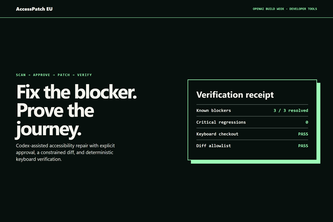
The company appears to be a single-person project named AccessPatch EU, submitted by John Papadakis for the OpenAI 2026 hackathon. The author describes it as a tool that automates accessibility patching during checkout flows, using synthetic testing, AI (GPT-5.6), and browser automation (Playwright). It claims to close a loop between runtime behavior and source code, offering deterministic proof of fixes.
What changed: The project is presented as a hackathon submission with no evidence of prior traction or commercial activity. It does not appear to have launched as a product or service beyond this one-off development effort.
The single most important open question: Is there any indication that the author intends to build this into a scalable, revenue-generating business, or is it purely experimental?
Note
This analysis is based entirely on the self-reported, unverified description provided by the author. No third-party verification, funding rounds, customers, revenue, or traction data are available.
What The Product Actually Is
The description states that AccessPatch EU:
- Runs a synthetic localhost checkout using Playwright and axe-core.
- Captures privacy-scrubbed evidence of accessibility issues.
- Assigns stable finding IDs to map findings to source markers.
- Uses GPT-5.6 to correlate browser evidence with source code and propose minimal changes.
- Pauses for human approval before applying edits, restricting changes to
src/checkout. - Replays the same keyboard journey after patching.
- Publishes a validated before/after receipt.
- Includes a no-login deterministic fixture path for judges.
It is described as a single Vite/React application with a TypeScript CLI orchestrating workflows including atomic run storage, Playwright traces, sanitized DOM evidence, Zod contracts, Git allowlists, and deterministic verification.
Claim: AccessPatch EU is an accessibility patching tool that integrates AI-assisted code repair into a deterministic workflow.
Evidence: Author's own write-up.
Positioning & Claim Evolution
The author positions AccessPatch EU as:
- A solution to the problem of "blocked keyboard checkout" where UI may appear polished but traps users.
- A way to close the loop between runtime behavior and source code.
- A tool that provides deterministic proof of accessibility fixes.
- An automated system for generating and validating patches with human oversight.
It is framed as a developer tool aimed at improving accessibility compliance in checkout flows, particularly for keyboard-only users.
Claim: The product aims to automate accessibility remediation while maintaining human control and deterministic verification.
Evidence: Author's own write-up.
Target Customer & ICP
The description does not explicitly name target customers or define an ideal customer profile (ICP). However, it implies:
- Developers working on web applications with checkout flows.
- Teams concerned with accessibility compliance (e.g., EAA/WCAG).
- Organizations seeking deterministic proof of fixes.
It is unclear whether the tool targets enterprise clients, open-source projects, or individual developers.
Claim: The target audience includes developers and teams focused on accessibility in web development.
Evidence: Inferred from use case described; not directly stated.
Business Model & Pricing Evidence
There is no evidence of pricing, monetization strategy, or business model in the description. The project is presented as a hackathon submission with no indication of commercial intent beyond its demonstration.
Claim: No information provided on how the product would be sold or priced.
Evidence: Not evidenced.
Technical & Delivery Signals
The author describes:
- A Vite/React frontend and TypeScript CLI backend.
- Use of Playwright, axe-core, GPT-5.6, and Zod.
- Implementation includes atomic run storage, Git allowlists, deterministic verification, and privacy scrubbing.
- The system supports both interactive and automated (fixture) workflows.
Claim: The tool uses modern developer technologies to automate accessibility patching with deterministic verification.
Evidence: Author's own write-up.
Traction & Maturity Signals
There is no evidence of traction, adoption, or maturity beyond the hackathon submission. No customers, revenue, usage metrics, or product launches are mentioned.
Claim: No traction or commercial activity evidenced.
Evidence: Not evidenced.
Competitive Context
The description does not mention competitors or existing solutions in the accessibility patching or automated compliance space. It is unclear whether similar tools already exist or how AccessPatch EU would differentiate itself.
Claim: No competitive context provided.
Evidence: Not evidenced.
Open Questions & Risks
Key risks and open questions include:
- The tool is described as a single-person hackathon project with no commercial traction.
- It relies heavily on AI (GPT-5.6) for patching, which may raise concerns about accuracy or over-reliance.
- No mention of scalability, performance, or integration beyond local development environments.
- The tool explicitly states it does not provide legal advice or certification — a potential limitation for enterprise adoption.
Claim: Risks include lack of commercial traction, AI dependency, and limited scope.
Evidence: Inferred from self-reported description.
Questions the description leaves open
- What is the intended path to market? Is this meant to be a product or a proof-of-concept?
- Are there any plans for commercialization beyond this hackathon submission?
- How would the tool scale beyond local development environments?
- Has the author considered how to integrate with existing CI/CD pipelines or accessibility testing frameworks?
- What are the limitations of the deterministic verification approach in real-world usage?
Note: These questions are based on the self-reported description and are not validated.
Overall Assessment
There is no evidence that AccessPatch EU has reached a stage suitable for investment or partnership. It is presented as a single-developer hackathon project with no commercial traction, revenue, or customer data.
Claim: Not ready for investment or partnership.
Evidence: Not evidenced.
User Stories BotA demo video on every pull request
Get a demo video on every new feature
GitHub App that watches your pull requests and records a narrated, captioned demo.
Save time on demo prep and make informed decisions faster with a video walkthrough of every new feature.
Source
Submitted to the OpenAI 2026 hackathon on Devpost. Project home on Devpost. Back to the full gallery on Devpost.
This competitive analysis was produced by top-founders.com (opens in a new tab)
Generated by a language model from this project's public Devpost page — its tagline, the author's own write-up and any built-with tags listed there — as captured in August 2026. Short quotations are the author's words. It is an opinion on the idea as a business, not on the people behind it, and it reflects the description as published then. If the project has moved on, request a correction below. The analysis is not independent research and contains no verified traction, revenue or customer data.
An independent guide by KFG International LLC — not affiliated with, endorsed by, or connected to Devpost or OpenAI.