

Archive position — measured, not model output
0 likes on Devpost
2,263 of the 7,850 archived projects have more likes, and 5,587 share exactly 0 — so this project's #7,796 place in the like-ranked listing is a tie-break inside that group, not a ranking.
Projects (log scale)
Likes on Devpost. ▲ marks this project's group.
Show the figures
| Likes | Projects | Share of archive |
|---|---|---|
| 0 | 5,587 | 71.2% |
| 1 | 1,758 | 22.4% |
| 2 | 284 | 3.6% |
| 3–4 | 132 | 1.7% |
| 5–9 | 75 | 1.0% |
| 10+ | 14 | 0.2% |
 User Stories BotA demo video on every pull request
Get a demo video on every new feature
GitHub App that watches your pull requests and records a narrated, captioned demo.
Save time on demo prep and make informed decisions faster with a video walkthrough of every new feature.
Executive Summary
Zen Notes is a self-reported note-taking product that uses GPT-5.6 Terra to surface recurring ideas, tensions, and unfinished intentions from a user's own notes. The author states it is built with React 19, TypeScript, Cloudflare Workers, and OpenAI APIs, and deployed as a single-person project. It claims to offer "quiet reflection" rather than generative AI, with no persistent AI persona or silent mutations.
The product has no evident revenue, customers, or traction data — all claims are self-reported. The description states the author is codebird17 Dagar, and it was submitted as a hackathon project to the OpenAI 2026 hackathon on Devpost.
Key open question
What is the actual commercial viability of a product that relies entirely on AI for reflective retrieval without any generative or chat features? The description does not indicate whether this approach will attract users or generate revenue, nor does it describe any market validation or user feedback beyond the author's own account.
What The Product Actually Is
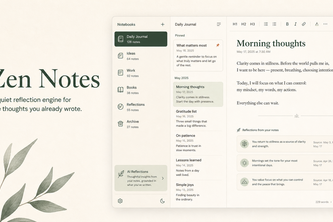
The description states that Zen Notes is a note-taking workspace with two intelligence moments:
- Quiet Review – examines one notebook and surfaces:
- Recurring threads
- Meaningful tensions
- Unfinished intentions
- Next moves
- Reflective questions
Each observation includes evidence that opens the exact source note.
- Related Thoughts – begins with a selected passage in the editor, finds conceptual continuations elsewhere in the notebook, explains why each one connects, and keeps the source a click away.
The product is described as having no persistent AI persona, no silent workspace mutation, and no unsupported “insight” without a path back to the writer's words. The model can notice and connect, but only the writer decides what becomes part of the notebook.
It uses GPT-5.6 Terra through the OpenAI Responses API, with a structured output contract enforced by Zod. The system enforces search → read sequencing, and all outputs are grounded in source material before being presented to the user.
The product is built with React 19, TypeScript, Cloudflare Workers, and deployed via OpenAI Sites.
Inference The product appears to be a single-user, AI-assisted reflection tool for personal note-taking that emphasizes traceability and control over AI-generated content. It is not a chatbot or generative assistant.
Positioning & Claim Evolution
The author states Zen Notes is built to explore "a different role for AI in a writing product" — not another prompt box, not an assistant that produces more text, but a quiet layer that helps someone hear their own thinking again and then gets out of the way.
It positions itself as focusing on reflective retrieval, rather than generation or chat. It explicitly rejects:
- Chatbot interfaces
- Silent workspace mutations
- Unsupported insights without evidence
The author claims this is not about “generating” content, but helping users notice what their existing archive is already saying.
Inference The positioning is a clear departure from typical AI note-taking tools that emphasize productivity through generation or summarization. It is positioned as a tool for personal reflection and longitudinal thinking, with an emphasis on control and traceability.
Target Customer & ICP
The description states that Zen Notes is for:
- Writers
- Founders
- Researchers
- Students
- Knowledge workers whose useful thoughts accumulate faster than they can revisit them
It claims the first success measures would not be generated words or time spent chatting, but:
- Evidence opened
- Older notes revisited after a review
- Reflections explicitly saved
- Whether a person acts on an unfinished intention that would otherwise have remained buried
Inference The target customer is someone who writes regularly and values deep reflection over productivity. The ideal customer profile is likely a knowledge worker or creative professional with a substantial personal archive of notes.
Business Model & Pricing Evidence
No pricing, monetization strategy, or business model is described in the project write-up. The description states that no account or test credential is required for the public application, and it was submitted as a hackathon project.
Not evidenced There is no indication of:
- Revenue streams
- Pricing tiers
- Subscription models
- Freemium structure
- Customer acquisition costs
Technical & Delivery Signals
The system is built with:
- React 19
- TypeScript
- Cloudflare Workers
- OpenAI GPT-5.6 Terra via the OpenAI Responses API
- vinext
- Zod for structured outputs
- shadcn/ui
- Vite
Key technical features include:
- Tool-mediated access (search → read stages)
- Strict result contracts enforced by Zod
- Clickable evidence links
- Server-side API key handling
- Notebook isolation
- No write tool in the model
- HTML-escaping of model-authored text before entering editor
- Stateless requests with capped rounds
The author states that Codex was used as the primary build environment, and that it accelerated development through iterative refinement.
Inference The product is technically sophisticated for a hackathon project. It shows strong attention to safety boundaries, traceability, and user control over AI-generated content.
Traction & Maturity Signals
The description states:
- The project was submitted as part of the OpenAI 2026 hackathon
- The repository history begins on July 18, 2026
- It is a single-person project (team size: 1)
- No revenue, customers, or adoption data are provided
Not evidenced There is no evidence of:
- User base
- Customer feedback
- Product usage metrics
- Revenue
- Market traction
Competitive Context
The description states that most AI note products optimize for generation, rewriting, or chat. Zen Notes focuses on reflective retrieval, which the author claims is a different approach.
It explicitly contrasts itself with:
- Chatbot interfaces
- Generative assistants
- Silent workspace mutations
Inference The competitive space includes tools like Notion AI, Obsidian, Roam Research, and others that offer generative or chat-based features. Zen Notes positions itself as a niche product focused on reflection rather than productivity.
Open Questions & Risks
- No commercial traction or revenue model – The project is described as a hackathon submission with no evidence of monetization.
- Single-person development – No team, no scaling plan, no clear path to growth.
- Niche positioning – The focus on reflective retrieval may not appeal to a broad audience.
- No user feedback or testing data – All claims are self-reported.
- Dependency on GPT-5.6 Terra – If this model becomes unavailable or changes, the product could be at risk.
Questions the description leaves open
- What is your plan for monetization and customer acquisition?
- How do you intend to scale beyond a single developer?
- Have you tested the product with real users beyond the author’s own use case?
- What are the risks of relying on GPT-5.6 Terra, especially if it becomes unavailable or changes?
- How do you plan to differentiate from existing note-taking tools that offer generative AI features?
- What is your roadmap for future features and product development?
Overall Assessment
Not evidenced There is no evidence of:
- Revenue
- Customers
- Traction
- Market validation
- Financials
- Team scaling
- Product-market fit beyond the author’s own experience
The project is described as a hackathon submission with no commercial history or data. It is self-reported, unverified, and lacks any indication of viability beyond the author's own claims.
Assessment The product is an interesting experiment in reflective AI for personal note-taking, but there is no evidence to support its commercial potential or scalability. It is not ready for investment or partnership without further validation.
User Stories BotA demo video on every pull request
Get a demo video on every new feature
GitHub App that watches your pull requests and records a narrated, captioned demo.
Save time on demo prep and make informed decisions faster with a video walkthrough of every new feature.
Source
Submitted to the OpenAI 2026 hackathon on Devpost. Project home on Devpost. Back to the full gallery on Devpost.
This competitive analysis was produced by top-founders.com (opens in a new tab)
Generated by a language model from this project's public Devpost page — its tagline, the author's own write-up and any built-with tags listed there — as captured in August 2026. Short quotations are the author's words. It is an opinion on the idea as a business, not on the people behind it, and it reflects the description as published then. If the project has moved on, request a correction below. The analysis is not independent research and contains no verified traction, revenue or customer data.
An independent guide by KFG International LLC — not affiliated with, endorsed by, or connected to Devpost or OpenAI.