

Archive position — measured, not model output
3 likes on Devpost
128 of the 7,850 archived projects have more likes, and 93 share exactly 3 — so this project's #131 place in the like-ranked listing is a tie-break inside that group, not a ranking.
Projects (log scale)
Likes on Devpost. ▲ marks this project's group.
Show the figures
| Likes | Projects | Share of archive |
|---|---|---|
| 0 | 5,587 | 71.2% |
| 1 | 1,758 | 22.4% |
| 2 | 284 | 3.6% |
| 3–4 | 132 | 1.7% |
| 5–9 | 75 | 1.0% |
| 10+ | 14 | 0.2% |
 User Stories BotA demo video on every pull request
Get a demo video on every new feature
GitHub App that watches your pull requests and records a narrated, captioned demo.
Save time on demo prep and make informed decisions faster with a video walkthrough of every new feature.
Executive Summary
What the company appears to be
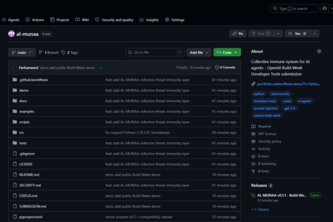
AL-MUNAA is a developer tool designed to improve AI agent safety by enabling agents within a trust family to share signed, privacy-safe threat antibodies. It uses HMAC fingerprints and deterministic guardrails to detect and block prompt-injection attacks across agents without exposing sensitive prompts or secrets.
What changed
The project was submitted as part of the OpenAI 2026 hackathon. The author describes it as a proof-of-concept tool built with Python, using GPT-5.6 for structured intent analysis and defensive vaccine generation, alongside deterministic policies for final authority.
Single most important open question
Is there evidence that AL-MUNAA can be scaled beyond its current synthetic test suite to real-world agent workflows, or does it remain a narrow vertical slice with limited production viability?
What The Product Actually Is
The description states that AL-MUNAA is a developer tool for AI agent safety. It wraps agent workflows with:
- Input and memory scanning
- An action gate
- Output verification
- A Threat Antibody Protocol
When an agent detects an attack, it creates a signed, privacy-safe HMAC fingerprint (antibody) that can be verified by other agents in the same trust family to block mutated versions of the attack before any dangerous tool call executes.
It is built as a Python package, with:
- Deterministic guardrails
- Reproducible tests
- A CLI demo
- Calibration script
- CI matrix
- Installable GitHub release
The author also notes that GPT-5.6 is used for:
- Structured intent analysis in gray cases
- Generating defensive vaccine variants (stored only as hashes)
- Test-first development of core protocol
Inference AL-MUNAA appears to be a safety layer or middleware that enables trust-family-based threat sharing among AI agents, using cryptographic and deterministic logic to maintain privacy while enabling cross-agent protection.
Positioning & Claim Evolution
The author positions AL-MUNAA as a developer tool for agent safety, focused on mitigating prompt-injection risks in autonomous AI agents. It is framed as an alternative to traditional, local, brittle prompt filters.
Key claims:
- Traditional filters are local and brittle.
- AL-MUNAA enables agents to develop “immune memory” and warn others without sharing private prompts or secrets.
- It uses a Threat Antibody Protocol with HMAC fingerprints for verification.
- The system supports trust-family-based propagation of antibodies.
The project’s evolution is described as:
- A focused vertical slice for demonstration purposes
- Built using test-first development with Codex and GPT-5.6
- Designed to be installable and testable without rebuilding
Inference AL-MUNAA positions itself as a novel, privacy-preserving approach to agent safety, but the author explicitly states it is not yet production-ready and remains a narrow vertical slice.
Target Customer & ICP
The description states that AL-MUNAA is a developer tool for AI agents. It targets:
- Developers building autonomous AI agents
- Teams managing agent fleets or trust families
It is not described as targeting end-users, enterprises, or consumers directly.
Inference The primary customer segment appears to be AI developers and engineering teams working with autonomous agents, particularly those in environments where prompt-injection risks are high and cross-agent threat sharing is valuable.
Business Model & Pricing Evidence
No evidence of a business model or pricing structure is provided. The description does not mention:
- Revenue streams
- Subscription plans
- Licensing models
- Customer acquisition costs
- Monetization strategy
Inference There is no evidenced business model or pricing information. The tool appears to be a prototype or proof-of-concept submitted for a hackathon.
Technical & Delivery Signals
The author states:
- AL-MUNAA is built as a Python package
- Uses deterministic guardrails and reproducible tests
- Includes a CLI demo, calibration script, CI matrix, and GitHub release
- Employs Jaccard similarity with padding-resistant containment matching
- Uses bounded HMAC sketches (256 to 512 entries)
- Rejects antibodies from different trust families
- Integrates GPT-5.6 for gray-case analysis and defensive vaccine generation
Tests:
- Full local suite: 74 tests passed
- Legacy matcher: 3/4 attacks detected, 0/5 false positives
- Calibrated matcher: 4/4 attacks detected, 0/5 false positives
- Demo margin improved from 0.0264 to 0.1474
- 64 deterministic family keys produced 576 fixture evaluations with zero fixture errors
Inference The tool is built with a test-first approach, and the author provides technical details about its architecture, including cryptographic elements and integration with GPT-5.6. The system shows some early-stage maturity in testing and validation.
Traction & Maturity Signals
No evidence of traction or adoption is provided:
- No customers
- No revenue
- No usage metrics
- No product-market fit signals
The author explicitly states:
- The project is a focused vertical slice
- The calibration matrix is small and synthetic
- It does not claim production-wide recall, zero false positives, or protection from every semantic rewrite
Inference There are no evidenced traction or maturity signals beyond the internal test suite. The tool remains in a pre-production prototype phase, with no indication of real-world deployment or adoption.
Competitive Context
No evidence is provided about:
- Competitors
- Market positioning
- Prior art or similar tools
- Competitive advantages or differentiation
The author does not reference existing solutions for AI agent safety or prompt-injection protection.
Inference There is no evidenced competitive context. The tool’s positioning is unanchored in a known market landscape, and no comparison to existing tools or approaches is made.
Open Questions & Risks
- Prototype-only: The system is described as a narrow vertical slice for hackathon demonstration.
- No production data: No real-world testing or deployment evidence.
- Limited scope: The calibration matrix is synthetic and small, not representative of real-world threats.
- Dependency on GPT-5.6: While deterministic logic is the final authority, GPT-5.6 is used for gray cases and vaccine generation — a potential point of fragility or inconsistency.
- Trust-family model: The system assumes shared trust families, which may not scale in complex or open agent ecosystems.
Inference The tool is not yet production-ready, and its scalability and robustness beyond the current test suite are unproven. Risks include over-reliance on synthetic data, limited threat coverage, and potential fragility in real-world deployment.
Questions the description leaves open
- What is the expected performance of AL-MUNAA against a real-world corpus of prompt-injection attacks?
- How does AL-MUNAA handle cross-trust-family communication or integration with external agents?
- Is there any plan to support other agent runtimes beyond the current Python-based prototype?
- What are the limitations of the HMAC-based antibody matching in terms of scalability and false-negative rates?
- How is the trust-family model enforced, and what happens if a family member is compromised?
- Are there plans for a dashboard or UI for monitoring antibody propagation across agent fleets?
Overall Assessment
Not evidenced
The description does not provide any information on:
- Financials
- Revenue
- Customers
- Market size
- Strategic fit
- Founders’ track record
- Product-market fit
This is a self-reported, unverified prototype, submitted for a hackathon. It shows early technical maturity and a novel idea but lacks evidence of traction, scalability, or commercial viability.
Inference
At this stage, AL-MUNAA is best described as an idea with potential, not a product ready for investment or partnership. A follow-up diligence effort would require:
- Real-world testing data
- Evidence of adoption or usage
- Proof of concept in production environments
- Clarity on monetization and scalability plans
User Stories BotA demo video on every pull request
Get a demo video on every new feature
GitHub App that watches your pull requests and records a narrated, captioned demo.
Save time on demo prep and make informed decisions faster with a video walkthrough of every new feature.
Source
Submitted to the OpenAI 2026 hackathon on Devpost. Project home on Devpost. Back to the full gallery on Devpost.
This competitive analysis was produced by top-founders.com (opens in a new tab)
Generated by a language model from this project's public Devpost page — its tagline, the author's own write-up and any built-with tags listed there — as captured in August 2026. Short quotations are the author's words. It is an opinion on the idea as a business, not on the people behind it, and it reflects the description as published then. If the project has moved on, request a correction below. The analysis is not independent research and contains no verified traction, revenue or customer data.
An independent guide by KFG International LLC — not affiliated with, endorsed by, or connected to Devpost or OpenAI.