

Archive position — measured, not model output
0 likes on Devpost
2,263 of the 7,850 archived projects have more likes, and 5,587 share exactly 0 — so this project's #7,791 place in the like-ranked listing is a tie-break inside that group, not a ranking.
Projects (log scale)
Likes on Devpost. ▲ marks this project's group.
Show the figures
| Likes | Projects | Share of archive |
|---|---|---|
| 0 | 5,587 | 71.2% |
| 1 | 1,758 | 22.4% |
| 2 | 284 | 3.6% |
| 3–4 | 132 | 1.7% |
| 5–9 | 75 | 1.0% |
| 10+ | 14 | 0.2% |
 User Stories BotA demo video on every pull request
Get a demo video on every new feature
GitHub App that watches your pull requests and records a narrated, captioned demo.
Save time on demo prep and make informed decisions faster with a video walkthrough of every new feature.
Executive Summary
What the company appears to be
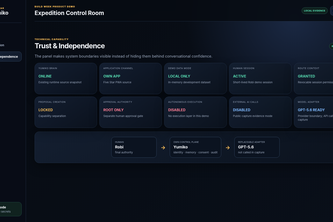
The project described by the caller is Yumiko Expedition Control Room, a self-reported AI companion runtime designed for solo expedition travelers. It is positioned as a consent-first system that supports human decision-making while maintaining control over data access and permissions.
What changed
The author states this project began as part of a real-world expedition planning effort (from Budapest to Yakutsk) and evolved into a demonstration of an AI companion runtime with explicit permission controls. It was built during the OpenAI 2026 hackathon using tools like FastAPI, JavaScript, HTML/CSS, and Codex with GPT-5.6.
Single most important open question
Is there evidence that Yumiko has moved beyond a prototype or demonstration into actual use by travelers, or whether it is merely an experimental concept?
Note: This analysis is based entirely on the self-reported description provided by the author. No external verification, traction data, revenue figures, customer names, or historical performance are available.
What The Product Actually Is
The description states that Yumiko Expedition Control Room is a consent-first AI companion runtime for solo travelers. It demonstrates how a traveler can interact with AI tools while retaining control over access to sensitive information such as route data and permissions.
It includes:
- A local backend (FastAPI) with a JavaScript/HTML/CSS interface.
- An interface that shows exactly what data is requested, why it's needed, where it remains, and for how long.
- A visible countdown timer and explicit revocation control.
- Audit logging of user decisions.
- No real production data or API credentials included in the demo.
Inference: The system enforces permission-based access through UI and backend logic. It is not a chatbot but an AI companion runtime with structured workflows around consent and decision-making.
Positioning & Claim Evolution
The author claims that Yumiko is not another chatbot, but rather an AI companion runtime designed to support travelers while keeping authority with the human user.
Key positioning elements:
- Consent-first: Access must be explicitly granted and can be revoked.
- Provider-independent: Not tied to a single AI model or provider.
- Human-in-control: Decision-making remains with the traveler.
- Trust-building through visibility: System behavior makes access, duration, and authority visible.
Claim vs Fact: These are stated as design principles and goals. There is no evidence of actual adoption or commercial traction.
Target Customer & ICP
The description states that Yumiko targets solo expedition travelers, particularly those planning long-distance journeys like the Budapest-to-Yakutsk route mentioned.
Inference: The target audience is individuals who travel alone and make critical decisions in remote environments, where AI assistance could improve situational awareness without compromising autonomy or privacy.
Business Model & Pricing Evidence
There is no evidence of pricing, monetization strategy, or business model in the provided description.
Not evidenced — No mention of subscriptions, usage fees, partnerships, or any commercial structure.
Technical & Delivery Signals
The system was built using:
- Backend: FastAPI
- Frontend: JavaScript, HTML, CSS
- AI tools used: Codex with GPT-5.6 Sol
- Development environment: Local sample data only; no production secrets or private memory included
- Testing: Lifecycle tests verify denial, grant, use, revocation, and audit logging
Inference: The project uses modern development practices (CI/CD-like testing), but lacks evidence of scalability or deployment in real-world settings.
Traction & Maturity Signals
The description does not provide any traction signals such as:
- Revenue
- Customers
- User base
- Product adoption
- Market validation
Not evidenced — The project is described as a hackathon submission and demonstration, not a product in active use.
Competitive Context
No competitive landscape or market positioning is described. The author does not reference existing products or platforms that serve similar audiences (e.g., travel apps, AI assistants for outdoor adventurers).
Not evidenced — No mention of competitors or differentiation from other tools.
Open Questions & Risks
- Prototype-only: The project is presented as a demonstration, not a product in use.
- No commercial traction: No evidence of revenue, customers, or adoption.
- Limited scope: Only local sample data and simulated workflows are shown.
- Founder team size: One person (gtrgear Terenyi) — raises questions about execution capacity.
- Unverified claims: All features are self-reported without independent validation.
Inference: The project may be a proof-of-concept or experimental idea, not yet ready for market deployment or investment.
Questions the description leaves open
- Has Yumiko been tested in real-world expeditions beyond the Budapest-to-Yakutsk planning phase?
- What is the plan to transition from a demo to a usable product?
- Are there any early adopters or pilot users currently testing the system?
- How will user data be stored and managed in persistent mode?
- What are the technical challenges expected when scaling beyond local development?
Overall Assessment
Not evidenced — There is no evidence of revenue, traction, or a clear path to monetization.
Confidence Level: Low
This is a self-reported prototype or demonstration submitted for a hackathon. It shows thoughtful design around consent and user control but lacks any indication of commercial viability or real-world usage. The author states that the next steps include field testing during an actual expedition, which suggests this is still in early development.
User Stories BotA demo video on every pull request
Get a demo video on every new feature
GitHub App that watches your pull requests and records a narrated, captioned demo.
Save time on demo prep and make informed decisions faster with a video walkthrough of every new feature.
Source
Submitted to the OpenAI 2026 hackathon on Devpost. Project home on Devpost. Back to the full gallery on Devpost.
This competitive analysis was produced by top-founders.com (opens in a new tab)
Generated by a language model from this project's public Devpost page — its tagline, the author's own write-up and any built-with tags listed there — as captured in August 2026. Short quotations are the author's words. It is an opinion on the idea as a business, not on the people behind it, and it reflects the description as published then. If the project has moved on, request a correction below. The analysis is not independent research and contains no verified traction, revenue or customer data.
An independent guide by KFG International LLC — not affiliated with, endorsed by, or connected to Devpost or OpenAI.