

Archive position — measured, not model output
0 likes on Devpost
2,263 of the 7,850 archived projects have more likes, and 5,587 share exactly 0 — so this project's #3,867 place in the like-ranked listing is a tie-break inside that group, not a ranking.
Projects (log scale)
Likes on Devpost. ▲ marks this project's group.
Show the figures
| Likes | Projects | Share of archive |
|---|---|---|
| 0 | 5,587 | 71.2% |
| 1 | 1,758 | 22.4% |
| 2 | 284 | 3.6% |
| 3–4 | 132 | 1.7% |
| 5–9 | 75 | 1.0% |
| 10+ | 14 | 0.2% |
 User Stories BotA demo video on every pull request
Get a demo video on every new feature
GitHub App that watches your pull requests and records a narrated, captioned demo.
Save time on demo prep and make informed decisions faster with a video walkthrough of every new feature.
Executive Summary
The company appears to be a solo fintech project with an ambitious scope, claiming to build a multimodal social network and financial ecosystem. The author states it is a self-contained, JavaScript-based system, currently in pre-production with local deployment capabilities but no verified traction or revenue. It is positioned as a future-oriented platform integrating banking, payments, social networking, e-commerce, education, media, and more.
What changed
The project description was submitted to the OpenAI 2026 hackathon, indicating it is a prototype or proof-of-concept in early development stages.
The single most important open question
Is there any evidence of actual user adoption, revenue generation, or functional deployment beyond local environments?
What The Product Actually Is
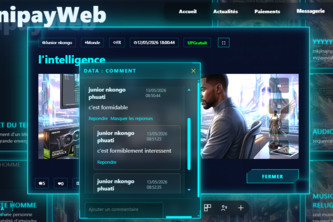
- The description states that Écosystème Unipay is a fintech project.
- It claims to offer multiple services, including:
- A digital banking service
- A mobile payments aggregator
- A multimodal social network
- Remote work tools
- E-commerce capabilities
- An investment network
- Media sales and TV broadcasting services
- Cinema and series subscription services
- Digital library and educational portal
- Management platform for institutions and universities
- The project is described as being built with JavaScript.
- It is claimed to be in a pre-production stage, with local deployment already operational but not yet deployed publicly due to financial constraints.
Inference: The product appears to be a highly ambitious, multi-functional platform that combines fintech and social media elements. However, the description does not clarify whether these components are integrated or separate offerings.
Positioning & Claim Evolution
- The author positions Écosystème Unipay as a fintech project with an ambitious innovation agenda, aiming to address limitations in current banking services.
- It is described as a future-oriented platform that integrates various digital services under one umbrella.
- The tagline, “Réseau social multimodal” (Multimodal social network), suggests a focus on social interaction and multimedia content within the broader financial ecosystem.
Inference: The positioning seems to evolve from a simple fintech solution toward a comprehensive digital ecosystem, though no evidence supports whether this vision has been realized or validated by users.
Target Customer & ICP
- The description states that the project aims to serve public and private companies.
- It also mentions universities and educational institutions as potential users of its digital library and management portal.
Not evidenced: No specific customer segments, personas, or user types are defined. There is no indication of how the target audience would interact with the platform beyond general references to public/private entities.
Business Model & Pricing Evidence
- The description does not provide any information about:
- Revenue streams
- Pricing models
- Monetization strategies
- Customer acquisition costs
- Unit economics
Not evidenced: No evidence of a defined business model or pricing structure is provided. The project is described as being in pre-production with no verified commercial activity.
Technical & Delivery Signals
- The system is built using JavaScript.
- It is claimed to be locally operational, with the architecture already designed and in development.
- The author notes that it has more than 50 million lines of code.
- Deployment is stated to be in progress, but not yet live due to financial constraints.
Inference: The technical stack and scale suggest a complex, possibly large-scale system. However, there is no evidence of actual deployment or performance metrics.
Traction & Maturity Signals
- The project is described as being in pre-production.
- It has not yet been deployed publicly, despite local functionality.
- The author mentions that the project has already reached 50 million lines of code, but this does not indicate user adoption or product maturity.
Not evidenced: No evidence of traction, customers, usage data, or product-market fit is provided. The project remains in an early development phase with no verified market presence.
Competitive Context
- The description does not mention any competitors.
- It does not provide a clear understanding of the competitive landscape or how it differentiates from existing platforms in fintech, social media, or digital ecosystems.
Not evidenced: No competitive analysis or differentiation strategy is evident. The scope of the project implies potential overlap with multiple industries, but no specific competitive positioning is stated.
Open Questions & Risks
- The project is described as being developed by a single person ("schwarz junior").
- It is in pre-production, with financial difficulties preventing public deployment.
- The claim of 50 million lines of code raises questions about feasibility and maintainability.
- The scope of the platform is extremely broad, potentially leading to overextension or lack of focus.
- No evidence of revenue, customers, or product-market fit.
Inference: The solo development model, combined with financial constraints and an overly ambitious scope, presents significant risks for execution and scalability.
Questions the description leaves open
- What specific problem does Écosystème Unipay solve that existing platforms do not?
- How is the platform currently being tested or validated (if at all)?
- What are the key assumptions underlying the business model, and how are they being tested?
- Is there any evidence of user feedback or early adopters?
- What is the timeline for public deployment, and what financial hurdles remain?
- How does the team plan to scale beyond a single developer?
Overall Assessment
- The project is described as self-contained, built in JavaScript, and currently in pre-production.
- It has no verified traction or revenue.
- It is not yet deployed and faces financial constraints.
- The scope of the platform is extremely broad and may be difficult to execute effectively.
Assessment: Based on the self-reported description alone, there is no evidence of a viable business model, customer base, or commercial readiness. This appears to be an early-stage concept with high ambition but no demonstrated progress toward market validation. Any investment or partnership decision should be contingent upon further verification of functionality, traction, and scalability.
User Stories BotA demo video on every pull request
Get a demo video on every new feature
GitHub App that watches your pull requests and records a narrated, captioned demo.
Save time on demo prep and make informed decisions faster with a video walkthrough of every new feature.
Source
Submitted to the OpenAI 2026 hackathon on Devpost. Project home on Devpost. Back to the full gallery on Devpost.
This competitive analysis was produced by top-founders.com (opens in a new tab)
Generated by a language model from this project's public Devpost page — its tagline, the author's own write-up and any built-with tags listed there — as captured in August 2026. Short quotations are the author's words. It is an opinion on the idea as a business, not on the people behind it, and it reflects the description as published then. If the project has moved on, request a correction below. The analysis is not independent research and contains no verified traction, revenue or customer data.
An independent guide by KFG International LLC — not affiliated with, endorsed by, or connected to Devpost or OpenAI.