

Archive position — measured, not model output
0 likes on Devpost
2,263 of the 7,850 archived projects have more likes, and 5,587 share exactly 0 — so this project's #7,793 place in the like-ranked listing is a tie-break inside that group, not a ranking.
Projects (log scale)
Likes on Devpost. ▲ marks this project's group.
Show the figures
| Likes | Projects | Share of archive |
|---|---|---|
| 0 | 5,587 | 71.2% |
| 1 | 1,758 | 22.4% |
| 2 | 284 | 3.6% |
| 3–4 | 132 | 1.7% |
| 5–9 | 75 | 1.0% |
| 10+ | 14 | 0.2% |
 User Stories BotA demo video on every pull request
Get a demo video on every new feature
GitHub App that watches your pull requests and records a narrated, captioned demo.
Save time on demo prep and make informed decisions faster with a video walkthrough of every new feature.
Executive Summary
What the company appears to be
ZAHRAA™ AI is a self-reported educational AI tool designed to support teachers in creating personalized lessons by prompting them to reason through instructional decisions before content generation. It claims to implement a "pedagogical reasoning layer" (Z-PRL) that guides lesson design based on classroom context, learner needs, and teaching strategy.
What changed
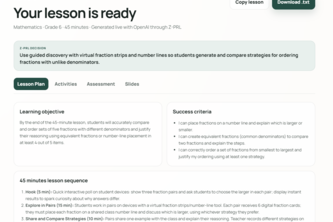
The project evolved from an initial rule-based prototype to a serverless web application integrating OpenAI’s API for dynamic lesson generation. The author states it now connects to the OpenAI Responses API via a secure Vercel function, protects API keys, and includes a transparent fallback mechanism.
Single most important open question — the commercial due-diligence read
Is there evidence of real-world teacher adoption or feedback that validates the need for this type of pedagogical reasoning tool in educational settings?
What The Product Actually Is
The description states that ZAHRAA™ AI is a responsive web application built with HTML, CSS, JavaScript, and hosted on Vercel. It uses a serverless function to connect to the OpenAI Responses API, which generates structured lesson plans based on inputs such as subject, grade level, learning goal, class size, learner support needs, teaching strategy, assessment approach, and available resources.
The system is described as implementing a Z-PRL (ZAHRAA™ Pedagogical Reasoning Layer) that collects teacher input through focused questions before generating content. It also includes a local fallback mechanism if the OpenAI connection fails.
Not evidenced:
- Whether the product is currently live or used by teachers.
- The actual structure of the Z-PRL or how it processes inputs into instructional decisions.
- If the system supports export formats beyond what is described in the write-up (e.g., PDF, Word).
Positioning & Claim Evolution
The author claims that ZAHRAA™ AI positions itself as an alternative to "most educational AI tools" that generate content instantly without considering pedagogical reasoning. It introduces a four-stage workflow:
- Understand the teacher’s request and classroom context.
- Reason through learner needs, teaching strategy, assessment approach, and available resources.
- Decide on an appropriate instructional design.
- Generate a complete educational lesson.
This evolution from instant generation to reasoning-first reflects a shift toward human-centered AI in education, aiming to support rather than replace teacher judgment.
Inferred:
- The positioning is rooted in criticism of current AI tools that bypass pedagogical thought processes.
- The project’s claim of being “think first, generate second” is framed as a response to perceived over-reliance on automated content creation.
Not evidenced:
- No evidence of market research or user interviews supporting this positioning.
- No data on how the product differentiates from existing lesson-planning tools or AI assistants used by teachers.
Target Customer & ICP
The description states that ZAHRAA™ AI is designed for teachers who want to create context-aware, personalized lessons. It specifically mentions:
- Teachers needing to consider learner support needs,
- Classroom constraints,
- Instructional strategies,
- Assessment methods,
- Differentiation.
It also notes that the system supports different subjects (e.g., Mathematics and History) and includes features like multilingual interfaces and curriculum alignment in future versions.
Inferred:
- The target customer is a teacher or educator, likely at the K–12 level, given references to grade levels and classroom context.
- The ICP may be teachers seeking tools that enhance their planning process rather than replace it.
Not evidenced:
- No evidence of actual teacher users or feedback.
- No segmentation data (e.g., grade levels, subject specializations, school types).
- No indication of whether the tool is aimed at individual teachers or institutions.
Business Model & Pricing Evidence
The description does not contain any information about pricing, monetization strategy, or business model. It only describes the technical architecture and functionality.
Not evidenced:
- No mention of how the product will be sold or who pays for it.
- No indication of whether it is free, subscription-based, or enterprise-focused.
- No evidence of revenue streams or customer acquisition plans.
Technical & Delivery Signals
The project is built as a responsive web application using:
- HTML, CSS, JavaScript
- Serverless functions on Vercel
- OpenAI Responses API
- Protected environment variables for API keys
- Local fallback for technical failures
It supports both desktop and mobile interfaces and includes transparency features such as clearly indicating when output is from a local fallback.
Inferred:
- The use of serverless architecture suggests scalability and ease of deployment.
- The inclusion of a fallback mechanism shows awareness of reliability concerns in AI systems.
Not evidenced:
- No evidence of performance metrics, uptime, or error handling beyond the fallback.
- No information on how the system scales or handles concurrent users.
- No mention of data privacy or security compliance measures.
Traction & Maturity Signals
The description states that:
- The project was submitted to the OpenAI 2026 hackathon.
- It has been tested with different subjects (Mathematics, History).
- A live History test generated a lesson about the causes of World War I and displayed: “Generated live with OpenAI through Z-PRL.”
Inferred:
- The product is in an early stage of development, likely a prototype or MVP.
- It has undergone some form of internal testing but lacks external validation.
Not evidenced:
- No evidence of real-world usage by teachers or schools.
- No data on user engagement, retention, or feedback loops.
- No indication of whether the tool is being used in classrooms or pilot programs.
Competitive Context
The description does not provide any information about competitors or how ZAHRAA™ AI compares to existing tools in the educational AI space.
Not evidenced:
- No mention of competing platforms (e.g., Teachers Pay Teachers, Khan Academy, Notion AI, etc.).
- No evidence of competitive advantages or unique value propositions beyond its "reasoning-first" approach.
- No indication of market size or growth trends in the educational AI sector.
Open Questions & Risks
- Lack of Traction: The project is described as a hackathon submission with no evidence of real-world adoption.
- Unproven Market Need: There is no evidence that teachers actually need or want this type of reasoning layer in their lesson planning.
- Technical Risks: While the system uses serverless functions and API protection, there’s no evidence of robust error handling or scalability testing.
- Overpromising on AI Integration: The claim that it "generates live with OpenAI" may be misleading if the system does not yet support full integration or consistent performance.
- No Business Model: Without a clear monetization strategy, the project lacks commercial viability.
Inferred:
- The lack of real-world feedback raises questions about whether the solution addresses actual pain points in teaching workflows.
- The focus on transparency and fallbacks may indicate early-stage development with unresolved technical challenges.
Questions the description leaves open
- What specific problems do teachers face in lesson planning that this tool aims to solve?
- Have you conducted any user research or interviews with educators?
- How does the Z-PRL layer actually make instructional decisions? Is it rule-based, AI-driven, or a hybrid?
- What is your plan for scaling beyond the hackathon prototype?
- Are there any partnerships or pilot programs with schools or districts?
- How do you intend to monetize this product?
- What are the key assumptions behind the "think first, generate second" approach?
- Can you demonstrate how the system handles edge cases or unexpected inputs?
Overall Assessment
Confidence Level: Low
The project is described as a hackathon submission, and there is no evidence of traction, revenue, customers, or adoption beyond self-reported claims. The author states that it was built for a competition and includes features like multilingual support and curriculum alignment in future versions.
While the idea of integrating pedagogical reasoning into AI tools has potential, the lack of real-world validation, user feedback, or business model makes it difficult to assess its commercial viability.
Assessment Not ready for investment or partnership at this stage. Further evidence of market need, user testing, and product maturity is required before considering deeper due diligence.
User Stories BotA demo video on every pull request
Get a demo video on every new feature
GitHub App that watches your pull requests and records a narrated, captioned demo.
Save time on demo prep and make informed decisions faster with a video walkthrough of every new feature.
Source
Submitted to the OpenAI 2026 hackathon on Devpost. Project home on Devpost. Back to the full gallery on Devpost.
This competitive analysis was produced by top-founders.com (opens in a new tab)
Generated by a language model from this project's public Devpost page — its tagline, the author's own write-up and any built-with tags listed there — as captured in August 2026. Short quotations are the author's words. It is an opinion on the idea as a business, not on the people behind it, and it reflects the description as published then. If the project has moved on, request a correction below. The analysis is not independent research and contains no verified traction, revenue or customer data.
An independent guide by KFG International LLC — not affiliated with, endorsed by, or connected to Devpost or OpenAI.