

Archive position — measured, not model output
0 likes on Devpost
2,263 of the 7,850 archived projects have more likes, and 5,587 share exactly 0 — so this project's #7,789 place in the like-ranked listing is a tie-break inside that group, not a ranking.
Projects (log scale)
Likes on Devpost. ▲ marks this project's group.
Show the figures
| Likes | Projects | Share of archive |
|---|---|---|
| 0 | 5,587 | 71.2% |
| 1 | 1,758 | 22.4% |
| 2 | 284 | 3.6% |
| 3–4 | 132 | 1.7% |
| 5–9 | 75 | 1.0% |
| 10+ | 14 | 0.2% |
 User Stories BotA demo video on every pull request
Get a demo video on every new feature
GitHub App that watches your pull requests and records a narrated, captioned demo.
Save time on demo prep and make informed decisions faster with a video walkthrough of every new feature.
Executive Summary
What the company appears to be
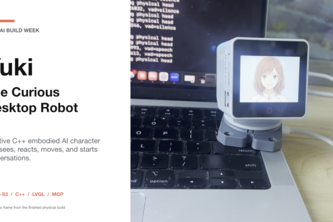
The author describes a desktop robot named Yuki, built as a hackathon project for the OpenAI 2026 hackathon. It is an expressive physical AI companion that uses embedded hardware (ESP32-S3) and software (C++, FreeRTOS, LVGL) to detect faces, respond to gestures, animate facial expressions, and interact with users through voice, movement, and light. The robot is designed to remain attentive between interactions and engage in curiosity-driven conversations.
What changed
This project represents a self-contained, embedded hardware/software system built from scratch by one individual (Bary Huang). It includes custom firmware modifications, on-device perception and animation logic, and integration of AI tools via the Model Context Protocol (MCP), all within a constrained environment like an ESP32-S3.
Single most important open question
Is there any evidence that this project has moved beyond the prototype or hackathon stage? The description is entirely self-reported and unverified — no revenue, customers, traction, or production data are provided. If it remains a personal or experimental endeavor, it may not yet be a viable commercial proposition.
What The Product Actually Is
The description states that Yuki is:
- A desktop robot with expressive facial features.
- Capable of face detection and gaze tracking using an on-device camera.
- Equipped with gesture wake-up (hand wave, head touch) and voice wake-word ("Hi Yuki").
- An animated character rendered in C++ and LVGL, using limited-animation principles inspired by Japanese TV animation.
- Integrated with hardware capabilities such as servos, LEDs, and a camera through MCP tools.
- Designed to explore the web around user interests via an idle curiosity scheduler.
- Built on M5Stack’s open-source firmware platform, extended at the firmware level.
Inference Yuki is a physical AI companion that combines embedded systems engineering with expressive animation and interaction design. It functions as both a hardware device and a software-controlled agent within a constrained runtime environment.
Positioning & Claim Evolution
The author claims:
- Yuki is an “expressive desktop robot” that remains visibly attentive between interactions.
- It replaces traditional voice assistants by offering a visible, animated presence.
- The design draws from Japanese limited-animation principles to reduce computational load while maintaining personality.
- It integrates with AI backends through MCP tools but keeps its own physical and sensory components on-device.
Inference The positioning is that of an experimental, expressive AI companion — not a mainstream product. The project seems to be an exploration of how embedded hardware can support emotional or conversational interaction in a low-resource setting.
Target Customer & ICP
Not evidenced.
The description does not identify:
- Specific customer segments.
- Use cases beyond personal experimentation.
- Market targeting or personas.
- Any indication of who would buy or use this product.
Absence of evidence
No information is provided about target customers, their needs, or whether the project addresses a market demand.
Business Model & Pricing Evidence
Not evidenced.
The description does not contain:
- Revenue streams.
- Pricing models.
- Monetization strategies.
- Any indication of commercial intent beyond the hackathon submission.
Absence of evidence
There is no evidence of any business model or pricing structure in the project description.
Technical & Delivery Signals
The author states:
- Built with C, C++, ESP-IDF, ESP32-S3, FreeRTOS, LVGL.
- Uses local face detection and gesture recognition.
- Implements layered animation using LVGL and custom rendering logic.
- Integrates with MCP tools for hardware control (servos, camera, LEDs).
- Runs on M5Stack’s open-source firmware, extended at the firmware level.
- Addresses memory constraints through careful task stack placement and model loading strategies.
Inference The technical approach is embedded systems-focused, using low-level programming and resource-aware design. The author demonstrates deep understanding of hardware-software integration in a constrained environment.
Traction & Maturity Signals
Not evidenced.
There is no mention of:
- Customers or users.
- Revenue or sales.
- Product adoption or usage metrics.
- Iterations beyond the hackathon version.
- Any production deployment or scaling efforts.
Absence of evidence
No traction or maturity indicators are present in the description.
Competitive Context
Not evidenced.
The description does not reference:
- Competitors.
- Market positioning relative to existing AI companions or robots.
- Prior art or similar products.
- Strategic differentiation from other devices.
Absence of evidence
No competitive analysis or market context is provided.
Open Questions & Risks
Inferences based on the self-reported nature of the project:
- Unverified claims: All statements are self-reported and unverifiable — no third-party validation.
- Prototype-only status: The project appears to be a hackathon prototype with no evidence of further development or commercialization.
- Single-person effort: Only one team member is listed, suggesting limited capacity for scaling or execution.
- Embedded complexity risk: The project involves complex embedded engineering and memory management; lack of independent testing or validation raises concerns about robustness.
- No monetization path: No indication that the author intends to commercialize or monetize the product.
Questions the description leaves open
- Has this project progressed beyond the hackathon stage? Are there plans for production or further development?
- What is the intended user base and use case for Yuki?
- How does the author plan to scale or improve upon the current embedded architecture?
- Is there any intention to integrate with existing AI platforms or services beyond what’s described?
- What are the long-term goals for this project — is it a personal experiment, a side hustle, or a commercial venture?
Overall Assessment
Not evidenced.
The description does not provide:
- Financials.
- Market opportunity.
- Team traction.
- Strategic fit for potential investors or partners.
- Any indication of readiness for investment or partnership.
Absence of evidence
No basis exists to assess whether this project is suitable for investment or partnership. It appears to be a personal or experimental endeavor, not yet a commercial proposition.
User Stories BotA demo video on every pull request
Get a demo video on every new feature
GitHub App that watches your pull requests and records a narrated, captioned demo.
Save time on demo prep and make informed decisions faster with a video walkthrough of every new feature.
Source
Submitted to the OpenAI 2026 hackathon on Devpost. Project home on Devpost. Back to the full gallery on Devpost.
This competitive analysis was produced by top-founders.com (opens in a new tab)
Generated by a language model from this project's public Devpost page — its tagline, the author's own write-up and any built-with tags listed there — as captured in August 2026. Short quotations are the author's words. It is an opinion on the idea as a business, not on the people behind it, and it reflects the description as published then. If the project has moved on, request a correction below. The analysis is not independent research and contains no verified traction, revenue or customer data.
An independent guide by KFG International LLC — not affiliated with, endorsed by, or connected to Devpost or OpenAI.