

Archive position — measured, not model output
0 likes on Devpost
2,263 of the 7,850 archived projects have more likes, and 5,587 share exactly 0 — so this project's #7,766 place in the like-ranked listing is a tie-break inside that group, not a ranking.
Projects (log scale)
Likes on Devpost. ▲ marks this project's group.
Show the figures
| Likes | Projects | Share of archive |
|---|---|---|
| 0 | 5,587 | 71.2% |
| 1 | 1,758 | 22.4% |
| 2 | 284 | 3.6% |
| 3–4 | 132 | 1.7% |
| 5–9 | 75 | 1.0% |
| 10+ | 14 | 0.2% |
 User Stories BotA demo video on every pull request
Get a demo video on every new feature
GitHub App that watches your pull requests and records a narrated, captioned demo.
Save time on demo prep and make informed decisions faster with a video walkthrough of every new feature.
Executive Summary
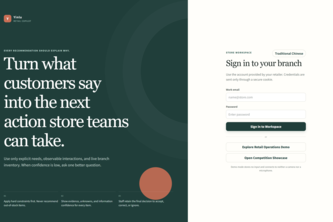
The company appears to be a solo project (1 person) submitted to the OpenAI 2026 hackathon, titled Yinlu Retail Copilot. The author describes it as an AI-powered retail sales assistant that provides explainable product recommendations while prioritizing privacy, consent, and safety. It includes a full-stack system with web and API components, recommendation logic, and simulated workflows for audio/vision processing.
What changed: This is a hackathon submission, not a commercial product or service. No evidence of revenue, customers, or operational traction exists beyond the project’s self-reported scope.
Single most important open question: Is there any evidence that this system has moved beyond the prototype stage into real-world deployment or pilot testing with actual retail staff?
Analysis basis: Self-reported only. The description is unverified and contains no data on revenue, customers, funding, or market traction.
What The Product Actually Is
- The description states that Yinlu Retail Copilot is an AI-powered retail sales assistant.
- It turns observable customer context into explainable product recommendations.
- It separates confirmed facts from inferred signals.
- It includes a bilingual retail workflow, top-3 product recommendations, conversation-based reranking, safety checks, consent-aware capture flows, and operational analytics for store teams.
- The system uses structured customer facts, product constraints, inventory context, and safety policies to produce traceable ranking decisions.
- It integrates with domain packs for retail catalogs and recommendation rules.
- Built using Next.js, FastAPI, PostgreSQL, Redis, Docker, and various AI tools including Whisper/faster-whisper, Qwen, ONNX, and OpenAI models like GPT-4o.
Inference: The system appears to be a simulated or demo version of an AI copilot designed for in-store retail use. It is not evidenced to be live or used by any real business.
Positioning & Claim Evolution
- The author positions the product as a privacy-first, safety-aware, and explainable AI assistant for retail staff.
- It emphasizes keeping “safety alerts separate” and avoiding silent inference of sensitive attributes.
- The system is described as more than a prompt demo — it includes working web experience, API, recommendation engine, domain-pack system, consent model, safety workflow, tests, simulation tooling, screenshots, and a demo video.
Claim vs. Fact: The description claims the product is “more than a prompt demo,” but this is self-reported and not independently verified. No evidence of actual deployment or adoption exists.
Target Customer & ICP
- The target customer is retail staff who need to quickly understand customer needs, recommend products, and avoid unsafe assumptions.
- It is intended for use in physical stores with a focus on human-in-the-loop decision-making.
- The system supports bilingual workflows, suggesting a global or multilingual retail environment.
Not evidenced: No evidence of actual customers, user personas, or market segmentation beyond the author’s stated intent.
Business Model & Pricing Evidence
- Not evidenced. The description does not mention any pricing structure, monetization strategy, or business model.
Inference: Given that this is a hackathon project and no commercial use case or pricing is described, it appears to be an experimental prototype with no known revenue model.
Technical & Delivery Signals
- Built with Next.js (frontend), FastAPI (backend), PostgreSQL, Redis, Docker.
- Uses AI technologies including Whisper/faster-whisper, Qwen, ONNX, OpenAI GPT-4o, and Playwright for testing.
- Includes structured recommendation logic, consent-aware capture flows, safety workflows, and domain-pack systems.
- Simulated audio and vision pipelines are mentioned, with high-risk signals kept behind consent gates.
- The system includes tests, simulation tooling, screenshots, and a demo video.
Inference: The technical stack suggests a full-stack prototype. However, no evidence of production readiness or scalability is provided.
Traction & Maturity Signals
- Not evidenced. No data on users, adoption, revenue, or operational usage exists.
- The project was submitted to a hackathon and described as a demo with simulated workflows.
- The author mentions “what’s next” includes improving live pilot workflow, adding more retail domains, and connecting POS/inventory systems — all of which are future plans, not current achievements.
Absence of evidence: No signs of traction or maturity beyond the prototype stage.
Competitive Context
- Not evidenced. No mention of competitors, market analysis, or positioning relative to existing solutions in the AI retail assistant space.
Inference: The project does not appear to be part of a competitive landscape, as it is described as a solo hackathon effort with no commercial presence.
Open Questions & Risks
- Solo team (1 member) — raises questions about scalability and long-term maintenance.
- Hackathon submission — implies prototype or demo-level functionality, not production-ready software.
- No evidence of real-world testing, customer feedback, or operational data.
- Privacy and safety features are emphasized, but no details on how these are implemented in practice or validated.
Open question: The lack of any commercial or operational evidence makes it difficult to assess viability beyond the demo stage.
Questions the description leaves open
- Has this system been tested with actual retail staff or customers?
- What is the current status of the “live pilot workflow” mentioned in the “What’s next” section?
- Are there any plans for integrating with real POS or inventory systems?
- How does the consent-aware model handle edge cases or ambiguous inputs?
- Has the team considered how to scale this beyond a single store or use case?
Overall Assessment
- Not evidenced. No information on funding, valuation, or commercial traction exists.
- The project is described as a hackathon submission with no evidence of commercial viability or market readiness.
- It is not clear whether the team intends to build this into a product or service.
Assessment: At this stage, Yinlu Retail Copilot appears to be an experimental prototype. There is insufficient evidence to support investment or partnership interest beyond its initial concept and demo phase.
User Stories BotA demo video on every pull request
Get a demo video on every new feature
GitHub App that watches your pull requests and records a narrated, captioned demo.
Save time on demo prep and make informed decisions faster with a video walkthrough of every new feature.
Source
Submitted to the OpenAI 2026 hackathon on Devpost. Project home on Devpost. Back to the full gallery on Devpost.
This competitive analysis was produced by top-founders.com (opens in a new tab)
Generated by a language model from this project's public Devpost page — its tagline, the author's own write-up and any built-with tags listed there — as captured in August 2026. Short quotations are the author's words. It is an opinion on the idea as a business, not on the people behind it, and it reflects the description as published then. If the project has moved on, request a correction below. The analysis is not independent research and contains no verified traction, revenue or customer data.
An independent guide by KFG International LLC — not affiliated with, endorsed by, or connected to Devpost or OpenAI.