

Archive position — measured, not model output
0 likes on Devpost
2,263 of the 7,850 archived projects have more likes, and 5,587 share exactly 0 — so this project's #3,842 place in the like-ranked listing is a tie-break inside that group, not a ranking.
Projects (log scale)
Likes on Devpost. ▲ marks this project's group.
Show the figures
| Likes | Projects | Share of archive |
|---|---|---|
| 0 | 5,587 | 71.2% |
| 1 | 1,758 | 22.4% |
| 2 | 284 | 3.6% |
| 3–4 | 132 | 1.7% |
| 5–9 | 75 | 1.0% |
| 10+ | 14 | 0.2% |
 User Stories BotA demo video on every pull request
Get a demo video on every new feature
GitHub App that watches your pull requests and records a narrated, captioned demo.
Save time on demo prep and make informed decisions faster with a video walkthrough of every new feature.
Executive Summary
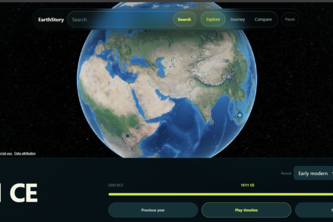
What the company appears to be: Earthstory is an interactive history platform that combines a 3D globe, timeline, and AI-powered guide to help users explore verified historical events through engaging storytelling. The description states it was built as a hackathon project by a team of four.
What changed: The project was submitted to the OpenAI 2026 hackathon on Devpost. It is described as a prototype with no evidence of revenue, customers or traction beyond its own self-reporting.
Single most important open question: Is there any evidence that this platform has moved beyond the prototype stage, or whether it has begun to attract users or generate interest from educators or learners?
What The Product Actually Is
The description states that Earthstory is an interactive platform that helps users explore history through a 3D globe and historical timeline. Users can search for historical places, events, or years, travel through different time periods, and view important events at their actual locations.
Each event includes verified historical information and trusted sources, while an AI-powered guide provides additional explanations to make learning history more engaging and accessible.
The platform integrates CesiumJS for the 3D globe, Supabase for backend services, and OpenAI APIs for the AI guide. It was built using Next.js, React, TypeScript, and other technologies.
Evidence: The author's own write-up.
Inference: This is a prototype built for a hackathon with no evidence of commercialization or user adoption.
Positioning & Claim Evolution
The description states that Earthstory aims to make history easier to understand and more enjoyable for students and anyone interested in learning about the past. It was inspired by the desire to move beyond textbook memorization toward visual exploration.
It positions itself as a tool that combines "a 3D globe, timeline, and AI-powered guide" to help users explore verified historical events through engaging storytelling.
Evidence: The author's own write-up.
Inference: The positioning is focused on educational engagement and accessibility, but there is no evidence of market traction or adoption beyond the hackathon project.
Target Customer & ICP
The description states that Earthstory is intended for students and anyone interested in learning about the past. It was inspired by the challenge of making history more engaging for secondary school learners who often rely on textbooks and memorization.
Evidence: The author's own write-up.
Inference: The target customer segment is not clearly defined beyond "students" and "history enthusiasts." No evidence of specific ICP or segmentation strategy.
Business Model & Pricing Evidence
Not evidenced. The description does not mention any business model, pricing structure, monetization plans, or revenue streams.
Evidence: The author's own write-up.
Inference: There is no indication that the platform has moved beyond a prototype stage or has begun to generate revenue.
Technical & Delivery Signals
The platform was built using Next.js, React, TypeScript, CesiumJS, Supabase, and OpenAI APIs. It uses GSAP for animations, Figma for interface design, and Notion for project planning.
The team used ChatGPT and Codex to assist with development, though they noted that AI tools sometimes required manual review and debugging.
Evidence: The author's own write-up.
Inference: The technical stack reflects modern web development practices, but there is no evidence of production deployment or scalability beyond the hackathon prototype.
Traction & Maturity Signals
Not evidenced. There is no mention of users, customers, revenue, or adoption metrics in the description.
Evidence: The author's own write-up.
Inference: This is a hackathon project with no evidence of traction or maturity beyond its initial development phase.
Competitive Context
Not evidenced. The description does not reference any competitors or market landscape.
Evidence: The author's own write-up.
Inference: No competitive analysis or positioning relative to existing history learning platforms is provided.
Open Questions & Risks
- Prototype-only status: The project was built as a hackathon submission with no evidence of further development or commercialization.
- No revenue or customer data: There is no indication that the platform has begun to attract users or generate income.
- Dependency on AI tools: The team noted challenges with AI-generated code, suggesting potential risks in relying heavily on AI for development.
- Lack of clarity on historical content quality and sourcing: While the description mentions "verified historical information," there is no evidence of how this verification is maintained or scaled.
Evidence: The author's own write-up.
Inference: These are inherent risks of a hackathon prototype with no traction or commercialization.
Questions the description leaves open
- Has the platform moved beyond the prototype stage? If so, what has changed?
- Are there any users or pilot programs in place?
- What is the plan for scaling historical content and maintaining accuracy?
- How does the team intend to monetize or sustain the platform?
- What are the key challenges in transitioning from a hackathon project to a viable product?
Evidence: The author's own write-up.
Inference: These questions aim to uncover whether the project has evolved beyond its initial concept and whether there is any traction or business model.
Overall Assessment
Not evidenced. There is no information about funding, partnerships, or investment interest in the platform.
Evidence: The author's own write-up.
Inference: Based on the self-reported description alone, there is no indication of commercial viability or strategic interest from investors or partners.
User Stories BotA demo video on every pull request
Get a demo video on every new feature
GitHub App that watches your pull requests and records a narrated, captioned demo.
Save time on demo prep and make informed decisions faster with a video walkthrough of every new feature.
Source
Submitted to the OpenAI 2026 hackathon on Devpost. Project home on Devpost. Back to the full gallery on Devpost.
This competitive analysis was produced by top-founders.com (opens in a new tab)
Generated by a language model from this project's public Devpost page — its tagline, the author's own write-up and any built-with tags listed there — as captured in August 2026. Short quotations are the author's words. It is an opinion on the idea as a business, not on the people behind it, and it reflects the description as published then. If the project has moved on, request a correction below. The analysis is not independent research and contains no verified traction, revenue or customer data.
An independent guide by KFG International LLC — not affiliated with, endorsed by, or connected to Devpost or OpenAI.