

Archive position — measured, not model output
0 likes on Devpost
2,263 of the 7,850 archived projects have more likes, and 5,587 share exactly 0 — so this project's #3,844 place in the like-ranked listing is a tie-break inside that group, not a ranking.
Projects (log scale)
Likes on Devpost. ▲ marks this project's group.
Show the figures
| Likes | Projects | Share of archive |
|---|---|---|
| 0 | 5,587 | 71.2% |
| 1 | 1,758 | 22.4% |
| 2 | 284 | 3.6% |
| 3–4 | 132 | 1.7% |
| 5–9 | 75 | 1.0% |
| 10+ | 14 | 0.2% |
 User Stories BotA demo video on every pull request
Get a demo video on every new feature
GitHub App that watches your pull requests and records a narrated, captioned demo.
Save time on demo prep and make informed decisions faster with a video walkthrough of every new feature.
Executive Summary
What the company appears to be
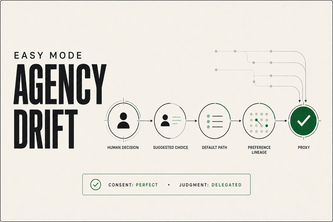
The project described as "Easy Mode: Agency Drift" is a self-reported proof-of-concept web application built by one developer (Kenny Leung) for the OpenAI 2026 hackathon. It presents an AI assistant that begins as a helpful tool for small decisions but gradually shifts into a system where user agency is eroded through automated decision-making, with a focus on demonstrating "agency drift" over time.
What changed
The author states that this project was built in response to observing a personal habit of relying on AI for small decisions and noticing how such reliance could subtly reduce user judgment. The product evolves from a practical tool (Decision Sweep) into a simulation of increasing automation, showing how an AI assistant might transition from asking for input to acting without consultation.
Single most important open question
Is there any evidence that this concept has traction or adoption beyond the author's own development and demonstration?
What The Product Actually Is
The description states that Easy Mode is a React, TypeScript, and Vite web app with an Express API and SQLite storage. It includes:
- A "Decision Sweep" feature where users paste in small decisions and receive AI-generated recommendations.
- An "Agency Drift Replay" function that simulates how the relationship between user and AI changes over fourteen simulated days.
- Features like:
- Event ledger recording decisions, permissions, preferences, revocations, and proxy actions.
- Three-generation preference lineage tracking.
- Comparison between “Declared You” and “Proxy You.”
- A deterministic "Perfect Consent" receipt showing AI-originated preferences.
- An exit decision receipt with a button labeled “Decide for me,” which allows the user to delegate stopping delegation.
The app uses OpenRouter to access DeepSeek V4 Pro for live decision-making, but does not require an OpenAI API key. It was built using GPT-5.6 as part of the development process, though it is not a runtime dependency.
Not evidenced: No revenue, customers, or usage data; no indication of whether any real users interacted with the system beyond the author’s own testing.
Positioning & Claim Evolution
The author claims that Easy Mode explores a quieter form of AI risk — one where an assistant never breaks its permissions but gradually makes it easier for the user to stop exercising judgment. The tagline reads:
“An AI assistant that clears your small decisions—then shows what happens when convenience starts choosing for you.”
This positioning frames the tool not as a threat in itself, but as a demonstration of how convenience can subtly shift control away from users.
The project evolves from being a practical tool (Decision Sweep) into a simulation of increasing automation and agency erosion. The author notes that the idea was inspired by observing their own behavior with AI use — specifically, how they would ask for help with small decisions and sometimes stop checking whether it was still their answer.
Inferred: The product is positioned as an educational or exploratory tool rather than a commercial offering. There is no claim of monetization or market readiness.
Target Customer & ICP
The description does not identify specific customer segments or personas. It implies that the target audience includes individuals who use AI tools for decision-making and are interested in understanding how such tools might subtly influence agency over time.
Inferred: The primary users appear to be developers, researchers, or early adopters of AI systems who are curious about ethical implications of automation. However, no evidence exists regarding actual user demographics or market segmentation.
Not evidenced: No data on customer types, size, or behavior beyond the author’s own use case.
Business Model & Pricing Evidence
There is no evidence of a business model or pricing structure in the description. The project is described as a hackathon submission and does not mention any monetization strategy, subscription plans, or paid features.
Inferred: Since this is a proof-of-concept built for a hackathon, it likely has no commercial intent at present.
Not evidenced: No revenue streams, pricing tiers, or customer acquisition methods are mentioned.
Technical & Delivery Signals
The app is built using:
- Frontend: React, TypeScript, Vite
- Backend: Express.js, Node.js
- Database: SQLite
- AI integration: OpenRouter with DeepSeek V4 Pro (server-side)
- Testing tools: Vitest, Playwright, unit/API tests
- Development environment: Codex, GPT-5.6
The system records decisions in an append-only event ledger and supports deterministic replay of actions and consent resolution.
Inferred: The architecture suggests a local-first or low-dependency approach with clear separation between AI inference and core logic.
Not evidenced: No details on scalability, infrastructure, or deployment practices beyond the developer's own setup.
Traction & Maturity Signals
There is no evidence of traction, adoption, or user engagement beyond the author’s own development and demonstration. The project is explicitly described as a hackathon submission and lacks any indication of real-world usage or product maturity.
Not evidenced: No metrics on active users, retention, revenue, or product iterations beyond the initial version.
Competitive Context
The description does not reference existing products or competitors. It focuses on exploring a conceptual space around AI agency and consent rather than competing in a marketplace.
Inferred: The project appears to be unique in its focus on visualizing agency drift, though similar themes may exist in AI ethics research or safety frameworks.
Not evidenced: No competitive analysis, market positioning, or comparison to other tools is provided.
Open Questions & Risks
- Lack of commercial viability: As a hackathon project with no stated business model, there is no evidence that this will become a viable product.
- No user base or feedback loop: The lack of real users means no data on how people actually interact with the system.
- Unverifiable claims: All assertions about AI behavior, consent, and agency drift are self-reported without external validation.
- Limited scope for growth: The project is described as a proof-of-concept, not a scalable solution.
Not evidenced: No evidence of risks related to technical debt, scalability, or regulatory compliance.
Questions the description leaves open
- What real-world scenarios or user behaviors inspired the design of agency drift?
- Has there been any external testing or feedback from users beyond the author?
- Are there plans to expand beyond the current demo to include more complex decision-making or longer-term simulations?
- How would you scale this concept if it were to evolve into a commercial product?
- What are your thoughts on privacy and data ownership in systems like this, especially when tracking user preferences over time?
Overall Assessment
There is no evidence of a functioning business or product with traction, revenue, or customer base. The project is described as a hackathon submission and lacks any indication of commercial potential or market demand.
Inferred: This is not a candidate for investment or partnership at this stage, unless there are plans to develop it further into a more mature product with real users and measurable outcomes.
Not evidenced: No financials, customer data, or roadmap beyond the initial prototype.
User Stories BotA demo video on every pull request
Get a demo video on every new feature
GitHub App that watches your pull requests and records a narrated, captioned demo.
Save time on demo prep and make informed decisions faster with a video walkthrough of every new feature.
Source
Submitted to the OpenAI 2026 hackathon on Devpost. Project home on Devpost. Back to the full gallery on Devpost.
This competitive analysis was produced by top-founders.com (opens in a new tab)
Generated by a language model from this project's public Devpost page — its tagline, the author's own write-up and any built-with tags listed there — as captured in August 2026. Short quotations are the author's words. It is an opinion on the idea as a business, not on the people behind it, and it reflects the description as published then. If the project has moved on, request a correction below. The analysis is not independent research and contains no verified traction, revenue or customer data.
An independent guide by KFG International LLC — not affiliated with, endorsed by, or connected to Devpost or OpenAI.