

Archive position — measured, not model output
1 like on Devpost
505 of the 7,850 archived projects have more likes, and 1,758 share exactly 1 — so this project's #1,879 place in the like-ranked listing is a tie-break inside that group, not a ranking.
Projects (log scale)
Likes on Devpost. ▲ marks this project's group.
Show the figures
| Likes | Projects | Share of archive |
|---|---|---|
| 0 | 5,587 | 71.2% |
| 1 | 1,758 | 22.4% |
| 2 | 284 | 3.6% |
| 3–4 | 132 | 1.7% |
| 5–9 | 75 | 1.0% |
| 10+ | 14 | 0.2% |
 User Stories BotA demo video on every pull request
Get a demo video on every new feature
GitHub App that watches your pull requests and records a narrated, captioned demo.
Save time on demo prep and make informed decisions faster with a video walkthrough of every new feature.
Executive Summary
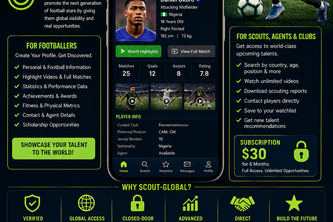
Scout-Global is a self-reported closed-door mobile application that the author states will showcase upcoming footballers (soccer) to club agents and scouts worldwide. The app is described as having paid membership access for viewing talent. It was submitted to the OpenAI 2026 hackathon by a single founder, Jide Ojeniyi.
The description provides no evidence of revenue, customers, traction or product functionality. The author states that it is an app built with technologies including FastAPI, React, and OpenAI's GPT-40, but does not describe how these are used in the context of football scouting or what the actual product experience entails.
The single most important open question is: What is the actual value proposition to club agents and scouts, and how will Scout-Global differentiate itself from existing talent identification platforms?
This analysis is based entirely on self-reported information. There is no evidence of any commercial activity, user base, or financial performance.
What The Product Actually Is
The description states that Scout-Global is "An App that showcases upcoming footballers (Soccer) to club agents and scouts worldwide." It will be a "closed-door App that allows only paid members access to view upcoming footballers."
The author declares the following technologies were used in its development: alembic, docker, fastapi, functioncalling, gpt-40, openai, react, sqlalchemy, typescript, uvicorn, vite.
However, there is no evidence provided about:
- The actual functionality or interface of the app
- How it identifies or ranks upcoming footballers
- Whether it includes features like video analysis, performance metrics, or scouting reports
- The specific user experience for agents and scouts
The product is described as a mobile application but no details are given about platform (iOS/Android), UI/UX design, or core features.
Positioning & Claim Evolution
The description states that Scout-Global will be an app that "showcases upcoming footballers to club agents and scouts worldwide." It also says it will be a "closed-door App that allows only paid members access to view upcoming footballers."
This positioning suggests the product is intended for:
- Club agents
- Football scouts
- Possibly talent identification professionals
The claim evolution appears to be:
- A platform for showcasing emerging soccer talent
- Access restricted to paid members
- Focused on global reach for agents and scouts
There is no evidence of how this positions itself relative to existing platforms or what unique value it offers over current scouting methods.
Target Customer & ICP
The description states that Scout-Global will showcase footballers to "club agents and scouts worldwide."
The author identifies the team as a single member: Jide Ojeniyi.
There is no evidence of:
- Specific customer segments within club agents or scouts
- Geographic targeting or localization strategy
- Customer personas or buyer profiles
- Whether the platform targets amateur, semi-professional, or professional levels of football
No information is provided about how the target customers are identified or reached.
Business Model & Pricing Evidence
The description states that Scout-Global "will be a closed-door App that allows only paid members access to view upcoming footballers."
This implies:
- A subscription-based model
- Paid membership for access
- Potential revenue from agent/scout memberships
However, there is no evidence of:
- Specific pricing tiers or structures
- Revenue model details (e.g., per-view, monthly/yearly subscriptions)
- Customer acquisition costs
- Monetization strategy beyond paid access
The business model remains undefined in the self-reported description.
Technical & Delivery Signals
The author declares that Scout-Global was built with:
- alembic
- docker
- fastapi
- functioncalling
- gpt-40
- openai
- react
- sqlalchemy
- typescript
- uvicorn
- vite
These technologies suggest:
- A modern web stack (React, TypeScript)
- Backend API using FastAPI
- Use of AI tools like GPT-40 for content generation or analysis
- Containerization with Docker
- Database ORM via SQLAlchemy
However, there is no evidence of:
- Actual product delivery or deployment
- Technical architecture diagrams or system design
- Performance metrics or scalability considerations
- Integration with football databases or APIs
- Data privacy or security measures
Traction & Maturity Signals
The description states that Scout-Global was submitted to the OpenAI 2026 hackathon on Devpost.
There is no evidence of:
- Any user base or customer adoption
- Revenue generation or monetization
- Product development milestones
- Market validation or feedback
- Team traction or prior experience
- Any form of product launch or beta testing
The project appears to be in early-stage development, with no demonstrated traction.
Competitive Context
The description does not provide any information about:
- Existing platforms for football talent identification
- Competitors in the scouting or agent services space
- Market size or competitive landscape
- Differentiation strategy from current solutions
No evidence is provided regarding how Scout-Global fits into the broader market for football scouting tools.
Open Questions & Risks
Key risks and open questions based on the self-reported description:
- Unproven market demand - No evidence of customer validation or market need
- Single-founder team - Limited resources for product development and execution
- No revenue model clarity - Unclear how the platform will monetize access
- Lack of traction - Submitted to hackathon but no commercial progress shown
- AI dependency - Heavy reliance on GPT-40 without clear use cases or competitive advantage
- Closed-door access model - May face challenges in building initial user base
- No product demonstration - No working prototype or functional app provided
Questions the description leaves open
- What specific problem are you solving for club agents and scouts that existing platforms don't?
- How do you plan to acquire your first 100 paying members?
- What is the competitive advantage of Scout-Global over established scouting tools?
- Can you describe the user journey from registration to viewing talent profiles?
- What are your assumptions about pricing and willingness to pay among agents/scouts?
- How will you source and verify upcoming footballer data for the platform?
- What metrics do you use to measure success beyond just user sign-ups?
- How does the AI integration (GPT-40) specifically enhance the scouting experience?
Overall Assessment
Not evidenced.
The self-reported description provides no information about:
- Financial performance or projections
- Customer acquisition or retention metrics
- Team track record or execution capability
- Market opportunity size or validation
- Product-market fit evidence
- Commercial viability or scalability
This is a very early-stage concept submitted to a hackathon. There is no evidence of any commercial activity, revenue, or traction. The author has not provided sufficient information to assess whether Scout-Global represents a viable business opportunity for investment or partnership.
The description states that the project was submitted to the OpenAI 2026 hackathon but provides no details about its current status, development progress, or potential for commercialization beyond the initial concept phase.
User Stories BotA demo video on every pull request
Get a demo video on every new feature
GitHub App that watches your pull requests and records a narrated, captioned demo.
Save time on demo prep and make informed decisions faster with a video walkthrough of every new feature.
Source
Submitted to the OpenAI 2026 hackathon on Devpost. Project home on Devpost. Back to the full gallery on Devpost.
This competitive analysis was produced by top-founders.com (opens in a new tab)
Generated by a language model from this project's public Devpost page — its tagline and any built-with tags listed there, since the author published no write-up — as captured in August 2026. Short quotations are the author's words. It is an opinion on the idea as a business, not on the people behind it, and it reflects the description as published then. If the project has moved on, request a correction below. The analysis is not independent research and contains no verified traction, revenue or customer data.
An independent guide by KFG International LLC — not affiliated with, endorsed by, or connected to Devpost or OpenAI.