

Archive position — measured, not model output
0 likes on Devpost
2,263 of the 7,850 archived projects have more likes, and 5,587 share exactly 0 — so this project's #7,728 place in the like-ranked listing is a tie-break inside that group, not a ranking.
Projects (log scale)
Likes on Devpost. ▲ marks this project's group.
Show the figures
| Likes | Projects | Share of archive |
|---|---|---|
| 0 | 5,587 | 71.2% |
| 1 | 1,758 | 22.4% |
| 2 | 284 | 3.6% |
| 3–4 | 132 | 1.7% |
| 5–9 | 75 | 1.0% |
| 10+ | 14 | 0.2% |
 User Stories BotA demo video on every pull request
Get a demo video on every new feature
GitHub App that watches your pull requests and records a narrated, captioned demo.
Save time on demo prep and make informed decisions faster with a video walkthrough of every new feature.
Executive Summary
What the company appears to be
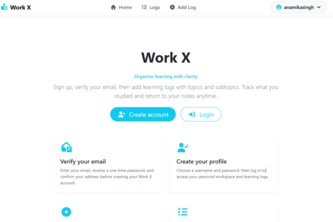
WorkX is a self-reported personal productivity tool designed to help users log, track, and build consistent learning habits by organizing topics and monitoring time spent on activities. It was built as a hackathon project by a single developer.
What changed
The author reports that this is an early-stage prototype, with no revenue, customers or traction evidenced. The project has not yet been released to the public or monetized.
Single most important open question
Is there evidence of user adoption or demand beyond the creator’s personal use case?
Analysis basis: This report is based entirely on the self-reported description provided by the author of the WorkX project, submitted as part of a hackathon entry. No external verification or historical data is available.
What The Product Actually Is
The description states that WorkX is a platform to organize topics, track progress, and build consistent learning habits. It allows users to create logs for specific dates, edit or delete them after authentication.
- Functionality: Log creation, editing, deletion.
- Authentication: User authentication with email verification via OTP.
- Technology stack: Built using Node.js, Express.js, EJS, HTML, CSS, Bootstrap, JavaScript, Passport.
- Not evidenced: No mention of integrations, dashboards, analytics, or automated logging features.
The product is described as a minimal working app built during a hackathon. It lacks advanced functionality such as activity tracking or automatic log generation.
Positioning & Claim Evolution
The author positions WorkX as a tool for personal time management and learning habit-building. It claims to help users understand how much time they spend on different topics.
- Claim: Helps track learning habits.
- Evolution: The project is described as a first attempt at building such a system, with plans to improve it further.
- Inference: The author's personal motivation (tracking their own time) suggests a niche focus on individual use rather than enterprise or scale.
The positioning is self-described and lacks any external validation or market positioning beyond the creator’s intent.
Target Customer & ICP
The description does not identify a specific customer segment or ideal customer profile (ICP). It is implied that the target user is an individual learner or student who wants to track their own learning progress.
- Inference: Likely individuals seeking personal productivity tools.
- Not evidenced: No data on demographics, use cases, or target personas.
The lack of customer segmentation or targeting information makes it difficult to assess whether the product addresses a broader market need.
Business Model & Pricing Evidence
There is no evidence of a business model or pricing structure in the provided description.
- Claim: Not stated.
- Inference: As a hackathon project, it likely has no monetization yet.
- Not evidenced: No revenue streams, subscriptions, or pricing tiers mentioned.
The product appears to be non-commercial at this stage.
Technical & Delivery Signals
The author reports that the app was built using a range of technologies including Node.js, Express.js, EJS, Bootstrap, and Passport for authentication.
- Technology stack: Node.js, Express.js, EJS, HTML, CSS, JavaScript, Bootstrap, Passport.
- Development approach: Minimal working app with styling and authentication implemented.
- Challenges faced: Authentication was a major hurdle; tools like Codex and ChatGPT were used to resolve issues.
- Learning outcomes: Authentication, OTP email verification, full-stack development.
The technical implementation is basic but functional. It shows foundational knowledge in web development and authentication systems.
Traction & Maturity Signals
There is no evidence of traction or maturity beyond the initial prototype:
- Not evidenced: No users, customers, downloads, or usage metrics.
- Inference: The project was submitted to a hackathon, indicating early-stage development.
- Future plans: Mentioned improvements include OAuth integration and automatic log creation.
The product is at an early stage with no signs of adoption or commercial traction.
Competitive Context
The description does not provide any information about competitors or market context.
- Not evidenced: No mention of similar tools, platforms, or competitive landscape.
- Inference: Given the focus on time tracking and learning habit-building, it may overlap with tools like Notion, Todoist, or Toggl, but no direct comparison is made.
Without competitive analysis, it's unclear how WorkX differentiates itself in the market.
Open Questions & Risks
Several risks and open questions are evident from the description:
- Single-person team: Only one developer involved.
- No traction or monetization: No evidence of users or revenue.
- Early-stage prototype: Built for a hackathon, not yet released to public.
- Limited scope: Basic functionality with no advanced features.
- Unverified claims: All statements are self-reported and unverifiable.
The lack of external validation, traction, and scalability raises concerns about viability as a commercial product.
Questions the description leaves open
- What is the actual user base or demand for this tool beyond personal use?
- How does WorkX plan to scale beyond a single developer’s effort?
- Are there any plans to monetize or generate revenue from the platform?
- Has the founder considered integrating with existing learning or productivity platforms?
- What are the specific technical challenges that remain unresolved?
These questions aim to uncover whether the project has potential beyond its current prototype stage.
Overall Assessment
There is no evidence of a viable business model, customer traction, or commercial readiness at this time.
- Not evidenced: No revenue, customers, or market validation.
- Inference: The project is likely a personal tool or proof-of-concept with limited commercial potential.
- Confidence level: Low — based on minimal self-reported evidence.
At this stage, WorkX does not meet criteria for investment or partnership consideration. It requires significant development and traction before it can be evaluated as a viable product.
User Stories BotA demo video on every pull request
Get a demo video on every new feature
GitHub App that watches your pull requests and records a narrated, captioned demo.
Save time on demo prep and make informed decisions faster with a video walkthrough of every new feature.
Source
Submitted to the OpenAI 2026 hackathon on Devpost. Project home on Devpost. Back to the full gallery on Devpost.
This competitive analysis was produced by top-founders.com (opens in a new tab)
Generated by a language model from this project's public Devpost page — its tagline, the author's own write-up and any built-with tags listed there — as captured in August 2026. Short quotations are the author's words. It is an opinion on the idea as a business, not on the people behind it, and it reflects the description as published then. If the project has moved on, request a correction below. The analysis is not independent research and contains no verified traction, revenue or customer data.
An independent guide by KFG International LLC — not affiliated with, endorsed by, or connected to Devpost or OpenAI.