

Archive position — measured, not model output
1 like on Devpost
505 of the 7,850 archived projects have more likes, and 1,758 share exactly 1 — so this project's #1,841 place in the like-ranked listing is a tie-break inside that group, not a ranking.
Projects (log scale)
Likes on Devpost. ▲ marks this project's group.
Show the figures
| Likes | Projects | Share of archive |
|---|---|---|
| 0 | 5,587 | 71.2% |
| 1 | 1,758 | 22.4% |
| 2 | 284 | 3.6% |
| 3–4 | 132 | 1.7% |
| 5–9 | 75 | 1.0% |
| 10+ | 14 | 0.2% |
 User Stories BotA demo video on every pull request
Get a demo video on every new feature
GitHub App that watches your pull requests and records a narrated, captioned demo.
Save time on demo prep and make informed decisions faster with a video walkthrough of every new feature.
Executive Summary
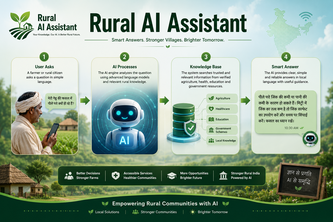
The description states that Rural AI Assistant is an AI-powered tool designed to help rural users in India access farming advice, government schemes, healthcare guidance, and education in local languages. It is presented as a self-contained project built using OpenAI APIs, JavaScript, HTML, CSS, and Firebase, with ambitions for multilingual support, voice input/output, offline capabilities, and integration with government services.
The author claims the tool aims to make AI accessible to underserved communities and provides simple, accurate, and local-language support. However, there is no evidence of revenue, customers, or traction beyond the project's submission to a hackathon.
Key open question
Is this an early-stage prototype or a functional product with real-world deployment? The description does not clarify whether it has been tested in rural settings or scaled beyond a single developer’s effort.
What The Product Actually Is
The description states that Rural AI Assistant is an AI-powered tool built using OpenAI APIs and other technologies (e.g., JavaScript, HTML, CSS, Firebase). It is designed to answer questions about farming, government schemes, healthcare, education, and daily life in simple language. The system supports multilingual capabilities and is intended for users with limited digital experience.
It includes features such as:
- Chat-based interface
- Support for local languages
- Mobile-first design
- Integration with OpenAI APIs
The author notes that the assistant provides easy-to-understand guidance, and the interface is designed to be simple and responsive across devices.
Inference The product appears to be a chatbot or conversational AI application, likely hosted on a web-based platform using serverless or cloud infrastructure. It is not described as a marketplace, SaaS platform, or developer tool.
Positioning & Claim Evolution
The description states that the project was inspired by the need for rural communities in India to access reliable information about farming, healthcare, education, and government schemes. The author frames it as an effort to make AI more accessible to underserved populations.
Key claims:
- The assistant helps users with limited digital experience.
- It provides answers in local languages.
- It aims to solve real-world rural problems.
- It is designed for social impact.
The project’s positioning has evolved from a hackathon submission into a vision of broader utility, including future features like voice support, offline capabilities, and integration with government services. However, the description does not indicate whether these features are implemented or tested.
Inference The product is positioned as a socially driven AI assistant for rural India, but its current scope remains unclear beyond a prototype.
Target Customer & ICP
The description states that Rural AI Assistant targets users in rural communities in India who struggle to access reliable information about farming, healthcare, education, and government schemes. It is designed to support people with limited digital experience.
It also mentions that the assistant provides answers in local languages, suggesting a focus on linguistic diversity within rural India.
Inference The ICP appears to be rural users in India with low-to-moderate digital literacy, seeking localized, multilingual support for practical needs. However, no specific customer segments or personas are defined.
Business Model & Pricing Evidence
The description does not state anything about a business model or pricing structure. It is presented as a prototype or hackathon project without indication of monetization plans, subscription models, or paid features.
Inference No evidence of a commercial model exists in the provided description.
Technical & Delivery Signals
The author states that the project was built using:
- OpenAI APIs
- Codex for coding assistance
- JavaScript, HTML, CSS
- Firebase backend
- React frontend
- REST API integration
- Prompt engineering techniques
It is described as mobile-first and responsive, designed to work on both desktop and mobile devices.
Inference The technical stack suggests a modern web application with AI integration. It is not described as a native app or enterprise-grade platform.
Traction & Maturity Signals
The description states that the project was submitted to the OpenAI 2026 hackathon, indicating it is at an early stage of development. There is no evidence of:
- Revenue
- Customers
- User adoption
- Product-market fit
- Deployment in real-world settings
Inference The product is likely a prototype or proof-of-concept with no demonstrated traction or maturity.
Competitive Context
The description does not mention any competitors or similar products. It is unclear whether there are existing tools or platforms that address the same rural information needs, such as government digital services, agricultural advisory apps, or multilingual chatbots for rural populations.
Inference No competitive landscape is described, and no evidence of prior market analysis or differentiation exists.
Open Questions & Risks
- Prototype vs. Product: The project is presented as a hackathon submission with no evidence of real-world deployment or user testing.
- Scalability Concerns: With only one team member (Priyanshu Mishra), it's unclear how the product will scale beyond a single developer’s effort.
- Lack of Traction: No revenue, customers, or usage data are provided.
- Unverified Claims: The social impact and utility claims are self-reported without external validation.
- Technical Limitations: The use of OpenAI APIs may raise concerns about cost, availability, and control over the AI model.
Questions the description leaves open
- What is the current status of the product? Is it a working prototype or a deployed solution?
- Has the assistant been tested in rural communities? If so, what were the results?
- How does the team plan to scale beyond one developer?
- Are there any partnerships with government agencies or NGOs involved in rural development?
- What is the long-term vision for monetization or sustainability?
- How will multilingual support be implemented and maintained?
- What are the technical limitations of using OpenAI APIs at scale?
Overall Assessment
The description states that Rural AI Assistant is a hackathon project built by one developer with ambitions to expand its functionality and reach. There is no evidence of revenue, customers, or traction beyond the submission.
Inference This is likely an early-stage idea or prototype with potential for social impact but not yet ready for investment or partnership consideration without further development and validation.
The project does not demonstrate commercial viability or a clear path to market adoption at this stage.
User Stories BotA demo video on every pull request
Get a demo video on every new feature
GitHub App that watches your pull requests and records a narrated, captioned demo.
Save time on demo prep and make informed decisions faster with a video walkthrough of every new feature.
Source
Submitted to the OpenAI 2026 hackathon on Devpost. Project home on Devpost. Back to the full gallery on Devpost.
This competitive analysis was produced by top-founders.com (opens in a new tab)
Generated by a language model from this project's public Devpost page — its tagline, the author's own write-up and any built-with tags listed there — as captured in August 2026. Short quotations are the author's words. It is an opinion on the idea as a business, not on the people behind it, and it reflects the description as published then. If the project has moved on, request a correction below. The analysis is not independent research and contains no verified traction, revenue or customer data.
An independent guide by KFG International LLC — not affiliated with, endorsed by, or connected to Devpost or OpenAI.