

Archive position — measured, not model output
1 like on Devpost
505 of the 7,850 archived projects have more likes, and 1,758 share exactly 1 — so this project's #1,842 place in the like-ranked listing is a tie-break inside that group, not a ranking.
Projects (log scale)
Likes on Devpost. ▲ marks this project's group.
Show the figures
| Likes | Projects | Share of archive |
|---|---|---|
| 0 | 5,587 | 71.2% |
| 1 | 1,758 | 22.4% |
| 2 | 284 | 3.6% |
| 3–4 | 132 | 1.7% |
| 5–9 | 75 | 1.0% |
| 10+ | 14 | 0.2% |
 User Stories BotA demo video on every pull request
Get a demo video on every new feature
GitHub App that watches your pull requests and records a narrated, captioned demo.
Save time on demo prep and make informed decisions faster with a video walkthrough of every new feature.
Executive Summary
What the company appears to be
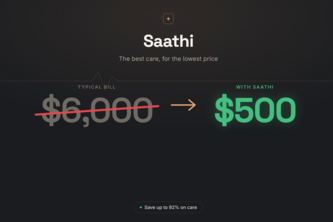
Saathi is a self-reported AI-powered patient advocate platform designed to simplify healthcare navigation by guiding patients through the process of finding affordable care. It claims to compare providers, verify insurance coverage, and generate a clear care plan before booking appointments.
What changed
The project was submitted as a hackathon entry (Devpost, OpenAI 2026) and is described as a working prototype with a complete six-step workflow built in a monorepo using FastAPI, Next.js, and OpenAI Agents SDK. It includes infrastructure for job queues, document processing, and deterministic fallbacks.
The single most important open question
Is there any evidence of traction, revenue, or real-world usage beyond the hackathon prototype?
Note: This analysis is based solely on the self-reported project description provided by the authors. No independent verification, archived data, or third-party sources are available. All claims are treated as stated by the author and not proven.
What The Product Actually Is
The description states that Saathi is an AI patient advocate platform with a six-step workflow:
- Intake
- Document Intelligence
- Provider Research
- Coverage Verification
- Recommendation
- Care Plan
It uses structured data from AI agents (via OpenAI Agents SDK) and supports manual review steps for accuracy.
- Evidenced: The product is described as a monorepo with FastAPI backend, Next.js frontend, and Supabase database.
- Inferred: That it functions end-to-end in a real-world setting is not evidenced; only that it was built to be tested end-to-end during development.
Positioning & Claim Evolution
The authors position Saathi as:
- A guide for navigating complex insurance systems
- An assistant that simplifies the process of finding affordable care
- A tool that reduces time spent decoding insurance and increases clarity around costs
They claim it addresses a common pain point: "millions of people face the same confusion when navigating a new diagnosis, surgery, or specialist referral."
- Evidenced: The tagline and write-up describe Saathi as an AI patient advocate.
- Inferred: That this is a scalable solution or has been adopted by users beyond the team is not evidenced.
Target Customer & ICP
The target customer is:
- Patients undergoing new diagnoses, surgeries, or specialist referrals
- Individuals who are overwhelmed by insurance complexity and need guidance on where to go and how much it will cost
- Evidenced: The inspiration story focuses on a pregnant woman needing prenatal care.
- Inferred: That the platform targets specific demographics or health conditions is not detailed.
Business Model & Pricing Evidence
There is no evidence of pricing, monetization strategy, or business model in the description.
- Not evidenced: No mention of how Saathi would make money or whether it’s intended for consumers, insurers, or providers.
Technical & Delivery Signals
The project was built as a monorepo with:
- FastAPI backend
- Next.js/React frontend
- Supabase for DB/auth/storage
- OpenAI Agents SDK (GPT-5.6)
- Regex-based extraction and rule-based scoring as deterministic fallbacks
- A durable job queue with retries, exponential backoff, and dead-letter handling
- Evidenced: The technical stack and infrastructure components are listed.
- Inferred: That this architecture supports production-scale use is not evidenced.
Traction & Maturity Signals
The project was submitted to a hackathon (OpenAI 2026) and described as:
- A working prototype with full six-step flow
- Tested end-to-end in development
- Used internally by the team to test their own sister’s case
- Evidenced: The internal use case and testing are mentioned.
- Not evidenced: No external users, customer feedback, or real-world adoption data.
Competitive Context
No mention of competitors or market positioning beyond general healthcare navigation tools.
- Not evidenced: No competitive landscape analysis, pricing comparisons, or differentiation from existing solutions.
Open Questions & Risks
Key risks include:
- Lack of traction or revenue
- Unverified claims about AI performance and reliability
- No evidence of real-world usage or customer validation
- The project is described as a hackathon submission — not a commercial product
- Inferred: That the platform can scale beyond prototype-level functionality without further development is not evidenced.
Questions the description leaves open
- What is the actual user base or pilot program, if any?
- How does Saathi handle edge cases in insurance documents that don’t conform to standard formats?
- Is there a plan for monetization or revenue generation?
- Has the platform been tested with real patients outside of internal use cases?
- What are the key assumptions about AI accuracy and trustworthiness that underpin the product?
Overall Assessment
At this stage, Saathi appears to be an early-stage prototype built during a hackathon. While it includes technical sophistication and a clear problem statement, there is no evidence of traction, revenue, or real-world adoption.
- Confidence level: Low
- Assessment: Not ready for investment or partnership unless further development and validation are demonstrated.
- Next steps: Validate the product with early users, assess scalability, and clarify monetization strategy.
User Stories BotA demo video on every pull request
Get a demo video on every new feature
GitHub App that watches your pull requests and records a narrated, captioned demo.
Save time on demo prep and make informed decisions faster with a video walkthrough of every new feature.
Source
Submitted to the OpenAI 2026 hackathon on Devpost. Project home on Devpost. Back to the full gallery on Devpost.
This competitive analysis was produced by top-founders.com (opens in a new tab)
Generated by a language model from this project's public Devpost page — its tagline, the author's own write-up and any built-with tags listed there — as captured in August 2026. Short quotations are the author's words. It is an opinion on the idea as a business, not on the people behind it, and it reflects the description as published then. If the project has moved on, request a correction below. The analysis is not independent research and contains no verified traction, revenue or customer data.
An independent guide by KFG International LLC — not affiliated with, endorsed by, or connected to Devpost or OpenAI.