

Archive position — measured, not model output
0 likes on Devpost
2,263 of the 7,850 archived projects have more likes, and 5,587 share exactly 0 — so this project's #3,805 place in the like-ranked listing is a tie-break inside that group, not a ranking.
Projects (log scale)
Likes on Devpost. ▲ marks this project's group.
Show the figures
| Likes | Projects | Share of archive |
|---|---|---|
| 0 | 5,587 | 71.2% |
| 1 | 1,758 | 22.4% |
| 2 | 284 | 3.6% |
| 3–4 | 132 | 1.7% |
| 5–9 | 75 | 1.0% |
| 10+ | 14 | 0.2% |
 User Stories BotA demo video on every pull request
Get a demo video on every new feature
GitHub App that watches your pull requests and records a narrated, captioned demo.
Save time on demo prep and make informed decisions faster with a video walkthrough of every new feature.
Executive Summary
Company: Dream Cloud
Self-reported basis: The entire analysis is based on a single author-supplied description from Devpost, submitted as part of an OpenAI 2026 hackathon project. No independent verification or additional data is available.
What the company appears to be: A self-described dream-sharing platform that allows users to submit anonymous dreams and explore similar ones across cultures and languages, with a focus on privacy and future research use. It is currently a demo/prototype built using AI tools like GPT-5.6 and Codex.
What changed: The author states the project began as an idea to preserve personal dreams and connect people through shared dream themes. It evolved into a prototype with user controls for sharing and research use, but remains unverified in terms of functionality or adoption.
Single most important open question: Is there any evidence that users are actively submitting or engaging with the platform beyond the demo phase? The description does not indicate whether the demo has been deployed or used by anyone.
What The Product Actually Is
The description states:
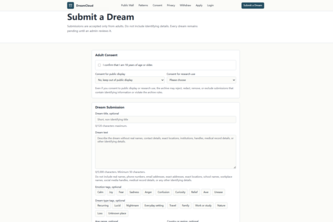
- DreamCloud Archive is an anonymous, privacy-first dream archive designed for adults.
- People can submit dreams and choose whether to share them publicly or allow research use.
- It is not designed for mystical interpretation or mental health diagnosis.
- The current version is a demo that demonstrates submission but does not store dreams yet.
Inference: Based on the author’s own account, DreamCloud is an experimental platform built with AI tools to collect and explore human dreams in a privacy-conscious way. However, the demo lacks functionality for actual dream storage or retrieval.
Positioning & Claim Evolution
The description states:
- The platform aims to connect people through shared dreams across cultures and languages.
- It supports future research by allowing users to consent to de-identified dream reports being used.
- It is described as a “consent-first” and “privacy-first” platform.
Inference: The positioning has evolved from a personal idea (preserving one’s own dreams) into a broader social and scientific tool, with an emphasis on user control over data sharing and responsible use of sensitive content.
Target Customer & ICP
The description states:
- The platform is designed for adults.
- It is intended for people who have dreams they want to preserve or explore.
- Users can choose how their dreams are shared — publicly, or only for research.
Inference: The target customer appears to be individuals with a personal interest in dreams, possibly including psychology students or dream enthusiasts. No specific ICP is defined beyond this general audience.
Business Model & Pricing Evidence
The description states:
- No account creation is required.
- Users can submit and choose how to share their dreams.
- There is no mention of pricing, monetization, or revenue streams.
Inference: The business model is not described. It appears to be a non-commercial prototype with no evidence of paid features or user fees.
Technical & Delivery Signals
The description states:
- Built using Codex, GPT-5.6, Next.js, React, Supabase, TypeScript, Vercel.
- The platform was built through iterative testing and revision with AI assistance.
- It is currently a demo that does not store dreams yet.
Inference: The technical stack suggests a modern web application built with AI-assisted development tools. However, the lack of actual data storage or user engagement indicates a prototype rather than a functional product.
Traction & Maturity Signals
The description states:
- The current version is a demo.
- It does not store users’ dreams yet.
- No mention of users, customers, or adoption metrics.
Inference: There is no evidence of traction, user base, or operational maturity. The platform remains in early-stage development.
Competitive Context
The description states:
- No direct competitors are mentioned.
- It is positioned as a privacy-first, consent-driven dream-sharing tool.
Inference: The competitive landscape is unclear. There is no evidence of similar platforms or market presence. The author does not reference existing tools for dream sharing or analysis.
Open Questions & Risks
The description states:
- The platform is built by a single person (psychology student).
- It is currently a demo with no actual data storage.
- No evidence of privacy controls, moderation, or legal compliance.
Inference:
- Single-person team: High risk due to lack of technical and business expertise.
- Demo-only status: No real-world usage or product-market fit validation.
- Privacy concerns: No mention of how sensitive dream data will be handled or protected.
- No traction: No evidence of users, adoption, or growth.
Questions the description leaves open
- What is the actual functionality of the platform beyond the demo?
- How are user dreams stored and managed in a privacy-compliant way?
- Are there any plans for moderation or content governance?
- Has the platform been tested with real users, or is it purely conceptual?
- What is the long-term vision for monetization or scaling?
- How does the team plan to ensure responsible use of sensitive dream data?
Overall Assessment
Not evidenced: There is no evidence of revenue, customers, traction, or a clear business model. The platform is described as a prototype with no actual functionality beyond a demo.
Confidence level: Low. The description is self-reported and unverified, with no data to support commercial viability or product-market fit.
Assessment: Not ready for investment or partnership at this stage. The project lacks evidence of user engagement, technical maturity, or business sustainability. It remains an experimental idea in early development.
User Stories BotA demo video on every pull request
Get a demo video on every new feature
GitHub App that watches your pull requests and records a narrated, captioned demo.
Save time on demo prep and make informed decisions faster with a video walkthrough of every new feature.
Source
Submitted to the OpenAI 2026 hackathon on Devpost. Project home on Devpost. Back to the full gallery on Devpost.
This competitive analysis was produced by top-founders.com (opens in a new tab)
Generated by a language model from this project's public Devpost page — its tagline, the author's own write-up and any built-with tags listed there — as captured in August 2026. Short quotations are the author's words. It is an opinion on the idea as a business, not on the people behind it, and it reflects the description as published then. If the project has moved on, request a correction below. The analysis is not independent research and contains no verified traction, revenue or customer data.
An independent guide by KFG International LLC — not affiliated with, endorsed by, or connected to Devpost or OpenAI.