

Archive position — measured, not model output
0 likes on Devpost
2,263 of the 7,850 archived projects have more likes, and 5,587 share exactly 0 — so this project's #3,806 place in the like-ranked listing is a tie-break inside that group, not a ranking.
Projects (log scale)
Likes on Devpost. ▲ marks this project's group.
Show the figures
| Likes | Projects | Share of archive |
|---|---|---|
| 0 | 5,587 | 71.2% |
| 1 | 1,758 | 22.4% |
| 2 | 284 | 3.6% |
| 3–4 | 132 | 1.7% |
| 5–9 | 75 | 1.0% |
| 10+ | 14 | 0.2% |
 User Stories BotA demo video on every pull request
Get a demo video on every new feature
GitHub App that watches your pull requests and records a narrated, captioned demo.
Save time on demo prep and make informed decisions faster with a video walkthrough of every new feature.
Executive Summary
What the company appears to be
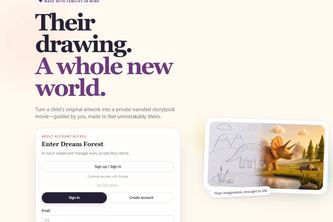
Dream Forest is a self-reported AI-powered application that allows adults to upload a child’s drawing and transform it into an animated and narrated story adventure. The app uses GPT-5.6 for interpretation and story generation, and Vertex AI/Gemini for media generation and TTS. It is described as a personal project built by one developer (Scott B) during a hackathon.
What changed
The author states that this was a hackathon project with an initial working version completed in about 3 weeks. The app currently supports basic image upload, AI interpretation, story planning, and video generation using static images and transitions. It is described as being in early development, with plans to expand into mobile apps, 3D worlds, and sharing features.
The single most important open question
Is there any evidence of revenue, customer traction or product-market fit beyond the author’s own account? The description contains no data on users, monetization, or adoption — only claims about functionality and future ambitions.
Note: This analysis is based entirely on the self-reported, unverified project description provided by the caller. All statements are labeled as such unless otherwise noted.
What The Product Actually Is
- The description states that Dream Forest allows adults to upload a child’s drawing.
- It uses GPT-5.6 for "Artwork Understanding" and story planning.
- It leverages Vertex AI and Gemini-based models for media generation and TTS.
- The final output is an MP4 video assembled with FFmpeg, viewable from the Story Worlds dashboard.
- The app supports building a “Story World” from one or more artwork pieces.
- Only adults can register accounts and upload artwork.
Inference: Based on the author's description, this appears to be an AI-powered storytelling tool for children’s artwork. However, no actual product data, usage metrics, or user feedback are provided.
Positioning & Claim Evolution
- The tagline is: “Bring your child's artwork to life. Build story worlds they can call their own and boost their imaginations.”
- The author states that this project fulfills a childhood dream of turning drawings into animated stories.
- The app is positioned as an AI-powered creative tool for families, aiming to empower children’s imagination through technology.
- It claims to be different from existing tools by generating full narratives and videos directly from uploaded artwork without requiring explicit prompts.
Inference: The positioning emphasizes emotional resonance (childhood dreams) and creative empowerment. However, there is no evidence of market validation or competitive differentiation beyond the author's own claims.
Target Customer & ICP
- The target customer is an adult who owns a child’s drawing.
- The app requires adult registration and upload capabilities.
- The intended user experience is for parents or caregivers to help children create story worlds from their artwork.
- There is no mention of specific age groups, educational institutions, or other potential users.
Inference: The ICP seems to be primarily family-oriented, with a focus on creative engagement between adults and children. No evidence exists regarding broader market segments or customer personas.
Business Model & Pricing Evidence
- The description does not state any pricing model or monetization strategy.
- There is no mention of subscriptions, freemium tiers, pay-per-use, or other business models.
- The app currently operates in a demo mode and is not yet publicly available for general use.
- No revenue streams are described beyond the author’s personal goals.
Inference: There is no evidence of a defined business model. The project appears to be in early development with no commercial structure evident.
Technical & Delivery Signals
- Built using React, Vite, TypeScript/JavaScript, Node.js, Express, Firebase, Google Cloud services (Cloud Run, Secret Manager, Vertex AI).
- Uses Codex for development assistance.
- Integrates OpenAI APIs (GPT-5.6), Vertex AI, and Gemini models.
- Video generation uses FFmpeg to compile outputs.
- The author reports that the first working version was completed shortly before the hackathon deadline.
Inference: The technical stack suggests a modern web-based SaaS product with cloud integration. However, no evidence of scalability, performance data, or production readiness is provided.
Traction & Maturity Signals
- The app has been developed in about 3 weeks during a hackathon.
- It currently supports basic functionality including image upload, AI interpretation, story generation, and video output.
- The author mentions that the current version produces low-quality videos but demonstrates a working pipeline.
- No data on user engagement, retention, or adoption is available.
Inference: This is an early-stage prototype with limited real-world usage. There is no evidence of traction or product maturity beyond initial development.
Competitive Context
- The author states that similar apps exist but are limited to static image generation and require explicit user input.
- These apps do not generate full narratives or videos from a single artwork upload.
- Dream Forest aims to surpass these limitations by using AI to interpret the child’s original intent and build consistent story worlds.
Inference: The competitive landscape includes other generative AI tools for storytelling, but none appear to offer the same level of automation from raw artwork. No evidence exists about market share or competitive positioning.
Open Questions & Risks
- The app is described as a hackathon project with no commercial traction.
- There is no evidence of revenue, customers, or monetization strategies.
- The author notes challenges around token usage and cost efficiency, which may impact scalability.
- No mention of data privacy, security, or compliance measures for handling children’s artwork.
- The app is currently in demo form and not yet publicly accessible beyond the hackathon submission.
Inference: Key risks include lack of commercial viability, scalability concerns, and potential regulatory issues related to child data handling. These are inferred from the absence of supporting evidence.
Questions the description leaves open
- What is your plan for monetization and pricing?
- Have you conducted any user testing or gathered feedback from parents or children?
- How do you intend to scale the AI infrastructure to handle increased demand?
- What are the legal and ethical considerations around collecting and using children’s artwork?
- Are there any existing competitors, and how does Dream Forest differentiate itself in the market?
- What is your timeline for moving from demo to full product release?
Note: These questions are based on the lack of evidence in the description regarding commercial viability, user experience, and technical scalability.
Overall Assessment
- The project is described as a personal hackathon effort with no verified traction or revenue.
- There is no evidence of customer acquisition, product-market fit, or financial performance.
- The author has not yet launched the app beyond a demo version.
- No funding rounds, partnerships, or investor interest are mentioned.
Inference: At this stage, there is insufficient evidence to support an investment or partnership decision. This appears to be a concept in early development with no demonstrated commercial potential. Further due diligence would require access to actual product data, user feedback, and financials — none of which are present in the provided description.
User Stories BotA demo video on every pull request
Get a demo video on every new feature
GitHub App that watches your pull requests and records a narrated, captioned demo.
Save time on demo prep and make informed decisions faster with a video walkthrough of every new feature.
Source
Submitted to the OpenAI 2026 hackathon on Devpost. Project home on Devpost. Back to the full gallery on Devpost.
This competitive analysis was produced by top-founders.com (opens in a new tab)
Generated by a language model from this project's public Devpost page — its tagline, the author's own write-up and any built-with tags listed there — as captured in August 2026. Short quotations are the author's words. It is an opinion on the idea as a business, not on the people behind it, and it reflects the description as published then. If the project has moved on, request a correction below. The analysis is not independent research and contains no verified traction, revenue or customer data.
An independent guide by KFG International LLC — not affiliated with, endorsed by, or connected to Devpost or OpenAI.