

Archive position — measured, not model output
0 likes on Devpost
2,263 of the 7,850 archived projects have more likes, and 5,587 share exactly 0 — so this project's #5,769 place in the like-ranked listing is a tie-break inside that group, not a ranking.
Projects (log scale)
Likes on Devpost. ▲ marks this project's group.
Show the figures
| Likes | Projects | Share of archive |
|---|---|---|
| 0 | 5,587 | 71.2% |
| 1 | 1,758 | 22.4% |
| 2 | 284 | 3.6% |
| 3–4 | 132 | 1.7% |
| 5–9 | 75 | 1.0% |
| 10+ | 14 | 0.2% |
 User Stories BotA demo video on every pull request
Get a demo video on every new feature
GitHub App that watches your pull requests and records a narrated, captioned demo.
Save time on demo prep and make informed decisions faster with a video walkthrough of every new feature.
Executive Summary
What the company appears to be
Otthonsegítők AI CareFlow is a self-reported Hungarian-language home-help request intake system built as a WordPress plugin prototype. It uses deterministic local interpretation for natural-language processing, with an optional GPT-5.6 upgrade path that is currently disabled and not activated.
What changed
The project is described as a hackathon submission (Devpost entry) that explores conversational intake without handing safety-critical decisions to unrestricted language models. It implements a safety-first routing system for home-help requests in Hungarian, separating emergency, healthcare, and general help tasks.
Single most important open question
Is there evidence of any real-world usage or traction beyond the prototype, and what is the actual business model for scaling this beyond a hackathon demo?
What The Product Actually Is
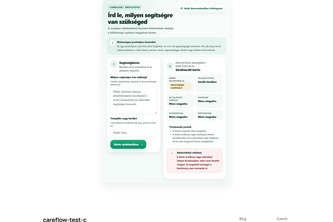
The description states that CareFlow is a WordPress prototype for Hungarian-language home-help requests. It converts user descriptions into structured search criteria including task type, daypart, frequency, duration, and service area.
It assigns each request to one of three safety-first routes:
- GENERAL_HOME_HELP
- REGULATED_HEALTHCARE
- URGENT_EMERGENCY
The prototype does not create bookings, verify real healthcare professionals, give medical advice, or store submitted requests. All provider records displayed are fictional test data.
The system uses a deterministic Hungarian request parsing layer called "CareFlow Local Intelligence" that runs entirely on the WordPress server without external network requests or API keys.
An optional GPT-5.6 structured enhancement is implemented but disabled by default and has not been activated using a paid API key.
Positioning & Claim Evolution
The description states that the project was built to explore how conversational intake can remain simple without handing safety-critical decisions to an unrestricted language model.
It positions itself as a safety-first approach to home-help routing, distinguishing between emergency, regulated healthcare, and general help tasks. The system is described as having explicit boundaries for emergency, healthcare, and privacy handling.
The claim evolution shows a shift from a simple conversational intake tool to a hybrid architecture that combines deterministic local interpretation with an optional AI enhancement layer — but the latter remains disabled and unactivated.
Target Customer & ICP
The description states that the system is designed for Hungarian-language home-help requests. It targets users who describe help needs in everyday language rather than through service categories or technical filters.
It appears to be aimed at individuals seeking home-help services in Hungary, particularly those with needs that may involve regulated healthcare or emergency situations.
The description does not specify whether the target includes service providers, caregivers, or government agencies. It focuses on the intake process for end-users.
Business Model & Pricing Evidence
Not evidenced.
The description does not contain any information about pricing models, revenue streams, customer acquisition costs, or monetization strategies beyond the prototype's current state.
Technical & Delivery Signals
The system is implemented as a standalone WordPress plugin using server-side PHP, HTML templates, and CSS.
Processing pipeline includes:
- WordPress nonce, sanitization, and input-length validation
- Deterministic Hungarian request parsing
- Authoritative privacy, emergency, and healthcare safety gates
- CareFlow Local Intelligence (network-free)
- Optional GPT-5.6 structured enhancement (disabled by default)
The prototype passes 54 automated PHP regression assertions, PHP 8.2.29 syntax checks, and manual LocalWP tests covering various scenarios including general help, healthcare routing, emergency handling, sensitive-data blocking, negation, duration, and clock-time interpretation.
Traction & Maturity Signals
Not evidenced.
The description states that all provider records are fictional test data, and the system does not create bookings or store submitted requests. There is no mention of real users, customers, or adoption metrics.
The project is described as a prototype and a hackathon submission (Devpost entry), with no evidence of live deployment or operational usage beyond testing.
Competitive Context
Not evidenced.
The description does not provide any information about competitors, market size, or competitive positioning. It focuses only on the internal architecture and functionality of the prototype.
Open Questions & Risks
- Prototype-only status: The system is described as a prototype with no real-world usage or operational deployment.
- Disabled AI enhancement: The optional GPT-5.6 upgrade path is not activated, suggesting no current commercial use of AI features.
- No revenue or customer data: There is no evidence of any revenue generation, customer base, or traction beyond the development phase.
- Limited scope: The system only handles Hungarian-language requests and does not appear to integrate with real provider verification or booking systems.
- Unverified claims: The description contains self-reported claims about safety boundaries and deterministic control that cannot be independently verified.
Questions the description leaves open
- What is the actual business model for scaling this beyond a prototype?
- Are there any plans to activate the GPT-5.6 upgrade path, and what would be the cost implications?
- Has there been any real-world testing or feedback from Hungarian home-help users?
- How does the team plan to integrate with existing home-help service providers or platforms?
- What are the legal and regulatory considerations for deploying such a system in healthcare contexts?
- Is there any intention to expand beyond Hungarian language support?
Overall Assessment
Not evidenced.
The description provides no information about funding rounds, valuations, headcount, or any commercial traction that would indicate readiness for investment or partnership. It is described as a hackathon submission with no evidence of operational or market validation.
User Stories BotA demo video on every pull request
Get a demo video on every new feature
GitHub App that watches your pull requests and records a narrated, captioned demo.
Save time on demo prep and make informed decisions faster with a video walkthrough of every new feature.
Source
Submitted to the OpenAI 2026 hackathon on Devpost. Project home on Devpost. Back to the full gallery on Devpost.
This competitive analysis was produced by top-founders.com (opens in a new tab)
Generated by a language model from this project's public Devpost page — its tagline, the author's own write-up and any built-with tags listed there — as captured in August 2026. Short quotations are the author's words. It is an opinion on the idea as a business, not on the people behind it, and it reflects the description as published then. If the project has moved on, request a correction below. The analysis is not independent research and contains no verified traction, revenue or customer data.
An independent guide by KFG International LLC — not affiliated with, endorsed by, or connected to Devpost or OpenAI.