

Archive position — measured, not model output
0 likes on Devpost
2,263 of the 7,850 archived projects have more likes, and 5,587 share exactly 0 — so this project's #3,808 place in the like-ranked listing is a tie-break inside that group, not a ranking.
Projects (log scale)
Likes on Devpost. ▲ marks this project's group.
Show the figures
| Likes | Projects | Share of archive |
|---|---|---|
| 0 | 5,587 | 71.2% |
| 1 | 1,758 | 22.4% |
| 2 | 284 | 3.6% |
| 3–4 | 132 | 1.7% |
| 5–9 | 75 | 1.0% |
| 10+ | 14 | 0.2% |
 User Stories BotA demo video on every pull request
Get a demo video on every new feature
GitHub App that watches your pull requests and records a narrated, captioned demo.
Save time on demo prep and make informed decisions faster with a video walkthrough of every new feature.
Executive Summary
Project: DreamsAfterHours
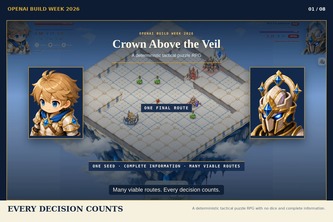
Tagline: Climb a cloud-shrouded tower where every step matters. Plan battles, manage scarce resources, and forge your path to the Sky Guardian.
Self-reported basis: The entire analysis is based on the author's own description of the project, as submitted to the OpenAI 2026 hackathon on Devpost. No external verification or historical data is available.
What the company appears to be:
DreamsAfterHours is a solo-developed, deterministic tactical puzzle RPG titled Crown Above the Veil, built for web and desktop platforms. The game is described as a ten-floor strategy game with no hidden randomness in combat, where players make decisions based on full information. It includes systems such as tactical forecasts, expedition oaths, rewind mechanics, and procedural generation.
What changed:
The project evolved from a three-floor prototype into a ten-floor strategy game during OpenAI Build Week, using AI tools like Codex and GPT-5.6 to expand gameplay depth, implement new strategic systems, and improve QA. The author states that the final version includes automated testing, deterministic solvability checks, and shared codebases between web and desktop versions.
Single most important open question:
Is there evidence of any form of commercial traction or user engagement beyond the solo developer’s own playtesting and automated verification?
What The Product Actually Is
The description states that Crown Above the Veil is a tactical puzzle RPG set inside a floating castle, with the following features:
- A semi-procedural floating tower (ten floors)
- Players collect keys, equipment, HP, and Gold
- Combat has no hidden randomness; players see exact outcomes before fighting
- Tactical Forecast shows enemy traits, expected hits, HP cost, XP reward, and Rank progression
- At Rank 3, players choose one of three Expedition Oaths (Dawnblade, Aegis Warden, Veilbinder), each leading to different viable strategies
- A Chrono Crystal allows three rewinds to undo choices or recover from fatal decisions
- Seeded expeditions allow replaying layouts and completing optional mastery goals
The game is built using:
- React 19 + TypeScript
- PixiJS for the tactical board
- Tailwind CSS v4
- Vite for Web build
- Electron for Windows/Linux packages
- Vitest and Oxlint for automated verification
It is described as a deterministic game where all decisions have clear consequences, but players are not given random luck to compensate for poor choices.
Claim: The product is a deterministic tactical puzzle RPG with no hidden randomness in combat.
Evidence: Author's own description of gameplay mechanics and systems.
Positioning & Claim Evolution
The author positions the game as an alternative to traditional RPGs that rely on random rolls or lucky drops. They state:
- “What if an RPG never hid the consequences of a decision from the player?”
- The idea grew into a tactical puzzle RPG with deterministic rules, where players must understand numbers and choose the right route.
- The game aims to offer tension through clarity, not through uncertainty.
The evolution from prototype to full ten-floor version occurred during OpenAI Build Week, using AI tools like Codex and GPT-5.6 to expand systems and implement new features such as:
- Strategic progression
- Backtracking mechanics
- Automated solvability checks
Claim: The game is a deterministic RPG that removes luck from combat but retains meaningful choice.
Evidence: Author’s own description of gameplay, design philosophy, and development process.
Target Customer & ICP
The author does not explicitly define a target customer or ideal customer profile (ICP). However, the game's mechanics suggest it may appeal to:
- Players who enjoy strategic depth in RPGs
- Fans of tactical puzzle games
- Gamers interested in transparent systems where outcomes are fully explained
The game is built for both web and desktop, suggesting a broad platform reach.
Claim: The target audience likely includes players seeking strategic, deterministic RPG experiences.
Evidence: Inferred from gameplay mechanics and genre positioning; no stated customer data or segmentation.
Business Model & Pricing Evidence
There is no evidence of any business model or pricing structure in the description. The author does not mention monetization, sales channels, subscriptions, or in-game purchases.
Claim: No commercial business model or pricing information provided.
Evidence: Author’s own description contains no mention of revenue, pricing, or monetization.
Technical & Delivery Signals
The project is described as a solo effort, built with AI assistance (Codex, GPT-5.6), but the final product does not depend on AI APIs at runtime.
Key technical details:
- Built with React 19 + TypeScript
- Uses PixiJS for rendering
- Tailwind CSS v4 for UI
- Vite for build tooling
- Electron for desktop packaging
- Vitest and Oxlint for testing
- Shared engine, content, save format, seeds, and assets between web and desktop versions
The author mentions:
- 169 automated tests
- 100,000 generated structure seeds
- 10,000 full-resource solver seeds
- Topology and door audits across all ten floors
- Deterministic seed replay and save compatibility checks
Claim: The game uses modern web/desktop tech stack with shared codebase and strong automated testing.
Evidence: Author's own description of tools used and QA processes.
Traction & Maturity Signals
There is no evidence of any form of traction, user base, or adoption beyond the developer’s own playtesting and automated verification.
The author states:
- The game was submitted to OpenAI Build Week
- It started as a prototype and evolved into a ten-floor version
- It includes extensive automated testing and solver-based validation
But no mention of:
- Users, players, or feedback
- Sales or downloads
- Public reviews or press
- Community engagement or growth metrics
Claim: No traction or maturity signals beyond solo development and internal QA.
Evidence: Author’s own description lacks any external validation or usage data.
Competitive Context
The author does not reference specific competitors or similar products. However, the game's positioning as a deterministic tactical RPG suggests it may compete with or be inspired by:
- Strategy games with deterministic combat (e.g., Fire Emblem, XCOM)
- Puzzle-based RPGs that emphasize planning and resource management
- Indie games focused on transparency in systems
Claim: The game is positioned as a deterministic tactical RPG, possibly inspired by strategy and puzzle genres.
Evidence: Inferred from gameplay description; no stated competitive analysis.
Open Questions & Risks
Several potential risks or open questions are present:
- Solo development: The project is entirely self-developed by one person (Raymond Chan). This raises questions about scalability, long-term maintenance, and ability to iterate quickly.
- No commercial traction: No evidence of users, sales, or adoption beyond the developer’s own testing.
- AI dependency in development, not runtime: While AI was used during development, the final product does not rely on AI APIs, which is a positive signal for stability but also implies limited AI integration in gameplay itself.
- Lack of monetization strategy: No mention of how the game will be sold or funded.
- No public release or distribution channel mentioned: The project remains unverified in terms of availability to players.
Claim: Risks include solo development, lack of traction, and unclear commercial path.
Evidence: Inferred from author’s description; no external data supports or contradicts these claims.
Questions the description leaves open
- What is the intended monetization strategy for Crown Above the Veil?
- How many people have played the game beyond your own testing?
- Are there any plans to release the game publicly, and if so, through which channels?
- Has the game been tested by others outside of yourself (e.g., blind playtesting)?
- What are the long-term goals for the DreamsAfterHours label or brand?
- How do you plan to scale beyond a solo developer model?
Inference: These questions aim to uncover commercial viability, user engagement, and future direction.
Overall Assessment
There is no evidence of any commercial traction, revenue, or customer base. The project is described as a solo-developed prototype, submitted to an AI hackathon, with no indication of public release or monetization strategy.
Claim: No basis for investment or partnership consideration at this time.
Evidence: Author’s own description lacks any commercial indicators or user engagement data.
User Stories BotA demo video on every pull request
Get a demo video on every new feature
GitHub App that watches your pull requests and records a narrated, captioned demo.
Save time on demo prep and make informed decisions faster with a video walkthrough of every new feature.
Source
Submitted to the OpenAI 2026 hackathon on Devpost. Project home on Devpost. Back to the full gallery on Devpost.
This competitive analysis was produced by top-founders.com (opens in a new tab)
Generated by a language model from this project's public Devpost page — its tagline, the author's own write-up and any built-with tags listed there — as captured in August 2026. Short quotations are the author's words. It is an opinion on the idea as a business, not on the people behind it, and it reflects the description as published then. If the project has moved on, request a correction below. The analysis is not independent research and contains no verified traction, revenue or customer data.
An independent guide by KFG International LLC — not affiliated with, endorsed by, or connected to Devpost or OpenAI.