

Archive position — measured, not model output
0 likes on Devpost
2,263 of the 7,850 archived projects have more likes, and 5,587 share exactly 0 — so this project's #7,730 place in the like-ranked listing is a tie-break inside that group, not a ranking.
Projects (log scale)
Likes on Devpost. ▲ marks this project's group.
Show the figures
| Likes | Projects | Share of archive |
|---|---|---|
| 0 | 5,587 | 71.2% |
| 1 | 1,758 | 22.4% |
| 2 | 284 | 3.6% |
| 3–4 | 132 | 1.7% |
| 5–9 | 75 | 1.0% |
| 10+ | 14 | 0.2% |
 User Stories BotA demo video on every pull request
Get a demo video on every new feature
GitHub App that watches your pull requests and records a narrated, captioned demo.
Save time on demo prep and make informed decisions faster with a video walkthrough of every new feature.
Executive Summary
What the company appears to be
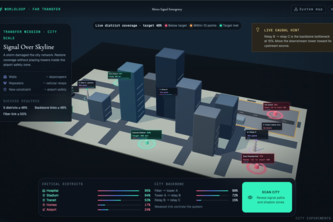
WORLDLOOP is an AI-powered educational platform that uses 3D interactive simulations to teach complex concepts through experimentation and reasoning. The platform claims to observe student behavior in virtual worlds, diagnose their mental models, and guide them toward conceptual understanding by selecting next experiments.
What changed
The author describes a shift from traditional AI tutoring approaches (which focus on answering questions or explaining concepts) to one that watches how students experiment, infers their thinking patterns, and creates challenges that reveal gaps in understanding. This is presented as an evolution from "AI that answers for the student" to "AI that helps the student discover why one explanation works better than another."
Single most important open question
Does WORLDLOOP actually demonstrate educational effectiveness or merely present a compelling conceptual framework? The description lacks evidence of any real-world testing, student outcomes, or measurable learning gains.
The analysis is based entirely on self-reported information from the author's own write-up. No independent verification exists for any claims made about product functionality, user behavior, or educational impact.
What The Product Actually Is
The description states that WORLDLOOP is:
- An AI-powered 3D discovery lab
- A platform where students learn by manipulating virtual worlds instead of reading explanations or answering quizzes
- Built with Next.js, React, TypeScript, Three.js, and GPT-5.6 for diagnostic reasoning
- Composed of three complete learning journeys (Wi-Fi apartment/city, Save the Orchard, Model Ate a Rumor)
- Designed to follow a structured learning loop: Predict → Intervene → Observe → Model → Revise → Transfer
The author claims it uses "structured diagnostic reasoning layer" with GPT-5.6 that analyzes learner behavior and proposes next experiments based on inferred beliefs and missing relationships.
Positioning & Claim Evolution
The description states the platform evolved from a problem identified by the author: traditional AI educational tools focus on producing answers or explanations rather than revealing how students think. The author positions WORLDLOOP as an alternative approach where "AI does not answer for the student" but instead "watches how the student experimented, inferred how they currently understood the system, and selected the next experience that could help them revise that understanding."
The platform claims to be built on research principles including active learning, productive failure, causal-model construction, learning by teaching, contrasting cases, metacognitive feedback, and preparation for future learning.
Target Customer & ICP
The description states that WORLDLOOP is designed for students learning complex systems through experimentation. It mentions three specific learning journeys:
- Wi-Fi apartment and connected city (for understanding network relationships)
- Save the Orchard and predator transfer (for ecosystem dynamics)
- Model Ate a Rumor and emergency data transfer (for data architecture concepts)
The author notes that these worlds are designed to help students move beyond simple distance-only explanations, understand structural similarities across different domains, and develop stronger understanding through evidence-based reasoning.
Business Model & Pricing Evidence
Not evidenced. The description does not contain any information about pricing models, revenue streams, or commercial arrangements.
Technical & Delivery Signals
The description states that WORLDLOOP was built solo using:
- Next.js, React, TypeScript, Three.js, React Three Fiber, Drei, CSS Modules
- Codex as engineering collaborator throughout the process
- GPT-5.6 for structured diagnostic reasoning layer
- Procedural 3D environments, direct object manipulation, mission state machines, timelines, responsive interfaces, system maps, and domain-specific learning engines
The author claims to have used Codex for debugging 3D interactions, improving dragging behavior, calibrating signal models, finding unsolvable level configurations, simplifying confusing mechanics, connecting system maps to live state, and turning usability problems into concrete fixes.
Traction & Maturity Signals
Not evidenced. The description contains no information about:
- User adoption or engagement metrics
- Revenue or funding status
- Customer base or institutional partnerships
- Product usage data
- Market validation or pilot programs
The author notes that this is a "research-aligned prototype, not a claim of proven classroom impact" and that testing with teachers and students is the next step.
Competitive Context
Not evidenced. The description does not contain any information about:
- Competitors in the edtech space
- Market positioning relative to existing platforms
- Differentiation from similar products
- Industry benchmarks or market size
Open Questions & Risks
Risk 1
The platform is described as a solo-built prototype with no evidence of real-world testing or educational validation. The author explicitly states it's "not a claim of proven classroom impact."
Risk 2
The technical claims about GPT-5.6 integration appear unverifiable without independent confirmation of the specific implementation details and response structures.
Risk 3
The product is described as having only three complete learning journeys, which may limit its market appeal or scalability.
Risk 4
The author's claim that "the most useful educational role for AI may not be explaining more. It may be designing better evidence" represents a conceptual approach rather than demonstrated effectiveness.
Questions the description leaves open
- What specific educational outcomes have been measured in any testing with students or teachers?
- How does WORLDLOOP ensure that its diagnostic reasoning layer actually improves learning compared to traditional methods?
- What validation process was used to confirm that the three learning journeys accurately represent the underlying concepts they claim to teach?
- Can you provide evidence of how the AI's inference engine works in practice, including examples of student behavior being interpreted and next experiments proposed?
- What are the actual technical limitations of the current prototype that would need to be addressed for broader deployment?
- How does the platform handle cases where students may not engage with the experimental process or may simply guess at solutions?
Overall Assessment
Not evidenced. The description contains no information about:
- Financial performance or funding status
- Market opportunity size
- Revenue projections or business model viability
- Strategic fit for potential partners or investors
- Exit scenarios or growth trajectory
The author describes WORLDLOOP as a research-aligned prototype that has not yet demonstrated proven classroom impact, suggesting it is in an early development stage without established commercial traction.
User Stories BotA demo video on every pull request
Get a demo video on every new feature
GitHub App that watches your pull requests and records a narrated, captioned demo.
Save time on demo prep and make informed decisions faster with a video walkthrough of every new feature.
Source
Submitted to the OpenAI 2026 hackathon on Devpost. Project home on Devpost. Back to the full gallery on Devpost.
This competitive analysis was produced by top-founders.com (opens in a new tab)
Generated by a language model from this project's public Devpost page — its tagline, the author's own write-up and any built-with tags listed there — as captured in August 2026. Short quotations are the author's words. It is an opinion on the idea as a business, not on the people behind it, and it reflects the description as published then. If the project has moved on, request a correction below. The analysis is not independent research and contains no verified traction, revenue or customer data.
An independent guide by KFG International LLC — not affiliated with, endorsed by, or connected to Devpost or OpenAI.