

Archive position — measured, not model output
0 likes on Devpost
2,263 of the 7,850 archived projects have more likes, and 5,587 share exactly 0 — so this project's #7,671 place in the like-ranked listing is a tie-break inside that group, not a ranking.
Projects (log scale)
Likes on Devpost. ▲ marks this project's group.
Show the figures
| Likes | Projects | Share of archive |
|---|---|---|
| 0 | 5,587 | 71.2% |
| 1 | 1,758 | 22.4% |
| 2 | 284 | 3.6% |
| 3–4 | 132 | 1.7% |
| 5–9 | 75 | 1.0% |
| 10+ | 14 | 0.2% |
 User Stories BotA demo video on every pull request
Get a demo video on every new feature
GitHub App that watches your pull requests and records a narrated, captioned demo.
Save time on demo prep and make informed decisions faster with a video walkthrough of every new feature.
Executive Summary
What the company appears to be
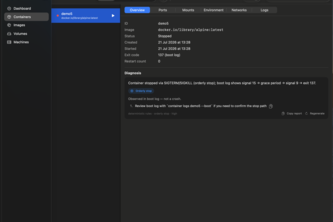
Wharfside Rulebook is a self-reported macOS-native tool that uses on-device AI to diagnose container crashes in Apple’s new container runtime. It operates under a deterministic principle: rules, not guesses, decide whether an AI model is invoked. The system includes a signed rulebook with citations and provenance metadata, built using Swift and GPT-5.6.
What changed
The project evolved from an internal tool with undocumented runtime behavior to one that enforces structured citations for all rules via a CI linting system. It introduced a schema (RuleReference) for linking rules to runtime sources, and added backward-compatible decoding while maintaining strict enforcement at authoring time.
Single most important open question
Is there any evidence of real-world usage or adoption beyond the author’s own development environment?
What The Product Actually Is
The description states that Wharfside is a native macOS app that diagnoses container crashes using on-device AI. It uses a deterministic approach, where an Ed25519-signed rulebook governs which AI models are invoked, and many diagnoses are answered by rules alone without model calls.
It includes:
- A Swift package (
wharfside-rules) containing:RuleReferenceschema for structured citations- Citation lint enforced in CI
- Forward-compatible decoding with strict linting
- Backfill of bundled rules with runtime source links
The system is built using:
- Swift
- Ed25519 signing
- GitHub Actions
- GPT-5.6 (Codex)
- Linux and macOS environments
Inference The product appears to be a developer tool focused on AI crash diagnosis in Apple container runtimes, with emphasis on trustworthiness through provenance and deterministic behavior.
Positioning & Claim Evolution
The author claims that Wharfside is built around the principle: “the model never guesses.” Rules decide what the model sees — or whether it’s invoked at all. This positions the tool as a trustworthy, deterministic diagnostic engine, especially for AI systems in containerized environments.
Key claims:
- Rules are now cited and signed, improving transparency.
- The system supports forward compatibility with older clients.
- A CI linting policy enforces citation requirements at authoring time.
There is no evidence of prior versions or positioning shifts; the project appears to be a single, self-contained development effort submitted for a hackathon.
Target Customer & ICP
The description does not state who the intended users are beyond the developer building it. It implies:
- Developers working with Apple’s container runtime
- Teams seeking deterministic AI crash diagnosis
- Users concerned with AI model accountability and provenance
No explicit customer segments, personas or market targeting were described.
Inference Likely targets include developers or engineers in Apple ecosystem environments who require reliable, auditable AI diagnostics for containerized applications.
Business Model & Pricing Evidence
There is no evidence of any business model or pricing structure. The project is described as a self-contained hackathon submission, with no mention of monetization, licensing, or commercial use cases.
Not evidenced
Technical & Delivery Signals
The author reports:
- Development was agent-driven using GPT-5.6 (Codex)
- CI linting enforces citation policies
- The system supports Linux and macOS
- Uses Ed25519 signing, with offline production key management
- Includes backward-compatible decoding and strict linting
- All tests pass on both platforms, with warnings-as-errors
The project is described as:
- Pure Swift
- Open-source (via GitHub)
- Designed for agent-driven development workflows
Inference The tool shows strong technical discipline in terms of workflow, security, and compatibility. It reflects a mature engineering approach to AI trustworthiness.
Traction & Maturity Signals
There is no evidence of:
- Revenue
- Customers
- Adoption
- Product-market fit
- User feedback or usage metrics
The project is described as a single-person hackathon submission, with no indication of external validation or traction beyond the author’s own development cycle.
Not evidenced
Competitive Context
There is no mention of competitors or existing solutions in this space. The description does not reference:
- Similar tools for AI crash diagnosis
- Container runtime debugging tools
- Provenance or citation systems for AI models
The project appears to be unique in its approach, but there is no evidence of a competitive landscape.
Not evidenced
Open Questions & Risks
- No real-world usage: The tool is described as a hackathon submission with no evidence of adoption.
- Single-person development: Only one team member (Sergey Akopkokhyants) is listed, raising questions about scalability or long-term maintenance.
- Limited scope: The focus on Apple container runtime and macOS limits its applicability.
- Agent dependency: Heavy reliance on GPT-5.6 for development raises concerns about reproducibility and control if the agent becomes unavailable or changes.
Questions the description leaves open
- What is the actual use case for this tool beyond the hackathon?
- Are there any plans to expand support beyond macOS or Apple container runtime?
- How would the system handle large-scale rulebook updates or community contributions?
- Is there any plan to integrate with CI/CD pipelines or enterprise environments?
- What is the long-term vision for the project, and how does it intend to scale?
Overall Assessment
This is a self-reported hackathon submission with no evidence of traction, revenue, or customer adoption. The tool demonstrates strong technical execution and engineering discipline but lacks commercial viability indicators.
Confidence: Low
The author states that the project was submitted to an OpenAI 2026 hackathon — this is not a product in the traditional sense, nor does it appear to be a commercial entity.
Not evidenced as a viable investment or partnership opportunity at this stage.
User Stories BotA demo video on every pull request
Get a demo video on every new feature
GitHub App that watches your pull requests and records a narrated, captioned demo.
Save time on demo prep and make informed decisions faster with a video walkthrough of every new feature.
Source
Submitted to the OpenAI 2026 hackathon on Devpost. Project home on Devpost. Back to the full gallery on Devpost.
This competitive analysis was produced by top-founders.com (opens in a new tab)
Generated by a language model from this project's public Devpost page — its tagline, the author's own write-up and any built-with tags listed there — as captured in August 2026. Short quotations are the author's words. It is an opinion on the idea as a business, not on the people behind it, and it reflects the description as published then. If the project has moved on, request a correction below. The analysis is not independent research and contains no verified traction, revenue or customer data.
An independent guide by KFG International LLC — not affiliated with, endorsed by, or connected to Devpost or OpenAI.