

Archive position — measured, not model output
1 like on Devpost
505 of the 7,850 archived projects have more likes, and 1,758 share exactly 1 — so this project's #2,220 place in the like-ranked listing is a tie-break inside that group, not a ranking.
Projects (log scale)
Likes on Devpost. ▲ marks this project's group.
Show the figures
| Likes | Projects | Share of archive |
|---|---|---|
| 0 | 5,587 | 71.2% |
| 1 | 1,758 | 22.4% |
| 2 | 284 | 3.6% |
| 3–4 | 132 | 1.7% |
| 5–9 | 75 | 1.0% |
| 10+ | 14 | 0.2% |
 User Stories BotA demo video on every pull request
Get a demo video on every new feature
GitHub App that watches your pull requests and records a narrated, captioned demo.
Save time on demo prep and make informed decisions faster with a video walkthrough of every new feature.
Executive Summary
The company appears to be a single-person project — Wen Studio — a browser-based learning app for adult beginners seeking to understand Traditional Chinese characters. The author states it uses AI-assisted development tools (OpenAI Codex, GPT-5.6) and is built with HTML, CSS, JavaScript, and local storage. It does not appear to have any revenue, customers or traction beyond the creator’s own use and development.
The single most important open question is: What is the actual commercial viability of a browser-based, non-monetary, self-contained educational tool for adult learners of Traditional Chinese?
This analysis is based entirely on the author's self-reported description — no third-party verification or historical data is available.
What The Product Actually Is
The description states that Wen Studio is:
- A browser-based learning app.
- Built with HTML, CSS, JavaScript, and uses Web Speech API, Canvas, and localStorage.
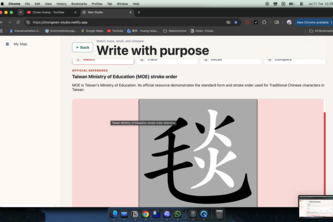
- Contains six freely accessible areas: Explore, Radicals, Learn, Write, Daily Chinese, My Map.
- Designed to help adult beginners understand Traditional Chinese characters through:
- Historical character forms
- Dictionary structure (radical-based lookup)
- Pronunciation (via pinyin and speech API)
- Writing practice (stroke order tracing)
- Useful phrases for everyday situations
- Uses no backend, login, or database.
- Deployed on Netlify, connected to a private GitHub repository.
- Built with AI assistance (OpenAI Codex, GPT-5.6), but the creator states they do not understand coding.
Inference: The app is a static, self-contained educational tool that does not require internet connectivity or user accounts beyond local storage.
Positioning & Claim Evolution
The author states:
- The app was inspired by a desire to help grown-up children learn Chinese, especially those who may not speak English as their first language.
- It aims to bridge the gap between traditional dictionary approaches and isolated character memorization.
- The app is described as beginner-friendly and gentle, focusing on historical forms, dictionary structure, pronunciation, and writing.
- It avoids inventing explanations or filling gaps in data with plausible-sounding but unverified content.
Inference: The positioning is that of a low-barrier, non-commercial, educational tool for adult learners. It does not claim to be a commercial product or platform.
Target Customer & ICP
The description states:
- The app was initially built to help the creator’s grown-up children learn Chinese.
- It is intended for adult beginners, especially those who may not speak English as their first language.
- It does not appear to target any specific segment beyond this general audience.
Inference: The ICP is likely adult learners of Traditional Chinese, with no clear segmentation or targeting beyond the creator’s personal motivation.
Business Model & Pricing Evidence
The description states:
- The app is free and accessible.
- It does not require an account, login, or payment.
- There are no pricing models described.
- No revenue streams, monetization strategies, or paid features are mentioned.
Inference: There is no business model evidenced. The app appears to be a non-commercial educational tool, not a product for sale or subscription.
Technical & Delivery Signals
The description states:
- Built with HTML, CSS, JavaScript.
- Uses Web Speech API, Canvas, and localStorage.
- No backend, database, or API key required.
- Deployed on Netlify.
- Built collaboratively with OpenAI Codex and GPT-5.6.
- The creator states they do not understand coding but used AI to implement features.
Inference: The app is a static web application, likely built using AI-assisted development tools, and does not rely on external services or infrastructure beyond browser capabilities.
Traction & Maturity Signals
The description states:
- The app contains:
- 49 historical-form journeys
- 1,025 reviewed character cards
- 214 radical entries
- 182 useful phrases
- It includes automated checks for missing radicals, invalid stroke arithmetic, incomplete content, pronunciation regressions, and invented fallback examples.
- The creator has reviewed all 1,025 character records against Taiwan MOE structure data.
- It is a self-contained tool, with no locked progression or fake grading.
Inference: The app shows maturity in content design and validation, but there is no evidence of user adoption, usage metrics, or feedback. It is not a product with traction or market validation.
Competitive Context
The description does not mention any competitors or existing tools in the Traditional Chinese learning space.
Inference: No competitive context is provided. The app appears to be a standalone educational tool, without reference to other platforms or products in the same domain.
Open Questions & Risks
- No commercial model: The app is not monetized, and there is no indication of plans to monetize.
- Single-person development: Only one person built it; no team, funding, or scalability evidence.
- No user data or feedback: No evidence of users, usage, or engagement beyond the creator’s own use.
- Self-reported content quality: The app claims to have reviewed 1,025 character records, but there is no independent verification of this.
- AI dependency: The app was built with AI tools, which may not be sustainable or scalable without human oversight.
Inference: The project is a personal educational tool, not a commercial product. It lacks any evidence of market traction, scalability, or monetization potential.
Questions the description leaves open
- What is the long-term vision for Wen Studio beyond personal use?
- How does the creator plan to validate the educational content for accuracy and effectiveness?
- Are there plans to expand beyond the current 1,025 characters or add new features?
- Has the app been tested with actual adult learners of Traditional Chinese?
- What are the technical limitations or scalability concerns of a static browser-based tool?
- Is there any intention to monetize or grow the platform beyond the creator’s own use?
Overall Assessment
The description states that Wen Studio is a self-contained, non-commercial educational tool built by one person using AI-assisted development.
There is no evidence of revenue, customers, traction, or commercial viability. The app appears to be an educational prototype, not a product for investment or partnership.
Inference: This is not a viable candidate for investment or partnership at this stage, as it lacks any commercial or market-oriented signals. It is a personal project with no demonstrated business model.
User Stories BotA demo video on every pull request
Get a demo video on every new feature
GitHub App that watches your pull requests and records a narrated, captioned demo.
Save time on demo prep and make informed decisions faster with a video walkthrough of every new feature.
Source
Submitted to the OpenAI 2026 hackathon on Devpost. Project home on Devpost. Back to the full gallery on Devpost.
This competitive analysis was produced by top-founders.com (opens in a new tab)
Generated by a language model from this project's public Devpost page — its tagline, the author's own write-up and any built-with tags listed there — as captured in August 2026. Short quotations are the author's words. It is an opinion on the idea as a business, not on the people behind it, and it reflects the description as published then. If the project has moved on, request a correction below. The analysis is not independent research and contains no verified traction, revenue or customer data.
An independent guide by KFG International LLC — not affiliated with, endorsed by, or connected to Devpost or OpenAI.